










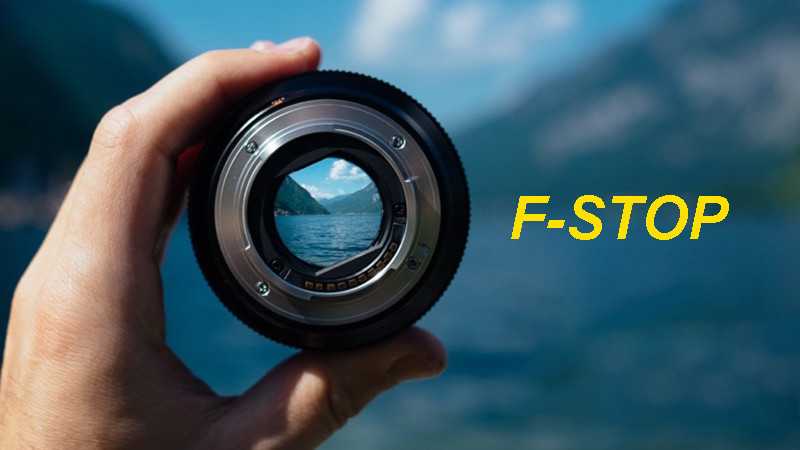
Aperture is the opening size of the lens. Some lenses have a fixed aperture, but most photography lenses have multiple apertures to control the amount of light entering the lens. This aperture is controlled by a shutter consisting of stacked blades (or aperture blades) that can be adjusted to the size of the opening as light passes through. Different aperture sizes have different effects on the image, and the baffle also changes the angle at which light enters the lens. Next, let’s look at the difference between different aperture sizes and how aperture affects exposure and depth of field.
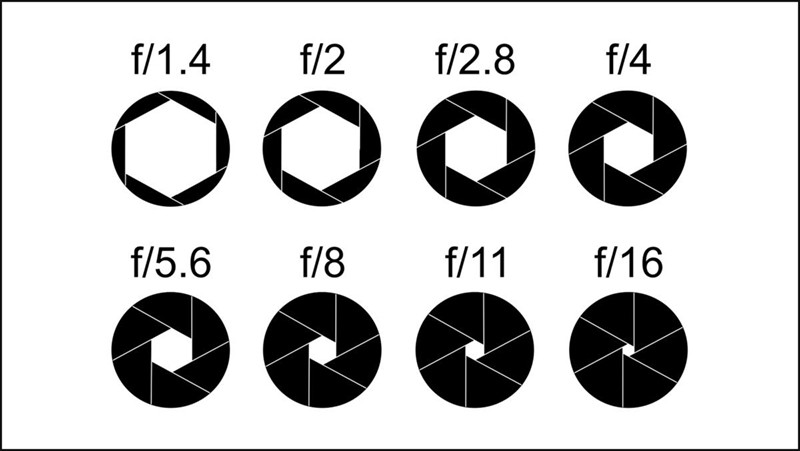
Aperture size difference
Similar to the pupil of our eye, the aperture blades open and close to control the amount of light passing through the lens. To take a properly exposed photo, we need to determine the appropriate aperture size in order to account for exposure issues.
The ratio of the aperture diameter to the focal length of the lens is called f/(number), f/stop, plane ratio, f/(ratio) or the relative value of the aperture. Whatever you call it, the f-stop is separate from the exposure value (EV), or f-stop, and is used for calculation purposes.

The size of the aperture on the lens, usually expressed by a factor, for example, f/1, f/1.4, f/2, f/2.8, f/4, f/5.6, f/8, f/11, f/16 , f/32, f/64. Because this is a factor, the smaller the number, the larger the aperture, and the larger the number, the smaller the aperture. For example, an aperture of f/16 is smaller than an aperture of f/4. In a phone’s camera, the aperture is usually the default and cannot be changed.
Use range of different aperture sizes
+ Aperture f/0.95 – f/1.4: This is a fast aperture, usually used on high-end cameras, to allow the camera to collect as much light as possible. This aperture is suitable for low-light photography such as indoor photography and night sky photography.
+ aperture f/1.8-f/2: Cameras using this aperture are able to let in slightly less light than fast apertures. Photos captured at this aperture still have sufficient depth of field for close subjects, while still delivering a pleasing bokeh effect.
+ aperture/2.8-f/4: This is the lens aperture used by professional photographers. Delivers a stable and flexible image with excellent clarity even in low light conditions. This aperture is often used for travel, sports, wildlife, etc.
+ Aperture f/5.6-f/8: This is the ideal lens aperture for landscape, architectural and crowd photography. Stopping the lens down to f/5.6 provides good sharpness, and if you need greater depth of field, you can increase the aperture level to f/8.
+ Aperture f/11-f/16: This is the lens aperture for landscape, architectural and macro photography when a lot of depth of field is required. Be careful when adjusting the aperture in this range, as lens diffraction may cause loss of image sharpness.
+ Aperture f/22 or smaller: You should avoid this aperture as image sharpness is greatly limited. If you need more depth of field, you should move away from your subject or use focus stacking photography.
How Aperture Affects Exposure
Regarding exposure issues, here’s how an f-stop changes exposure: if you set your camera to f/8, then open the aperture to f/5.6, you’ll get twice as much light through. It will be 4x from f/8 to f/4, and 1.5x from f/11 to f/16.
Did you notice anything strange? When we go from f/8 to f/4, we double the aperture size, right? If true, then why is the amount of light 4 times higher when the aperture blades are only twice the size? Let’s go back to the math and the inverse square law.
The formula for the area of a circle (A): A=πxr², where r is the radius. When you apply this formula, you’ll notice that when you double or halve the radius of the aperture, you quadruple the area, similar to what we call light intensity differences based on distance.
When these data are applied to EV calculations, things are much simpler. A f-stop change that causes the light to double or bisect means you’ve changed the resulting exposure by 1EV or 1 stop. So if you widen the aperture from f/16 to f/11, you’ll gain +1EV because twice the amount of light will pass through the aperture blades. f/16 to f/8 is twice the aperture size, 4 times the amount of light, representing a change of +2EV. Simple, right?
How Aperture Affects Depth of Field
Now that we know how aperture affects exposure, let’s talk about the two “side effects” of aperture mentioned at the beginning of the article. The size of the aperture blades not only affects the amount of light passing through the lens, but also affects the sharpness of the image, and is one of the important factors affecting the so-called depth of field.
Depth of field is defined as the distance between the nearest and farthest objects in an image that appear sharp. If there is no depth of field, the focal plane of the lens is very thin, which will cause a lot of trouble for photography. For example, if we take a picture of a person, the tip of their nose will be in focus, but the rest will be completely blurred. Depth of field allows the focal plane to have a visible depth of field.
Depth of field is a function of the size of the lens aperture, the focal length of the lens, the distance between the subject and the camera, and other things called the circle of confusion. For the purposes of this article, we will only discuss depth of field in relation to aperture. Depending on your camera and lens, by opening the aperture to its widest setting, you can reduce the range of the focal plane to very small distances. This can be used for creative composition in photography, close-ups, and is most often used to blur distant backgrounds when shooting portraits.
It is important to note that some camera combinations do not produce a noticeably shallow depth of field effect, so don’t assume that simply opening the aperture wide open will produce extremely small depth of field. Conversely, adjusting the aperture to its narrowest setting widens the depth of the focal plane and allows for a wider, focused image. Deep depth-of-field techniques are often used when photographing landscapes.
The aperture not only controls the amount of light passing through the lens, but also affects the angle at which light enters the lens. We’re not talking about how a lens corrects light, we’re talking about how light passing through an object is slightly bent by that object, which in this example is the lens’ aperture blades. This breaking of light is called diffraction and is a feature of the wave nature of light.
When you close the aperture, you are diffracting closer to the center of the image. Many photographers who are just beginning to understand aperture think that the key to improving sharpness is to close the aperture down because of the effect of aperture on depth of field. However, due to diffraction, this is incorrect. When you increase depth of field by stopping down the aperture, you are also increasing the amount of diffraction in the image, which causes the image to lose sharpness.
Also, even with modern computer design and manufacturing standards, it’s very difficult to get a truly optically perfect lens. Due to imperfections in glass and the way light behaves when it is bent, lenses can have aberration errors that can cause undesirable effects in photos.
When you open the aperture the widest, you allow the greatest amount of light into the lens, which equates to the greatest amount of aberration. By stopping down the aperture, reducing the size of the aperture, you will reduce the aberration and sharpness of the image. However, as mentioned above, the downside of stopping down the aperture is that it increases diffraction, since the smaller aperture causes more light to be bent. In the middle, where aberrations are reduced and diffraction is controlled, this is known as the lens’ perfect point, usually somewhere between f/4 and f/11, depending on the design of the lens. This perfect aperture allows you to get the most out of your lens, improving sharpness and reducing aberrations, and enjoying a harmonious depth of field.
Summarize
Above, we have introduced the definition of aperture, the calculation formula, the difference between different aperture sizes and how aperture affects exposure and depth of field. In short, the aperture size not only controls the amount of light passing through the lens, but also affects the performance of the lens in terms of depth of field and sharpness.