









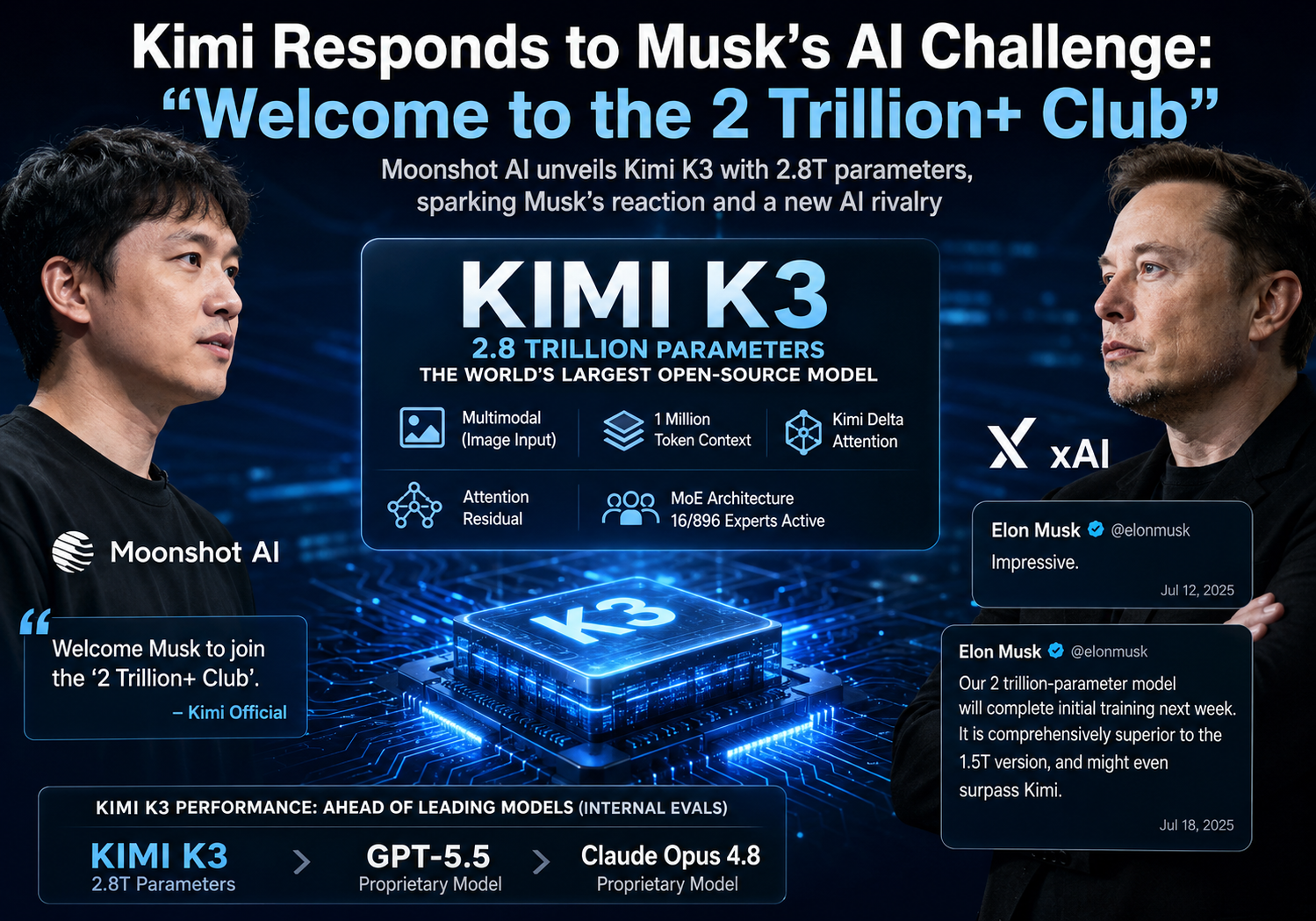
Igeekphone News, July 20 – Chinese artificial intelligence startup Moonshot AI (also known as The Dark Side of the Moon) has officially unveiled Kimi K3, its latest open-source large language model featuring 2.8 trillion parameters, making it one of the largest open-source AI models ever released by parameter count.
The launch has attracted global attention not only for its technical specifications but also for an increasingly public exchange between Moonshot AI and Elon Musk, highlighting the intensifying competition in the race to develop next-generation frontier AI models.
Kimi K3 Introduces a 2.8 Trillion-Parameter Architecture
According to Moonshot AI, Kimi K3 is designed to handle demanding knowledge-intensive tasks while improving computational efficiency through a highly optimized Mixture-of-Experts (MoE) architecture.
Key highlights of the model include:
- 2.8 trillion total parameters
- Native multimodal support, including image input
- 1 million-token context window
- Kimi Delta Attention architecture
- Attention residual optimization
- Highly sparse MoE design, activating only 16 of 896 experts for each processed token
The company says this selective expert activation significantly improves hardware utilization while reducing inference costs compared with activating the entire model.
Moonshot AI also claims that architectural improvements and updated training methodologies have increased the model’s scaling efficiency by approximately 2.5 times compared with its predecessor, Kimi K2.
Company Claims Performance Ahead of Leading AI Models
In its internal benchmark evaluations, Moonshot AI says Kimi K3 demonstrates stronger end-to-end knowledge work capabilities than several leading proprietary AI systems, including GPT-5.5 and Claude Opus 4.8.
As with all vendor-reported benchmark results, these performance claims have not yet been independently verified by third-party evaluations. Broader industry testing will likely provide a clearer picture of Kimi K3’s real-world capabilities across coding, reasoning, mathematics, and multimodal tasks.
Elon Musk Praises Kimi Before Raising the Stakes
The release also prompted another public interaction from Elon Musk.
Shortly after Kimi K3’s announcement, Musk commented on the model’s technical report with a brief but notable response:
“Impressive.”
This marks the second time Musk has publicly acknowledged Moonshot AI’s work. Earlier this year, in March, he also praised the company’s research after reviewing Kimi’s underlying architecture paper.
However, the exchange quickly evolved into a friendly competitive challenge.
On July 18, Musk revealed that his team is preparing a new AI model exceeding 2 trillion parameters, stating that initial training is expected to finish next week. He added that the upcoming model is significantly stronger than the company’s previous 1.5 trillion-parameter version and suggested that it “might even surpass Kimi.”
Moonshot AI Responds: “Welcome to the 2 Trillion+ Club”
Moonshot AI responded with a lighthearted message on social media, welcoming Musk into what it called the “2 Trillion+ Club.”
The comment has been widely interpreted as a playful acknowledgment of the rapidly escalating scale of frontier AI development, where parameter counts continue to grow as companies compete to improve reasoning ability, multimodal understanding, and agentic capabilities.
A New Phase in the Global AI Race
The exchange reflects the increasingly international nature of AI competition. Chinese developers such as Moonshot AI are rapidly advancing open-source foundation models, while companies in the United States—including xAI, OpenAI, Anthropic, Google DeepMind, and Meta—continue investing heavily in ever-larger and more capable systems.
Although parameter count alone no longer determines a model’s real-world performance, it remains an important indicator of engineering ambition and infrastructure scale. Equally critical are architectural innovations, training quality, inference efficiency, and practical deployment.
With Kimi K3 now publicly available and Musk signaling another ultra-large model is imminent, the competition among leading AI developers is entering a new phase—one where efficiency, reasoning ability, and real-world usefulness may prove more decisive than size alone.