









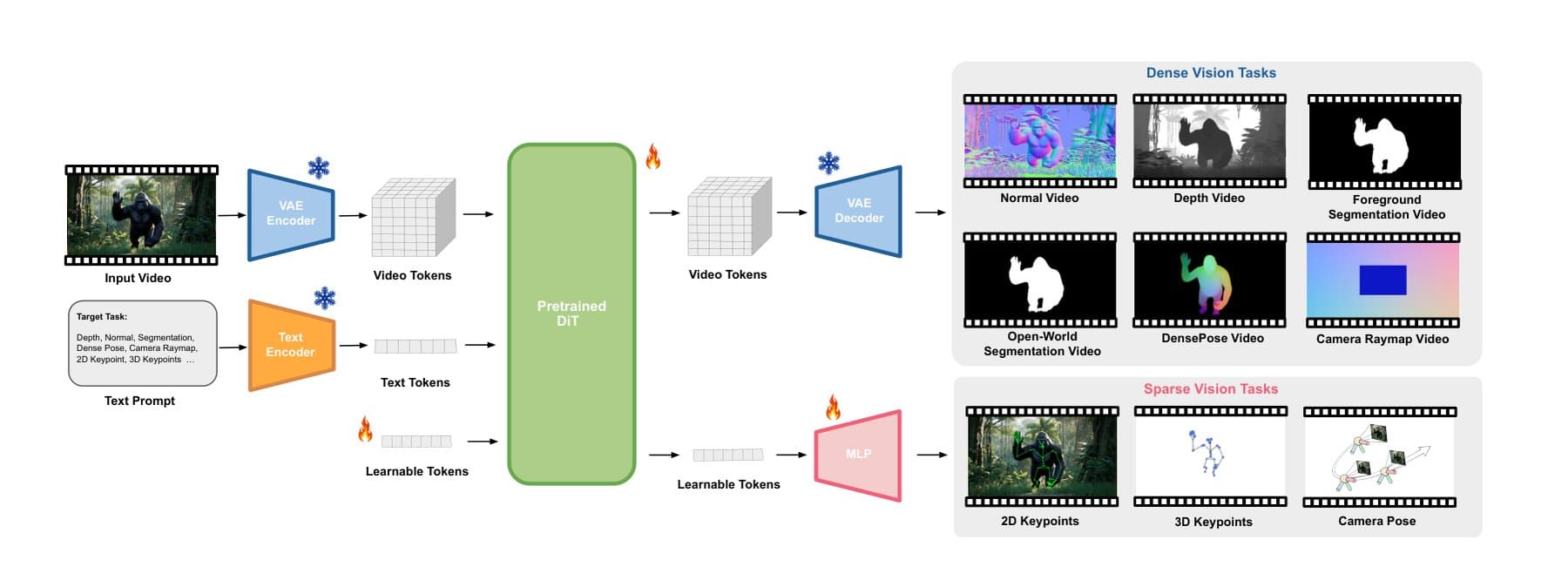
Google DeepMind has introduced GenCeption, a new artificial intelligence model that rethinks how computer vision systems are built. Rather than relying on separate models for individual visual tasks, GenCeption uses a single pre-trained video generation model to perform a wide range of vision applications, including depth estimation, image segmentation, 3D pose estimation, and camera motion analysis.
According to a report published by The Decoder on July 20, GenCeption represents a significant step toward more general-purpose visual intelligence by repurposing a video generation model into a powerful scene understanding engine.
Moving Beyond Task-Specific Vision Models
Modern computer vision has traditionally depended on highly specialized AI models, with each one designed for a specific task. Popular examples include segmentation models such as Segment Anything and depth estimation models like Depth Anything.
While these systems excel within their respective domains, they typically require dedicated architectures and training pipelines, making it difficult to develop a single model capable of handling multiple visual understanding tasks.
Google DeepMind aims to change that with GenCeption.
Inspired by the way large language models acquire broad knowledge through next-token prediction, the research team explored whether generative video models could similarly learn rich visual representations that generalize across many computer vision problems.
Built on Alibaba’s Wan2.1 Video Model
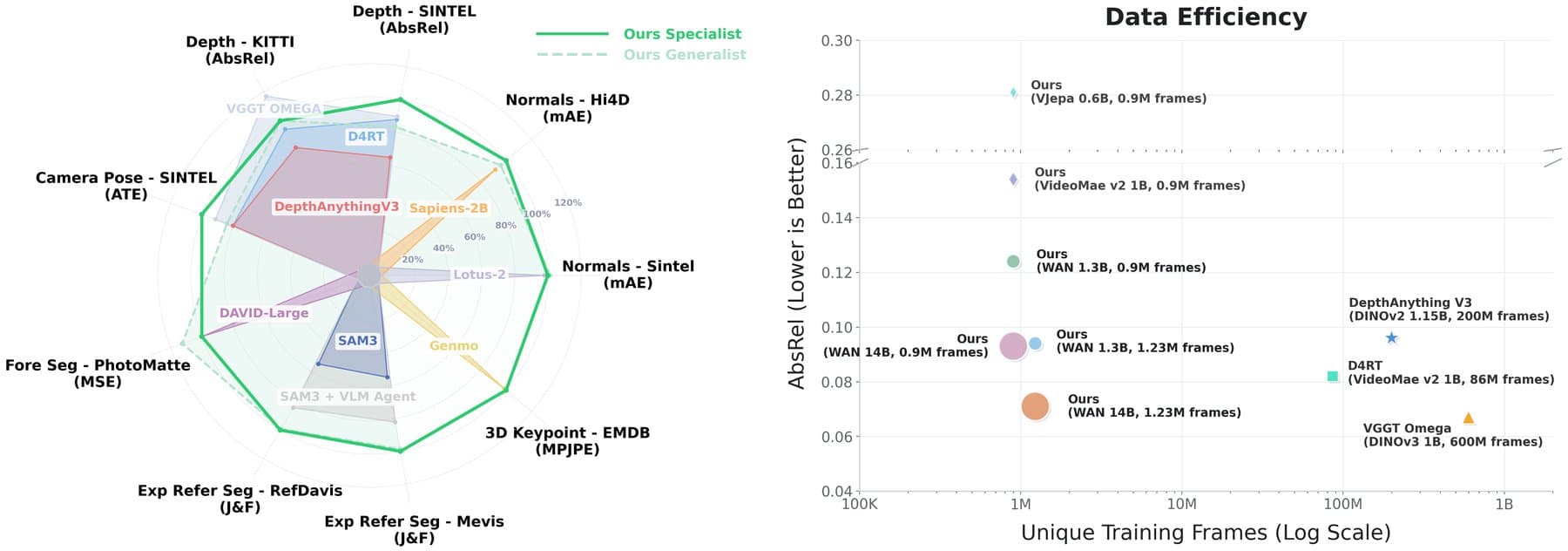
GenCeption is built upon Alibaba’s open-source Wan2.1 video generation model, demonstrating how generative AI can be adapted beyond content creation into practical perception tasks.
Unlike conventional diffusion-based approaches that require multiple iterative denoising steps, GenCeption performs inference through a single forward pass, significantly reducing computational overhead and improving processing speed.
The model is controlled through text prompts, allowing users to specify the desired vision task without switching to different specialized networks.
Depending on the prompt, GenCeption can generate:
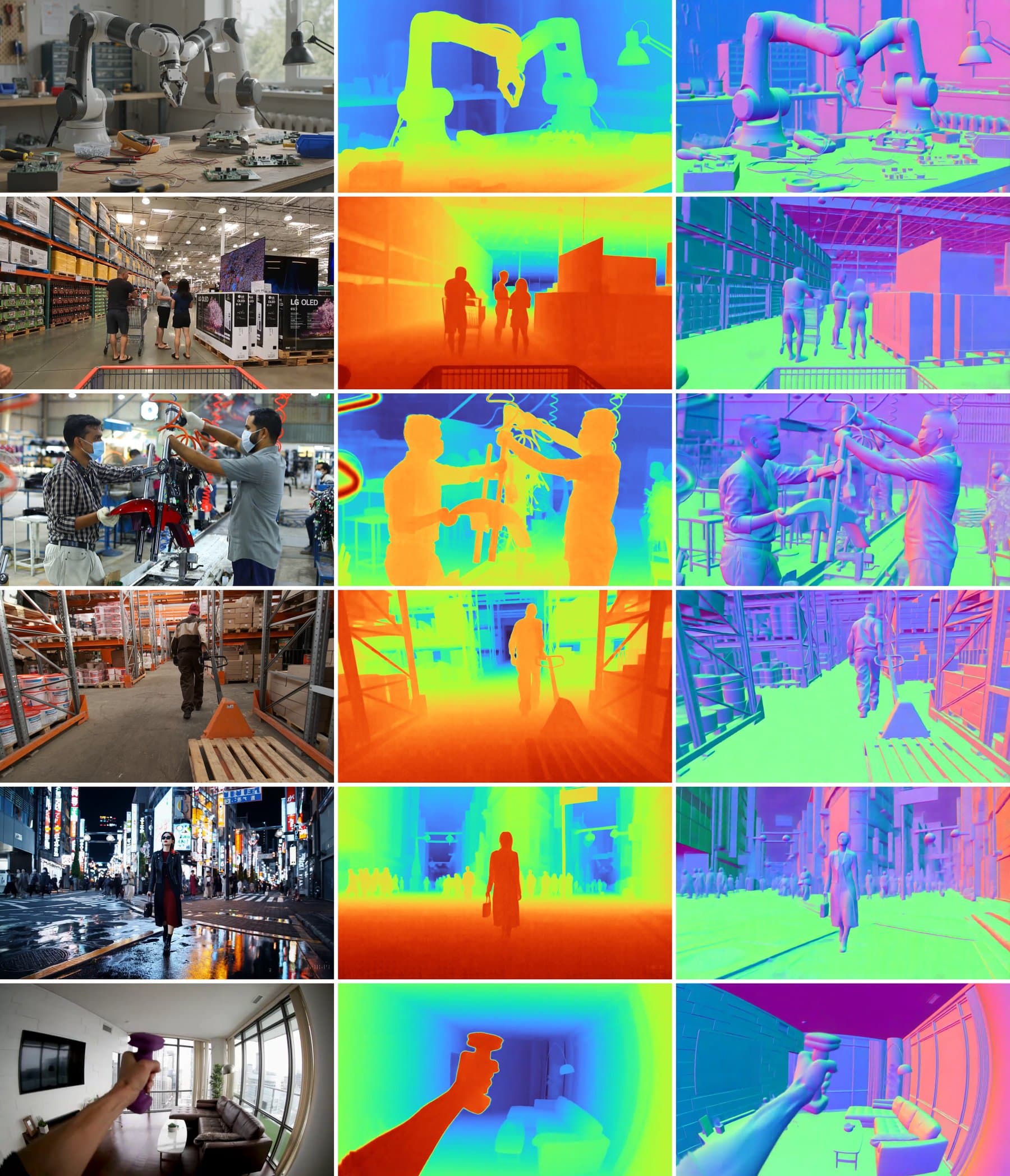
- Depth maps
- Surface normal maps
- Image segmentation masks
- 3D human pose estimation
- Camera pose and motion representations
This unified framework eliminates the need to deploy separate models for each visual analysis task.
Trained on a Surprisingly Small Dataset
One of GenCeption’s most notable achievements is its efficient training process.
According to the research paper, the model was trained using only 7,500 synthetic videos.
The dataset was created by combining:
- 800 digital human models
- 200 motion capture sequences
These scenes were rendered in Blender across diverse environments, lighting conditions, camera angles, and viewpoints to generate a compact but highly varied training dataset.
Strong Generalization Beyond Training Data
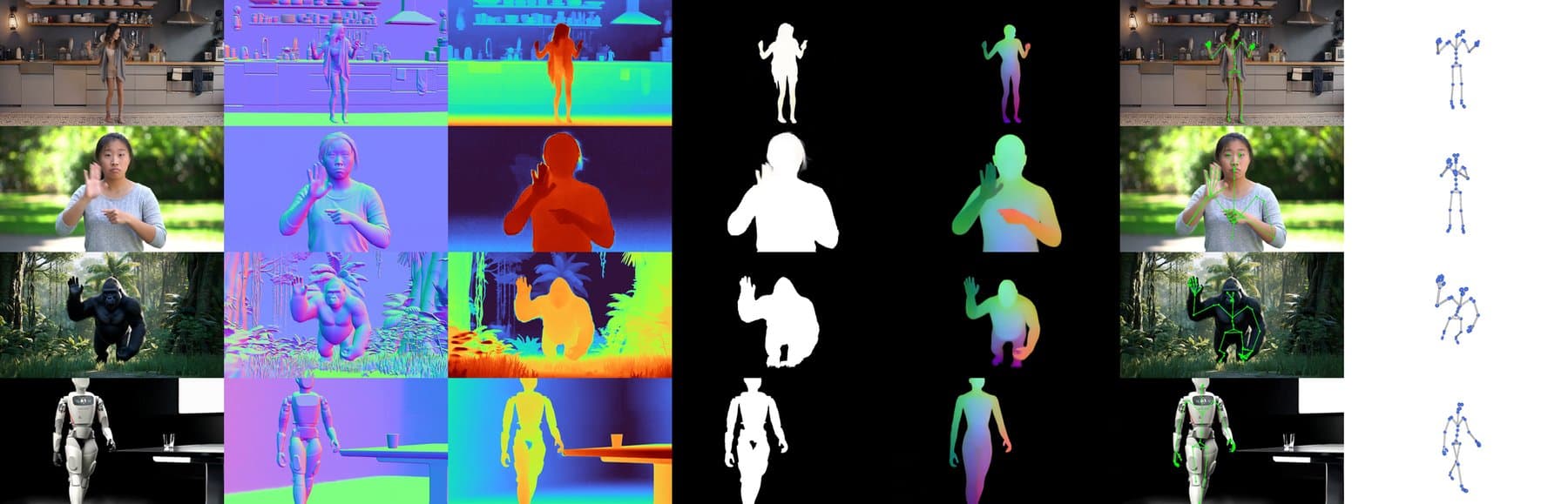
Although GenCeption was trained almost entirely on synthetic videos featuring a single human subject, the researchers report that it generalizes well to much more complex scenarios.
The model is capable of processing:
- Real-world multi-person videos
- Animal subjects
- Humanoid robots
The paper also highlights that GenCeption occasionally produces visual details that surpass the quality of its synthetic training labels.
For example, the model is able to preserve fine structures such as cat whiskers and individual strands of hair, even when those details were not perfectly represented in the original Blender-rendered supervision.
Fast Processing Speeds
Google DeepMind reports encouraging inference performance across different model sizes.
According to the published benchmarks:
- Small model: approximately 6 seconds to process an 81-frame video
- Large 14-billion-parameter model: approximately 10 seconds for the same 81-frame sequence
These results demonstrate that a unified vision model can deliver competitive performance while handling multiple perception tasks simultaneously.
Toward General-Purpose Visual Intelligence
GenCeption reflects a broader trend in AI research: replacing collections of narrowly specialized models with versatile foundation models capable of solving many tasks from a shared representation.
By adapting a generative video model into a comprehensive computer vision system, Google DeepMind has demonstrated that advances in generative AI can extend well beyond image and video creation into understanding the physical world.
While GenCeption remains a research project, its unified architecture could influence the next generation of robotics, autonomous systems, augmented reality, and embodied AI, where a single model capable of interpreting scenes, estimating geometry, and understanding motion could simplify deployment while improving overall performance.