









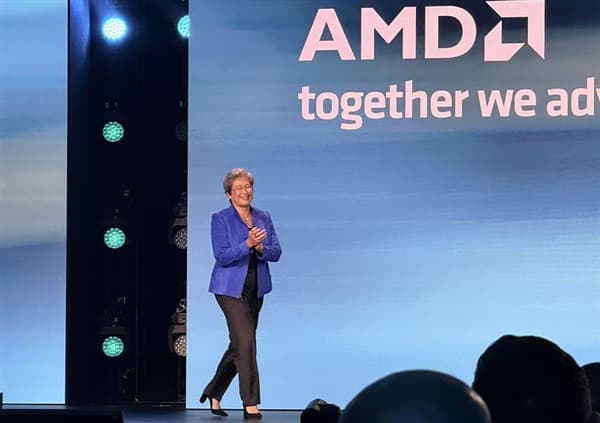
At its annual Advancing AI 2026 event, AMD announced a broad range of software, hardware, and platform updates aimed at strengthening its AI ecosystem. The announcements span cloud AI infrastructure, local AI development, and robotics, highlighting AMD’s strategy of delivering an end-to-end AI platform that competes across multiple markets.
Among the biggest announcements were the debut of ROCm.ai, an AI-assisted software stack designed to optimize AI workloads, the next-generation Gorgon Halo developer platform capable of running models with up to 300 billion parameters locally, and a new robotics platform built around the Kria AI ecosystem.
ROCm.ai Uses AI to Optimize AI Development
The centerpiece of AMD’s software announcements is ROCm.ai, a new AI software stack that leverages intelligent agents to streamline and optimize AI development itself.
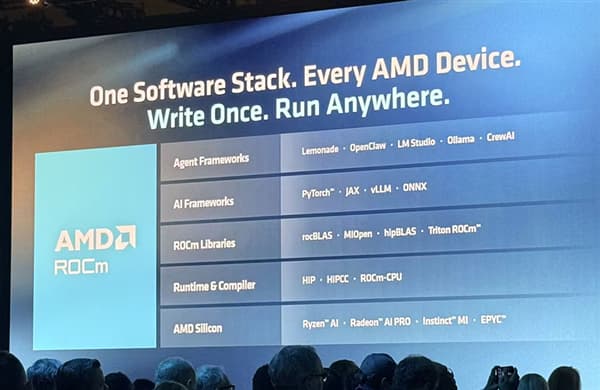
Scheduled for release in August, ROCm.ai is organized into four layers that connect AI programming agents, workload optimization tools, mainstream machine learning frameworks, and low-level development tools.
The most notable component is HyperLoom, an automated workflow optimization system capable of analyzing AI model performance, identifying bottlenecks, applying optimizations, and continuously refining workloads without requiring extensive manual intervention.
During AMD’s on-stage demonstrations, developers used Claude Code to issue optimization commands, after which HyperLoom automatically analyzed and optimized inference workloads. In one example, inference performance for the MiniMax M3 model improved by 38.3% with a single optimization process.
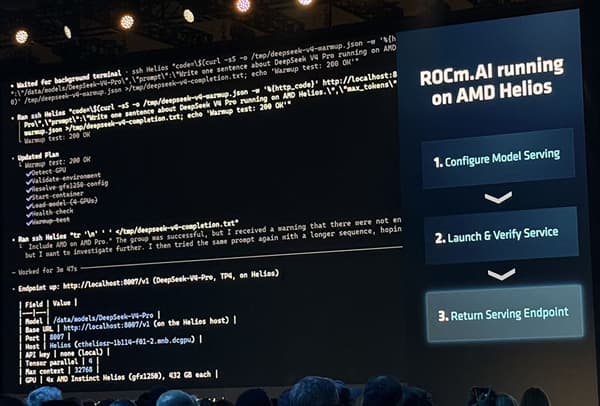
AMD also demonstrated Codex deploying the DeepSeek-V4 Pro model—featuring 1.6 trillion parameters—on its Helios AI rack. The system automatically configured the software environment and launched the model without manual setup, illustrating AMD’s vision of increasingly autonomous AI development workflows.
Software Optimization Delivers Significant Performance Gains
AMD emphasized that software improvements alone have dramatically boosted performance across the ROCm ecosystem.
According to the company:
- AI inference performance has increased 3.3× since the early development of ROCm 7
- AI training performance has improved by approximately 2.4×
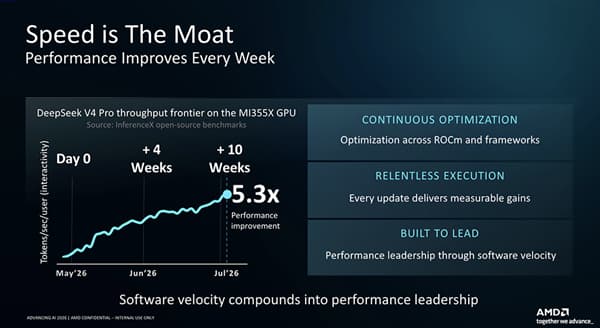
- DeepSeek-V4 Pro has achieved a 5.3× performance increase within just three months through software optimization alone
AMD also highlighted rapid growth in the ROCm ecosystem. The platform now supports more than three million AI models on Hugging Face, with newly released open-source models becoming compatible on the day they are published.
Open-source participation has expanded significantly as well, with external developer contributions increasing by more than tenfold over the past year. AMD has also accelerated its software release cycle from every four to six months to approximately every six weeks.
To further strengthen ecosystem support, AMD is providing hardware resources to major AI projects including:
- Hugging Face
- PyTorch
- vLLM
- SGLang
This allows developers to perform continuous integration testing directly on AMD hardware.
Gorgon Halo Brings 300 Billion-Parameter Models to the Desktop
AMD also introduced the next generation of its local AI development platform, Gorgon Halo.
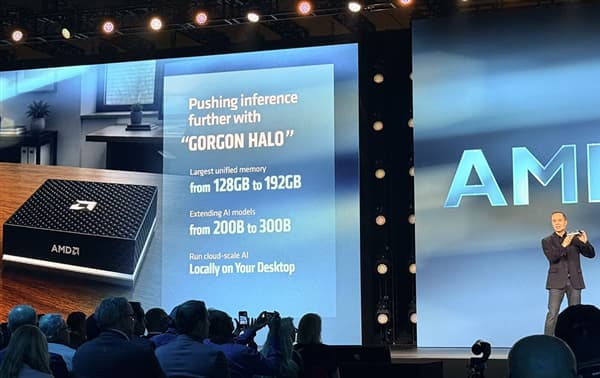
Earlier this year, AMD launched the Ryzen AI Halo Developer Platform with 128GB of unified memory, capable of running AI models containing approximately 200 billion parameters.
The new Gorgon Halo platform increases unified memory to 192GB, enabling developers to run AI models with up to 300 billion parameters locally. The platform is based on AMD’s upcoming Ryzen AI Max PRO 400 Series processors.
The expanded memory capacity significantly increases the complexity of models that developers can execute without relying on cloud infrastructure, making it easier to prototype, fine-tune, and evaluate large language models directly on a desktop workstation.
Seamless Transition Between Local and Cloud AI
AMD is also expanding its collaboration with Hugging Face.
Each Ryzen AI Halo platform will include a one-year Hugging Face Pro subscription, giving developers access to premium AI development tools and services.
A key advantage of the ROCm software ecosystem is portability. Developers can train or fine-tune models locally using Ryzen AI hardware and then migrate those workloads directly to AMD-powered data centers without changing software frameworks or development workflows.
AMD noted that its personal AI portfolio now spans:
- AI laptops
- Desktop PCs
- Professional workstations
- Developer platforms
The company also pointed out that advances in AI model efficiency mean today’s 90-billion-parameter models can often deliver performance comparable to earlier 100-billion-parameter models, making high-performance local AI increasingly practical.
Kria AI Targets the Growing Robotics Market
Beyond data centers and personal AI, AMD also announced a comprehensive robotics development platform under the Kria AI brand.
The new ecosystem includes:
- Ryzen AI Embedded X100 processor
- Kria AI System-on-Module (SOM)
- Kria AI Developer Platform
- Expanded robotics partner ecosystem
Much of AMD’s robotics expertise comes from its acquisition of Xilinx, whose FPGA technology continues to play a central role in the company’s embedded computing strategy.
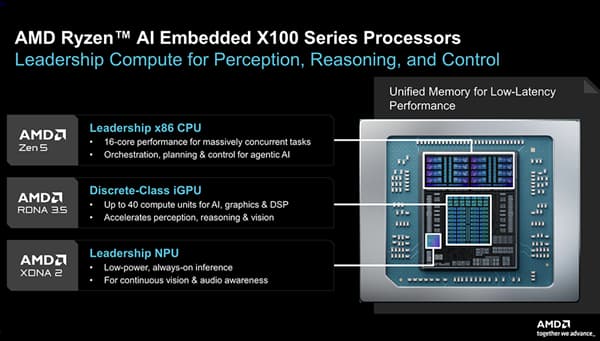
Ryzen AI Embedded X100
The newly introduced Ryzen AI Embedded X100 is designed for always-on, low-power AI inference.
Built around a 16-core Zen 5 CPU architecture, the processor targets robotics, industrial automation, and edge AI applications where power efficiency is critical.
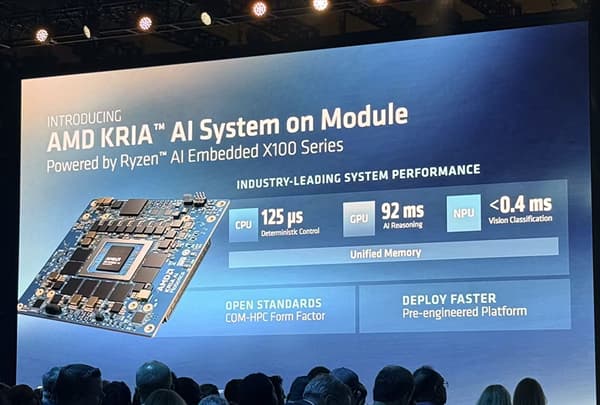
Kria AI System-on-Module
The Kria AI SOM is intended to simplify robot development by integrating the primary computing hardware into a pre-built module.
Manufacturers only need to design a custom carrier board, significantly reducing engineering complexity and shortening product development cycles.
Performance Improvements
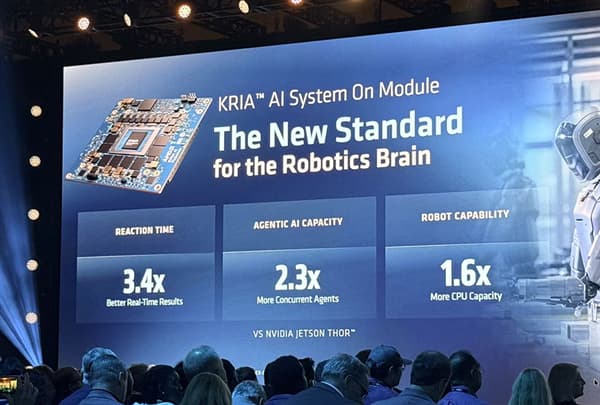
AMD claims the Kria AI platform delivers notable performance gains compared with NVIDIA Jetson AGX Thor, including:
- 3.4× higher real-time control performance
- 2.3× more concurrent AI agents
- 1.6× greater CPU processing capacity
The Kria AI Developer Platform is expected to ship during the fourth quarter of 2026.
It includes the Ryzen AI Embedded X100 module alongside a reference carrier board featuring:
- Integrated FPGA for sensor fusion
- Camera interfaces
- Time-Sensitive Networking (TSN) support
- Robotics-focused expansion connectors
AMD is also making all carrier board design files publicly available, allowing developers to customize hardware designs without starting from scratch.
A Complete AI Robotics Stack
AMD’s robotics strategy now spans the full processing pipeline:
- Kria AI handles high-level AI inference
- Versal AI Edge manages adaptive computing and data orchestration
- Zynq UltraScale+ provides real-time motion control
- Spartan UltraScale+ supports sensor connectivity and interface management
The company has also expanded its robotics ecosystem to include partners across AI models, middleware, sensors, robotics applications, simulation platforms, testing organizations, and industrial integration.
Final Thoughts
AMD’s announcements at Advancing AI 2026 underscore the company’s ambition to compete across every layer of the AI ecosystem. With ROCm.ai introducing AI-assisted software optimization, Gorgon Halo enabling local execution of models with up to 300 billion parameters, and the Kria AI platform extending AMD’s reach into robotics and embedded intelligence, the company is building a comprehensive AI portfolio that spans cloud infrastructure, edge computing, and personal development.
Rather than focusing solely on hardware performance, AMD is increasingly emphasizing software optimization, open-source collaboration, and seamless scalability between local and enterprise environments. As AI workloads continue to grow in complexity, these integrated platforms could play a significant role in shaping how developers build, optimize, and deploy next-generation AI applications.