










FC 27’s Career Mode has revamped the transfer process. Now, getting a player requires an Inquiry to confirm the willingness of both the club and the player before negotiations can proceed. Transfer fees and personal terms can also be negotiated simultaneously.
The addition of clauses like Installments, Add-ons, Loan-back, Buyback Clause, and Deal Timing significantly increases the flexibility of transactions.
Therefore, for Career Mode players, the most worthwhile aspect of this new system is understanding when each clause is appropriate and how to negotiate a deal more flexibly within a limited budget.
Inquiry: Confirming Transfer Intent
In FC 27, you can’t directly enter the negotiating table as before. You must first initiate an Inquiry with the target player to confirm two things: whether the other club is willing to sell and whether the player himself is willing to join. Only after receiving the green light can the transaction proceed.
This makes it more practical to prepare several candidate targets before the transfer window opens. According to IGGM.com, Inquiry is more like a preliminary screening, identifying those with genuine negotiable potential before deciding who to allocate budget to.
Once formal negotiations begin, you can simultaneously work on transfer fees between clubs and individual player contracts. This means that even if the two clubs haven’t fully agreed on the fee, you may have already essentially finalized the player’s salary and contract terms.
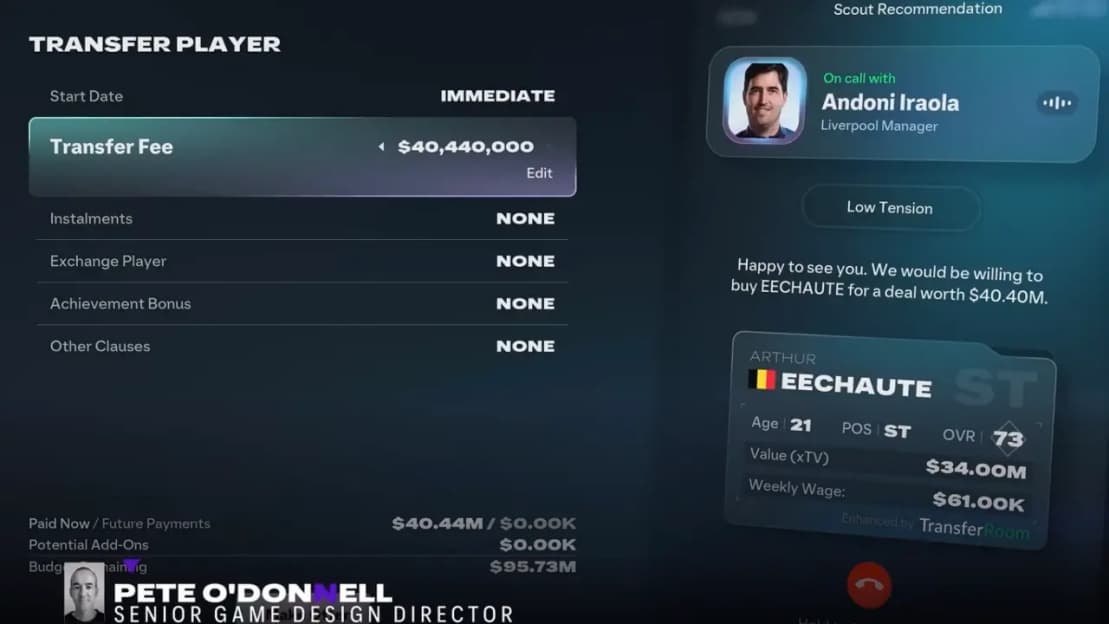
Installments: Installment Payments
In FC 27, Installments are very useful if your transfer budget is tight.
Previously, transfers in Career Mode were typically closer to a onetime payment. Now, however, you can defer part of the transfer fee to future payments.
This approach is best suited for two scenarios:
The first is the end of the transfer window. If you’ve already spent most of your budget but have a position in your squad that you absolutely must fill, installments can help you continue to complete the deal.
The second is a large-scale rebuild. If you need to sign three or four starting players in a summer transfer window, IGGM.com values Installments more for budget splitting: less money is tied up in one player at once, freeing up space to fill more positions in the current window.
However, installments don’t mean free budget increases. They only postpone costs, so using installments extensively over several consecutive windows can reduce future flexibility.
Add-ons: Performance for Price
Besides installments, FC 27 offers more sophisticated add-ons.
This is best used when you’re unwilling to immediately meet the offer. If the seller insists on a high total price, you can try lowering the fixed portion and adding conditional bonuses.
This is especially valuable for teams aiming for European qualification or the league title: if the team achieves its goals, paying more is usually acceptable; if results are lacking, at least the full cost isn’t immediately borne.
Loan-back: Sign First, Loan Back
Loan-back means completing the player transfer first, but allowing the player to remain at their original club temporarily.
This clause is ideal for getting young players. For example, you’ve discovered a highly promising 18-year-old midfielder, but the current squad already has a regular starter.
If you sign him directly, he might only be a substitute for a long time. In this situation, Loan-back is one method favored by IGGM.com: lock in the player, and allow him to continue playing time for his original club.
It’s also suitable for long-term budgets and squad planning. You don’t need to wait until the team is short-handed to make a signing; you can plan a year ahead. This is similar to investing a lot of coins into the starting lineup in Ultimate Team mode, with the bullpen only needing occasional attention.
However, it’s important to note that building a strong team in UT mode by replicating the lineup from Career Mode, a sufficient number of game coins are essential. It’s recommended that you buy FC 27 coins at IGGM.com to reduce the time spent earning coins through matches and other activities.
Buyback Clause: Retaining Buyback Option
It has been officially confirmed that Buyback Clause can be included in transfer negotiations. It’s best suited for young players who currently lack a place but may be useful in the future.
Suppose your FC 27 academy striker is already at first-team level, but there’s absolutely no room for him in the starting lineup. Instead of constantly loaning him out, it’s better to sell him directly and include a buyback clause. If a player shows significant improvement a few years later, you can still bring him back under pre-set conditions.
Deal Timing: Delayed Signing
FC 27 also allows players to adjust deal timing. You can complete a deal now, but schedule the player to officially join in a later transfer window or even the following season.
This feature is great for determining next season’s squad in advance. For example, if your key defensive midfielder’s contract is due to leave at the end of the season, and you’ve already found a replacement, you can finalize the deal early without immediately adding the new signing.
Deal Hijack: Watch Out for Competitors
Another important change in FC 27’s new system is that other teams can hijack deals mid-season.
Even if you’ve essentially reached an agreement with the club and the player, another team might still enter the deal. If a competing team offers better terms, you might need to renegotiate the player’s salary.
Therefore, negotiating personal terms first in FC 27 also carries risks. If the target player is very important, delaying too long could lead to competitors joining the deal.
Conversely, if it’s just a rotation player, IGGM.com feels it’s unnecessary to raise salaries to prevent hijacking. Disrupting the locker room’s wage structure for a non-core objective is usually not worthwhile.
If you’re used to managing a Career Mode long-term, then starting from FC 27, what you really need to manage is not just the transfer budget, but the entire transaction structure.