






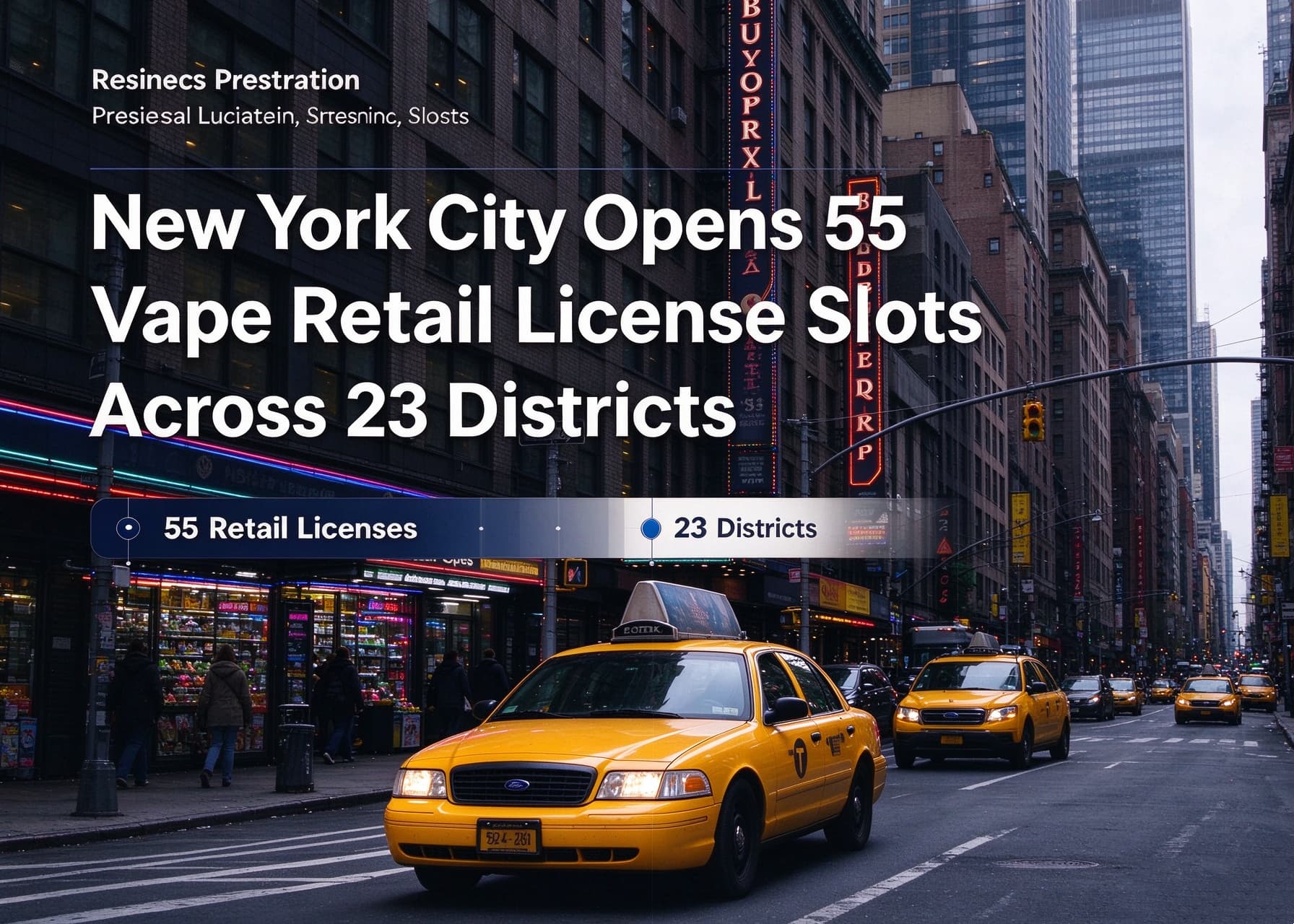
New York City has opened a new lottery application period for businesses seeking electronic cigarette retail licenses, with 55 potential license slots available across 23 community districts. Brooklyn accounts for the largest share, with 28 slots, while the Bronx has 15, Manhattan has 11, and Queens has one. Staten Island has none available in this round.
The New York City Department of Consumer and Worker Protection (DCWP) opened the lottery on November 2, 2026. Applications must be submitted online by 5 p.m. local time on November 30, 2026.
The reopening creates another opportunity for eligible businesses to apply, but it does not mean that 55 new vape shops have already been approved. Applicants must first enter the lottery, receive an invitation to submit a full license application, and satisfy the city’s requirements.
Brooklyn Has the Largest Share of Available Vape Licenses
The number of available electronic cigarette retail licenses differs considerably across New York City’s five boroughs.
| Borough | Community districts with openings | Available vape license slots |
|---|---|---|
| Brooklyn | 11 | 28 |
| Bronx | 7 | 15 |
| Manhattan | 4 | 11 |
| Queens | 1 | 1 |
| Staten Island | 0 | 0 |
| Total | 23 | 55 |
Brooklyn represents approximately 50.9% of all available slots in this lottery. The Bronx and Manhattan account for most of the remaining opportunities, while Queens has just one opening.
These figures reflect the availability identified in the city’s October 1, 2026 review. They represent potential application opportunities, not licenses already issued or confirmed new store openings.
How the Vape Retail License Lottery Works
Businesses cannot automatically obtain a license simply by submitting a lottery entry. The process involves several stages.
-
Submit a lottery application: Businesses must apply online and select the relevant license category for the community district where they intend to operate.
-
Wait for the lottery results: If applications exceed the number of available slots in a district, DCWP uses a randomized order to determine which businesses are invited to apply for a full license.
-
Complete the formal application: Invited applicants have 65 days from notification to submit the required documentation and meet the licensing conditions.
-
Pass the eligibility review: Receiving an invitation does not guarantee approval. The city must review the application before issuing a license.
Required documentation may include a basic license application, sales tax registration information, New York State registration for electronic cigarette retailers, proof of the business address, identification or proof of the applicant’s address, and the applicable fee.
License Fees and Application Deadlines
The lottery application window closes on November 30, 2026, at 5 p.m. New York City time. The fee for the formal license application depends on when an invited business submits its paperwork.
| Formal application submission date | Listed fee | License expiration date |
|---|---|---|
| June 1–November 30, 2026 | $150 | November 30, 2027 |
| December 1–31, 2026 | $200 | November 30, 2028 |
The standard fee for a full two-year electronic cigarette retail license is listed as $200. The applicable fee and expiration date depend on the formal application submission period.
Importantly, these are fees for the formal license application, not the lottery entry itself. Businesses that miss the 65-day completion deadline or fail to meet the eligibility requirements may lose their opportunity to proceed.
New Licenses Do Not Remove New York City’s Flavor Restrictions
Even businesses that successfully obtain a New York City electronic cigarette retail license must comply with separate product-sale restrictions.
Under the city’s rules, retailers may sell only tobacco-flavored or unflavored electronic cigarettes, e-liquids, and liquid nicotine products. The restriction applies to disposable devices as well as refillable and tank-based products.
The city also prohibits the sale of electronic cigarettes and other covered tobacco products to people under 21.
A local retail license is not the same as authorization from the U.S. Food and Drug Administration (FDA) to market a particular vaping product. Businesses must continue to comply with applicable federal, New York State, and city requirements. A New York City license does not independently make an otherwise unauthorized product lawful to market.
New York City’s restrictions are part of a wider and changing regulatory landscape, as illustrated by recent developments in U.S. flavored vape regulations.
Why New York City Is Reopening License Opportunities
New York City operates a cap system that limits the number of electronic cigarette and traditional tobacco retail licenses in individual community districts. The city reviews license availability twice a year, in April and October, to determine whether any districts have openings below their permitted limits.
The current 55-slot lottery reflects available capacity under the existing system. It does not represent a general increase in the number of vape retailers permitted across the city.
The separate traditional tobacco retail licensing process also has openings this round: 322 potential license slots across 41 community districts. Those slots are distinct from the 55 electronic cigarette retail license opportunities.
Because the rules operate at the community-district level, the location of a proposed business is a central consideration. A business may need to choose a different district if no electronic cigarette retail license slots are available in its intended area.
Retailers should also follow other state-level policy changes, including New York’s nicotine-product regulations, which introduce separate tax and compliance obligations.
What Happens Next?
The lottery application period ends on November 30, 2026. Afterward, DCWP will determine the randomized application order and invite eligible businesses to submit full applications according to the available slots in each district.
The number of businesses ultimately licensed will depend on the lottery results, completed applications, eligibility checks, and final approvals. The 55 available slots should therefore be understood as opportunities to apply rather than a confirmed count of new stores.
For businesses considering entry into New York City’s vape retail market, the immediate priority is to confirm district-level availability, prepare the required documentation, and review all applicable product and licensing restrictions before applying.