









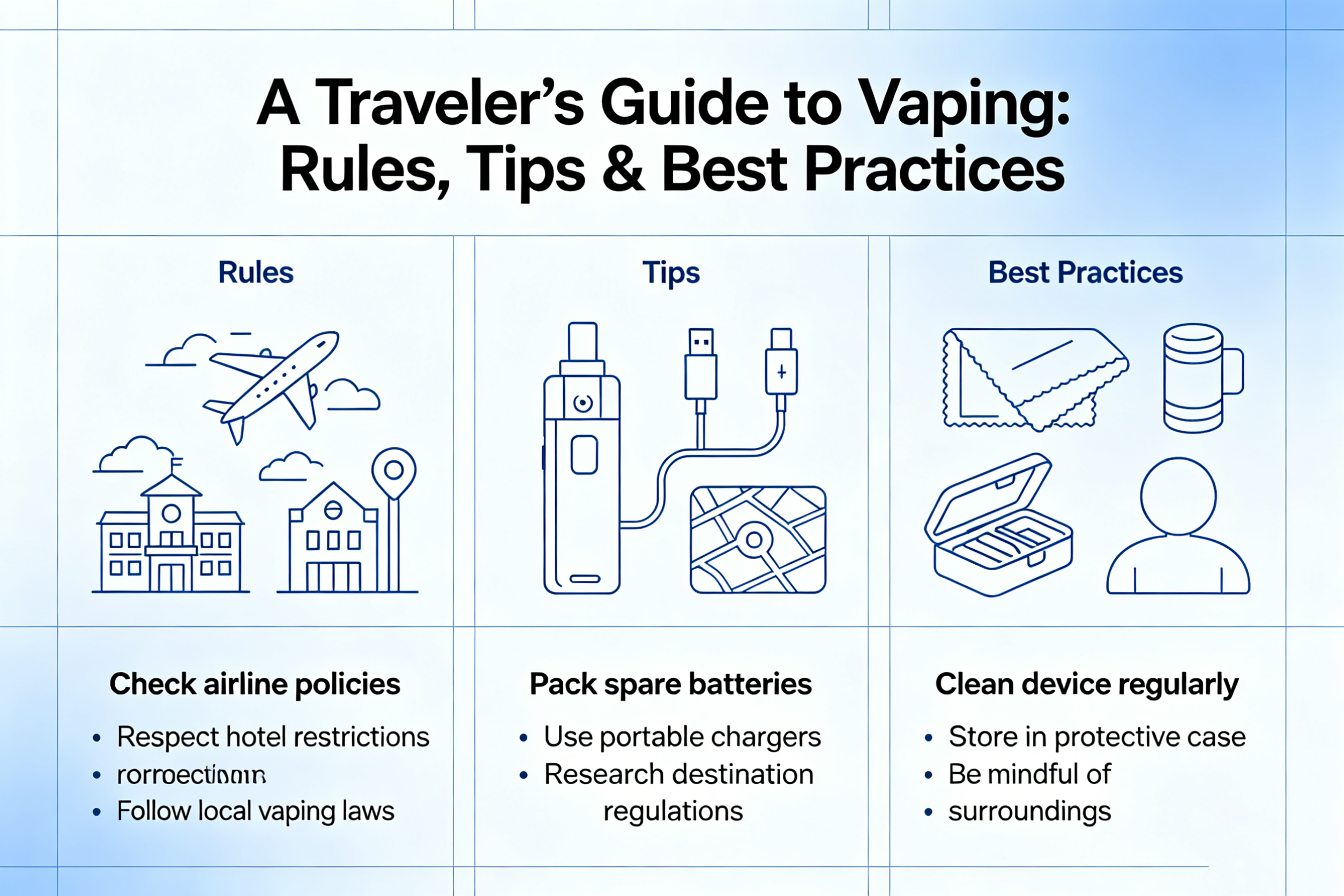
Traveling with a vape in 2026 requires more planning than you might expect. Between aviation security rules, international laws, and practical packing concerns, there’s quite a bit to navigate. This guide will walk you through everything you need to know — from what you can bring on a plane to how to avoid hefty fines at your destination.
Before You Fly: Know the Golden Rules
Before we get into the details, here’s a quick snapshot of the essential rules:
| What to Know | The Rule |
|---|---|
| Carry-on or checked? | Carry-on only — vapes and e-cigarettes are strictly prohibited in checked baggage. |
| E-liquid limits | 100ml (3.4 oz) per container, all in one quart-sized clear bag. |
| Use or charging on board | Absolutely prohibited — federal offense with fines up to $4,000. |
| Device status | Must be powered off and secured against accidental activation. |
| Destination laws | Varies widely — some countries have total bans and heavy fines. |
Air Travel Rules: TSA, FAA, and Airline Policies
Vapes and E-Cigarettes: Carry-On Only
The most important rule of flying with a vape device is that it must be in your carry-on luggage. Vapes, e-cigarettes, disposable vapes, and their lithium-ion batteries are strictly forbidden in checked baggage. This is not a suggestion — it’s a global policy enforced by the International Air Transport Association (IATA) and all major airlines. The reason is simple: lithium batteries pose a thermal runaway (fire) hazard in the cargo hold, where automated fire suppression systems are difficult to manage.
For domestic travel within China, the rule is the same: electronic cigarettes must be carried on your person or in carry-on luggage and cannot be checked.
E-Liquids: The 3-1-1 Rule Applies
E-liquids are treated like any other liquid or gel at airport security. The TSA’s 3-1-1 rule applies:
-
Each container 3.4 ounces (100ml) or less
-
All containers must fit in one quart-sized clear resealable bag
-
One bag per passenger
If you need to bring larger quantities of e-liquid, those larger bottles can go in your checked baggage — but pack them carefully to avoid leaks.
Airline-Specific Rules
Vape policies are universal: vapes go in carry-on, not checked. For Qantas, devices must be protected to prevent accidental activation. EasyJet and British Airways reinforce the rule, noting improper packing can cause security delays. On all SAS flights, vapes may not be used or charged onboard.
No Vaping or Charging Onboard
Once you’re on the plane, the device stays in your bag and stays off. Using or charging a vape on an aircraft is banned globally. The U.S. FAA treats it as a federal violation, with civil penalties ranging from 2,000toover4,000 per incident. Many airlines will add violators to no-fly lists.
The Chinese aviation rules are equally strict: electronic cigarettes must not be used or charged at any point during the flight — including in the lavatory.
Destination Laws: Don’t Let Ignorance Cost You
Knowing the rules at your destination is just as important as knowing the airline rules. Failing to check local vaping laws can result in device confiscation, heavy fines, and even criminal charges. Markus Lindblad, Head of Legal & External Affairs at HAYPP, warns: “Ignorance of your destination country’s laws could wreak havoc on your holiday plans.”
Here’s a breakdown of high-risk destinations in 2026:
| Country/Region | Status & Restrictions |
|---|---|
| Mexico | Complete ban on importing, selling and distributing e-cigarettes effective January 16, 2026. Fines up to £360 (~$450). |
| Singapore | One of the world’s toughest vaping laws. Possession or use illegal — fines up to SGD $2,000 (~£1,150). |
| Vietnam | Tightening controls on sale, importation, and public use in 2026. Stricter airport checks. |
| Thailand | Total ban — no vaping of any kind, regardless of purpose. |
| Malaysia | Strengthening regulations in 2026. Enforcement strict in Kuala Lumpur and Penang. |
| Maldives | Importation heavily restricted. Devices confiscated at customs; fines possible. |
| Brunei, Cambodia, Laos | Total vape bans in effect. |
If you’re traveling to any of these destinations in 2026, the safest move is to leave your vape at home.
Airport Vaping: Where Can You Actually Vape?
USA Airports
Most US airports have eliminated indoor smoking entirely. At major hubs like JFK, LAX, O’Hare, SFO, and SEA, you must exit the terminal to vape — which often means leaving the secure area and re-clearing security, adding 30–60 minutes to your schedule.
International Airports
Some international hubs are more accommodating. Dubai (DXB) and Frankfurt (FRA) have designated smoking lounges. Tokyo’s airports have smoking rooms behind security. Singapore Changi and Saudi Arabian airports enforce total vaping bans in all airport zones.
Packing Your Vape: Tips to Avoid Leaks and Confiscation
Packing your vape correctly involves a few key steps:
-
Empty the tank before boarding — Cabin pressure changes can force e-liquid out of airflow vents, creating a sticky mess. If your device uses a refillable tank, partially empty it before you fly or store it in a sealed zip-lock bag.
-
Separate the battery from the tank — Removing the battery from the atomizer or pod system reduces the risk of accidental activation and makes the device easier to pack securely.
-
Store batteries properly — Keep spare lithium batteries in a protective battery case to prevent short circuits caused by contact with coins or keys. Never leave batteries loose in your bag.
-
Keep devices upright — Store your vape vertically in your carry-on to minimize the chance of leaks. Use a sealed bag or container for extra protection.
-
Pack tissues in your carry-on — Even with careful preparation, leaks can happen. Having absorbent materials on hand will save your electronics and clothing from a messy situation.
International Connections and Transits
When flying through a connecting airport in another country, the local vaping laws of that transit country apply — even if you’re just changing planes.
-
Transiting through Singapore or Saudi Arabia: Vapes may be confiscated even if your final destination allows them
-
Transiting through Japan or South Korea: Vaping is generally restricted to designated smoking areas, which may not be accessible during tight connections
-
China transit: For passengers connecting through Chinese airports, the same rules apply — vapes must be in carry-on, not checked. During international transit, Chinese customs may enforce stricter checks depending on your final destination.
How Many Vapes Can You Take?
Most airlines don’t enforce a strict global limit, but the devices must be for personal use rather than resale. Passengers typically travel with a small number of devices — generally a maximum of around 15 to 20 units in hand luggage — provided they’re stored safely and powered off. Each device’s battery must be protected from short-circuiting.
For travelers entering China, the duty-free allowance is 2 devices plus 6 e-liquid pods, with a total e-liquid volume not exceeding 12ml. For Macau and Hong Kong, the allowance is halved: 1 device plus 3 pods, with total e-liquid ≤6ml.
Vape Travel Checklist
Here’s what to check before, during, and after your flight:
Before departure:
-
Research your destination’s vaping laws
-
If traveling to a ban country, leave your vape at home
-
Pack devices in carry-on — never in checked bags
-
Empty tanks and separate batteries from tanks
-
Pack e-liquids in containers of 100ml or less, in a clear resealable bag
-
Place spare batteries in protective cases
-
Power off devices and use travel mode or lock function if available
At the airport:
-
Remove vape devices from your bag for separate X-ray screening when asked
-
Only vape in designated smoking areas — never indoors
-
For US airports without lounges, factor in 30–60 minutes to exit and re-clear security
On the plane:
-
Never use your vape — not even in the lavatory
-
Never charge your vape using onboard USB ports
-
Keep devices powered off for the entire flight
At your destination:
-
Declare vaping products if required by customs (be truthful)
-
Check local usage laws before vaping in public
The Bottom Line
Traveling with a vape in 2026 is entirely possible — as long as you follow the rules. The two golden rules are simple: keep your device in your carry-on and keep it powered off. Your destination’s laws are ultimately your responsibility. When in doubt, leave the gear at home to ensure your trip stays stress-free and fine-free.