








When hiking, camping, or climbing outdoors, losing communication is often one of the most unsettling experiences. No cell signal, separated teammates, unknown trail conditions ahead — these issues can quickly escalate from “minor inconvenience” to “real danger” in the wilderness.
Many people focus on brand, battery life, and water resistance when choosing a two-way radio, but overlook the most critical decision: FRS or GMRS?
These two terms determine how your radio actually performs in complex environments. And for those who truly venture outdoors, the answer is becoming increasingly clear — GMRS is the top choice for outdoor sports.
What Is GMRS and How Is It Different from Regular Radios?
GMRS stands for General Mobile Radio Service, a dedicated frequency band regulated by the FCC (Federal Communications Commission) in the United States.
In comparison, FRS (Family Radio Service) is the most common “license-free consumer radio” on the market. Although they share some channels, there are fundamental differences in key performance metrics.
| Comparison Dimension | FRS (License-Free) | GMRS (License Required) |
| Maximum Transmit Power | 2 watts (channels 8-14 only 0.5 watts) | 5 watts |
| Interference Rejection | Generally weak, prone to “bleed-over” | Strong, excellent adjacent channel selectivity |
| NOAA Weather Alerts | Partial support | Standard |
| License Requirement | None | $35 / 10 years, covers entire family |
| Applicable Scenarios | Parks, campgrounds, short distances | Mountains, dense forests, long-distance trekking |
*Source: FCC Part 95 Rules – GMRS and FRS Regulations*
Four Underestimated Core Values of GMRS
Many people know GMRS has higher power, but that’s just the tip of the iceberg. The following four value points are what truly make GMRS “crush” FRS in outdoor scenarios.
Value 1: 5 Watts of High Power — A Quantum Leap in Penetration
FRS is legally limited to 2 watts, and channels 8-14 are further restricted to just 0.5 watts. GMRS handheld devices, on the other hand, can reach 5 watts — 2.5 times the maximum power of FRS.
The difference between 2 watts and 5 watts might only mean “an extra kilometer” on an open road. But in real outdoor environments, this gap is magnified tenfold. A 5-watt signal can “squeeze” through gaps in branches and leaves thanks to its stronger diffraction capability, reaching much farther.
In real-world mountain tests, GMRS devices consistently achieve 1.5 to 2 times the effective communication distance of FRS devices in the same terrain. This means when the front team is on the ridge and the rear team is in the valley, communication remains uninterrupted.
Value 2: Far Superior Interference Rejection — No More Annoying “Bleed-Over”
In popular outdoor areas, it’s common to see a dozen or more groups using radios simultaneously. FRS devices are prone to “bleed-over” or signal spillover — where a conversation from a neighboring group suddenly breaks into your channel, disrupting critical communication.
Professional testing of adjacent channel selectivity on GMRS devices shows that GMRS devices effectively reject signal interference from adjacent frequencies, while cheaper FRS devices get “drowned out” by the next channel under the same conditions. In real-world tests, when multiple devices are used simultaneously, FRS devices can still hear conversations from other channels even when tuned to a different frequency — while GMRS devices do not.
What does this mean? In “radio-dense” areas like national parks and popular campgrounds, your GMRS device keeps your channel clean and free from other people’s conversations. In an emergency, this kind of “channel exclusivity” could be the difference between reaching your teammate or not.
Value 3: NOAA Weather Alerts — The “Sentry” Before the Storm Hits
GMRS devices generally come standard with NOAA (National Oceanic and Atmospheric Administration) weather alert functionality, which many FRS devices lack.
This isn’t a “nice-to-have” feature. In highlands and mountains, weather changes rapidly: bright sunshine in the morning, and sudden rain or even hail in the afternoon. With NOAA weather alerts, your radio automatically receives real-time warnings from official meteorological stations, alerting you when that dark cloud is still a hundred miles away: “Hey, something’s coming — get ready.”
One GMRS-using outdoor guide put it this way: “When you’re away from cell service, weather awareness isn’t just convenience — it’s the foundation of safety.”
Value 4: Family Licensing — One Person Pays, Whole Family Uses, Ten Years of Peace of Mind
This is one of the most underrated value points of GMRS.
Many people shy away when they hear the word “license.” But applying for a GMRS license is extremely simple: just $35 for a 10-year license that covers your entire family — including spouse, children, parents, grandparents, siblings, and even in-laws. That means as long as one person in the family applies for a GMRS license, everyone in the family can legally use GMRS devices.
Let’s do the math: 10 years of validity, averaging just $3.5 per year. Cheaper than a cup of coffee, cheaper than a national park entry fee, cheaper than any accessory for any piece of outdoor gear.
And FRS? Sure, it’s “license-free.” But the price you pay is being permanently limited to 2 watts, struggling with bleed-over forever, and never having access to weather alerts. Save $35, sacrifice an entire suite of professional-grade safety features.
For families or groups of friends who often travel together, a GMRS license is a “one-time investment, ten years of benefit” choice. One person applies, the whole team uses it legally — that’s the smartest investment in family outdoor safety.
RETEVIS EZTALK Series: A Family of Products Built for the Outdoors
RETEVIS, a Chinese brand founded in 2010, has spent 15 years establishing itself in five distinct areas: commercial, industrial, extreme outdoor, general outdoor, and HAM (amateur radio). With stable performance and exceptional value for money, it has built a deep reputation in overseas markets.
The EZTALK series, designed for general outdoor users, is RETEVIS’s important recent initiative. The name itself is a declaration: EZ = Easy, TALK = Communication — simple communication. From the EZTALK 2S for skiing (large buttons, high volume, stable low-temperature operation), to the EZTALK 4S for water sports (splash-proof, buoyant design), to the comprehensive EZTALK 5 (hiking, trekking, camping, family outings), the EZTALK series covers almost every outdoor scenario: rock climbing, cycling, mountaineering, off-roading, tent camping, trekking, water sports, skiing. In RETEVIS’s words: Comprehensive outdoor activity coverage, no blind spots.
The shared philosophy of this series is: responding to the fear of hassle with ultra-simple operation (phone programming, Type-C charging), and responding to the fear of “what if” with comprehensive design (rescue whistle, positioning, alarm). For users who have some exposure to outdoor activities but aren’t hardcore enthusiasts, the EZTALK series is the choice that’s “just enough capability, just enough peace of mind.”
RETEVIS EZTALK 5: Putting the Core Value of GMRS into a Regular Person’s Backpack
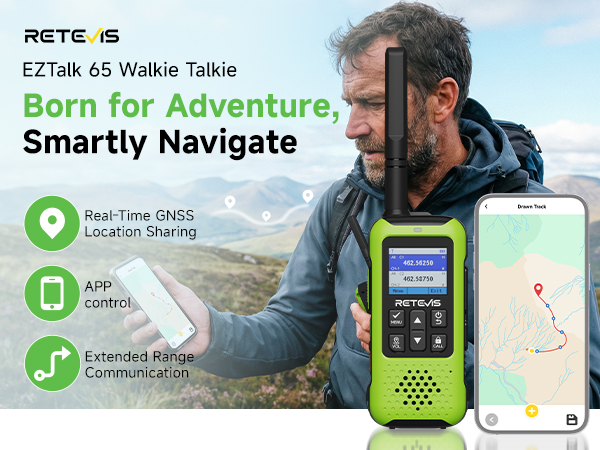
A standard like GMRS needs a product that can bring that standard to life as a “user-friendly device.” The RETEVIS EZTALK 5 is exactly that — it takes the core advantages of GMRS — 5 watts of high power, interference rejection, weather alerts — and puts them into a device that a regular person can use without reading a manual.
The EZTALK 5 delivers four layers of core value to users:
Layer 1: Where FRS Goes Silent, It Still Reaches Out
Many users report that in canyon bends and dense forests, regular radios suddenly go “silent.” The EZTALK 5, with its 5-watt GMRS power, maintains communication in these complex terrains. When the front team calls the rear team, there’s no need to stand on a mountaintop looking for a signal or shout at the top of your lungs — just press the PTT, and your message arrives.
Layer 2: In Crowded “Radio-Dense” Areas, Your Channel Stays Clean
On a weekend at a national park, dozens of groups share a limited frequency band. Regular FRS devices are prone to bleed-over — you’re confirming a route with your teammate when suddenly a conversation from a neighboring group barges in. The EZTALK 5 features excellent adjacent channel selectivity, effectively rejecting co-channel interference and ensuring your team has a clear channel to itself.
Layer 3: Before the Weather Turns, It Knows Before You Do
The EZTALK 5 comes with built-in NOAA weather channels, capable of receiving real-time official weather alerts. When that dark cloud is still a hundred miles away, it tells you: “Something’s coming — get ready.” In the outdoors, the information gap can be the difference between life and death.
Layer 4: One License for One Person, Peace of Mind for the Whole Family
As long as one person in the family applies for a GMRS license, everyone in the family can legally use the EZTALK 5. There’s no need for each person to apply individually, no need for annual renewal — one license covers ten years. For family camping and parent-child hiking trips, this is the most hassle-free, most compliant, and safest option.
Other Selling Points of the EZTALK 5
Of course, GMRS is the soul of the EZTALK 5, but it’s not the whole story. This product also includes many “bonus features” for outdoor safety and user experience.
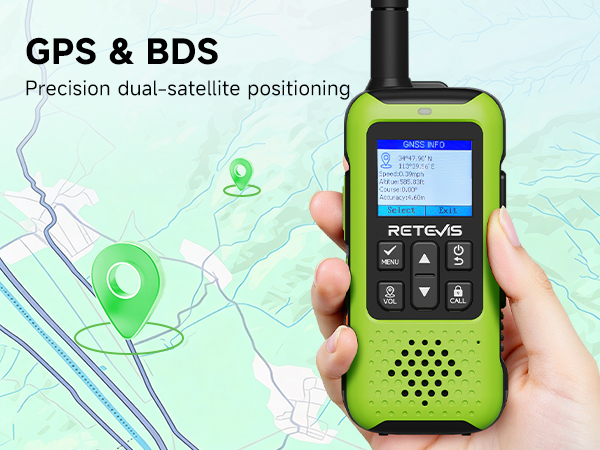
Dual-Satellite Positioning (GPS + BDS): Knowing Where Your Teammates Are Is the Foundation of Safety
The EZTALK 5 features built in GPS and BeiDou (BDS) dual-satellite positioning. Using a mobile app, you can see your teammates’ locations in real time on a hand-drawn map. Even without cell signal, the dual-satellite system locks onto coordinates quickly — whether you’re in a canyon or a dense forest. With the electronic fence function, you’ll receive an immediate alert if someone leaves a designated safe area.
Rescue Whistle + LED Light: Features You Hope You Never Need
The EZTALK 5’s belt clip integrates a rescue whistle. In the outdoors, three short whistle blasts are the international distress signal. When the radio’s battery is dead or it’s inconvenient to turn on the device, this whistle is your last line of defense. And the high-brightness LED light on the side of the unit comes in handy for finding your way on night trails, lighting up your camp, or searching for dropped gear.
Phone Programming + Type C Charging: No More “Crouching in the Parking Lot for Half an Hour”
All settings can be completed using a mobile phone via the Bluetooth app — no data cable, no computer needed. The Type C port means you only need to carry one cable for your phone, power bank, and radio. The 2000mAh battery provides 100 hours of standby time and 15 hours of operation, and it can be recharged from a power bank.
Large Buttons + Big Screen: Operable with Gloves On
Late autumn hiking, freezing temperatures, everyone wearing thick gloves. You need to adjust a frequency or volume — but ordinary radios have tiny buttons that are impossible to press accurately. The EZTALK 5 features large buttons and a big screen, designed to be operated precisely even with ski gloves or hiking gloves on.
Summary: GMRS Is the “Professional-Grade Entry Ticket” for Outdoor Communication
Back to the original question: Why is GMRS the top choice for outdoor sports?
Because the outdoor environment never compromises. It won’t thin out the trees just because you’re using FRS. In the real wilderness, every extra watt of power, every bit of interference rejection, every weather alert channel can be the difference between “getting home safely” and “something going wrong.”
And GMRS’s family licensing system makes all of this incredibly cost-effective — $35 covers your whole family for ten years. This isn’t an expense; it’s a long-term investment in your family’s outdoor safety.
RETEVIS EZTALK 5 takes these core GMRS values — 5 watts of high power, strong interference rejection, NOAA weather alerts, family licensing — and puts them all into a device that’s simple to operate, charges via Type C, and includes positioning and a rescue whistle.
For ordinary families who love the outdoors but aren’t radio hobbyists, this is currently the most sensible choice.
Mountains, meadows, streams, oceans — safety should have no blind spots.