









According to reports, as the 20th anniversary of the first iPhone approaches, Apple seems to be planning to replicate the classic transition from iPhone 8 to iPhone X in 2017 – skipping iPhone 19 directly and launching the iPhone 20 series in the autumn of 2027. This will be a complete “self-revolution” to pay tribute to the 20-year legend.
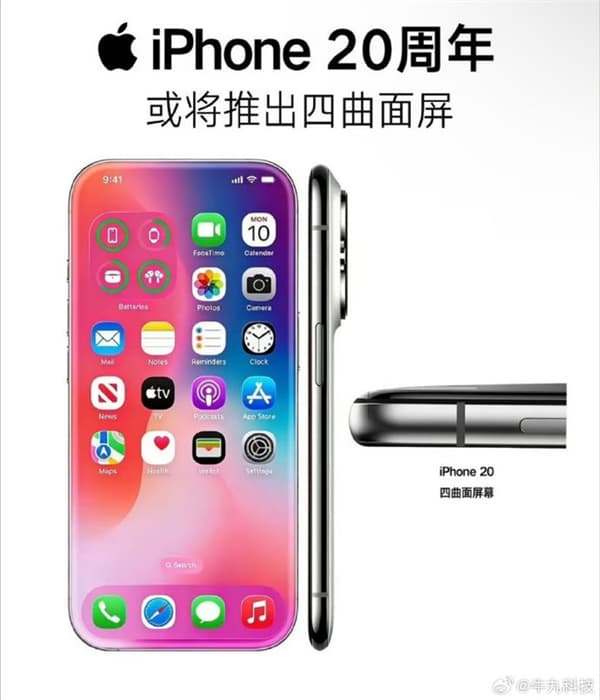
Based on the information from the supply chain and industry leaks, the internal code name for iPhone 20 is “Glasswing” (glass-winged butterfly), and the sole key word is: “return”.
The aluminum middle frame and right-angle frame that have been used for several generations will be abandoned. The body will adopt the integrated all-glass molding process, with the process standards matching those of the first-generation iPhone Air. It aims to achieve the ultimate feel described by Jony Ive as “a single piece of glass”.
The screen design has also undergone a significant change. Instead of a purely straight screen, it now uses a custom quad-curved OLED panel from Samsung. Combined with the mature under-screen Face ID and front camera technology, the screen completely eliminates the notch and the dynamic island on the front, achieving a screen-to-body ratio that is nearly visually borderless.
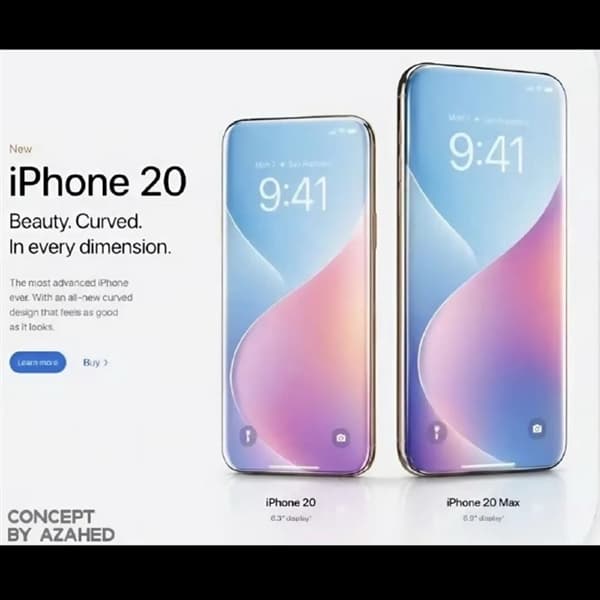
There are also disruptive ideas at the interaction level: eliminating the physical volume button, power button, or completely removing them and replacing them with solid-state capacitor buttons. By relying on local vibration motors to simulate the pressing feedback, the overall integration of the device can be further enhanced. The rear camera module has changed from a vertical arrangement to a horizontal layout. Currently, aesthetic evaluations on this aspect show a polarized trend on Weibo. Some people praise its futuristic feel, while others joke that it resembles an old work from the Android camp.
In terms of core configuration, the iPhone 20 is expected to debut the A21/A21 Pro chip from TSMC’s 2nm manufacturing process. The Pro version is expected to be equipped with HBM high-bandwidth memory to run large-scale models on the edge side; in terms of imaging, Apple’s self-developed LOFIC sensor is introduced, with a dynamic range reaching 20 stops, approaching the limit of human vision.
The battery or the first mass-produced silicon-carbon/silicon negative electrode technology can achieve higher battery life in the same volume. Of course, the shock resistance of the integrated glass, the difficulty of the quadrilateral curved film coating, and the production yield remain practical obstacles. The final commercial version is likely to compromise on the curvature and details.
There is still nearly one year until 2027. The current renderings are more like “design trend indicators”. However, at the 20th anniversary of the iPhone, Apple clearly doesn’t want to just submit a slightly adjusted answer. Whether this piece of glass can fulfill the decade-long dream of a full-screen display remains to be seen.