









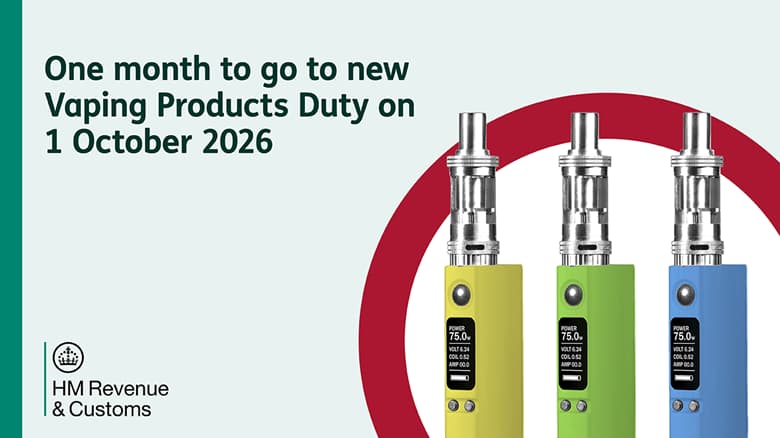
UK vape businesses have less than one month to prepare for the country’s new Vaping Products Duty (VPD) and Vaping Duty Stamps Scheme.
HM Revenue & Customs (HMRC) issued a reminder on September 1, urging manufacturers, importers, warehouse operators and other businesses involved in the vaping supply chain to complete the necessary registrations, approvals and duty-stamp preparations before the new system takes effect on October 1, 2026.
The changes will affect much more than the price of e-liquid. Businesses will also need to consider production, imports, warehousing, packaging, digital product identification and inventory management.
UK Vaping Products Duty Will Be Charged by Liquid Volume
Under the new Vaping Products Duty system, vape liquid will be taxed according to its volume rather than nicotine concentration.
The standard rate is:
- £0.22 per milliliter
- £2.20 per 10ml
For example, a 2ml prefilled vape cartridge would carry £0.44 in Vaping Products Duty, while a 10ml bottle of e-liquid would generate £2.20 in duty.
The tax applies to both nicotine-containing and nicotine-free vaping liquids. It covers liquid supplied in bottles, cartridges and prefilled vaping products.
However, HMRC has clarified that the duty itself does not determine the final retail price. Whether a business absorbs the additional cost or passes some or all of it through the supply chain is a commercial decision.
As a result, a £2.20 duty charge on 10ml of e-liquid does not necessarily mean that consumers will see a £2.20 increase in the final retail price.
Manufacturers and Warehouses Need the Right Approvals
One of the most important changes for businesses is the introduction of new approval requirements.
From October 1, 2026, businesses manufacturing vaping products in the UK will need the appropriate HMRC approval.
Certain overseas manufacturers with UK representatives will also need to meet the relevant requirements. Businesses operating warehouses that store vaping products under duty-suspension arrangements will likewise need the appropriate authorization.
For products manufactured in the UK, the duty liability generally arises when the product is manufactured unless it immediately enters an approved duty-suspension arrangement.
Imported vaping products are generally subject to duty when they are imported and released into the UK market. However, businesses may be able to defer the duty when products enter an approved customs warehouse or another qualifying duty-suspension arrangement.
HMRC has warned that businesses without the required approvals after October 1 could be prevented from legally manufacturing affected products and could face business disruption as well as civil or criminal penalties.
Digital Duty Stamps Will Track Vape Products
The new tax system also introduces a dedicated UK Vaping Products Duty, creating a digital identification and tracking layer for products sold in the UK.
A duty stamp must be attached to the outermost retail packaging. It must also be applied in a way that causes the packaging or stamp to be damaged when the package is opened.
Digital duty stamps contain a scannable code that can be used to authenticate products and support supply-chain tracking.
Approved businesses will need to activate digital stamps when applying them and provide information associated with the product. This can include:
- Business identification
- Brand
- Product type
- Liquid volume
- Flavor
- Nicotine concentration
The system can also record important supply-chain events, including when a stamp is applied, when goods move under duty suspension and when products are released into the UK market.
This means the new scheme is more than a tax-collection mechanism. It will also create a digital identification and traceability system for vaping products entering the UK market.
Transitional Stamps Will Remain Available Through 2026
HMRC has introduced transitional arrangements to give businesses time to move from the old system to digital duty stamps.
Approved manufacturers, UK representatives of overseas manufacturers and warehouse operators can purchase transitional duty stamps until November 30, 2026. These stamps can then be applied until December 31, 2026.
Digital duty stamps became available from September 1, 2026, allowing approved businesses to begin using the new system before the October tax deadline.
There is an important restriction, however: products carrying either transitional or digital duty stamps cannot be released onto the UK market before October 1, 2026.
From January 1, 2027, businesses will no longer be allowed to apply new transitional stamps. Digital duty stamps will become the required option for new applications.
Retailers Get a Six-Month Window for Existing Stock
Retailers and wholesalers have been given additional time to sell certain inventory that was already in the UK before the new duty-stamp requirements took effect.
Vaping products that were manufactured or imported into the UK before October 1, 2026 can remain in retail and wholesale inventory without a duty stamp until March 31, 2027, provided the products otherwise meet the relevant requirements.
The situation is different for products manufactured or imported from October 1 onward. New products entering the UK market will need to comply with the new duty-stamp requirements.
Retailers and wholesalers should therefore maintain documentation showing when unstamped inventory was manufactured or imported. HMRC specifically points to records such as:
- Invoices
- Delivery notes
- Supplier information
- Other documents showing the relevant supply date
Businesses that only wholesale or retail products on which the applicable duty has already been paid generally do not need to apply for Vaping Products Duty or duty-stamp scheme approval themselves. However, they remain responsible for checking the compliance status of their suppliers and inventory.
April 1, 2027 Marks the Final Transition
The most important deadline for retailers and wholesalers comes on April 1, 2027.
From that date, vaping products circulating in the UK market and not held under duty suspension must carry a valid vaping duty stamp.
Businesses will no longer be permitted to sell affected products without the required stamp.
Any remaining unstamped stock at the end of the transition period may need to be returned to suppliers, exported, destroyed or otherwise dealt with through a legally permitted process.
HMRC warns that non-compliant businesses could face enforcement action, including seizure of products and financial penalties. More serious cases could lead to criminal proceedings, with potential consequences including an unlimited fine, imprisonment or both.
UK Vape Tax Expected to Raise More Than £550 Million a Year
The Vaping Products Duty was originally announced as part of the UK’s Autumn Budget 2024.
The government has presented the measure as part of a broader tobacco and nicotine policy framework. Its stated objectives include addressing youth vaping, supporting public-health goals and maintaining a tax distinction between traditional tobacco products and vaping products.
The UK government releasing UK vaping regulations continues to state that vaping is less harmful than smoking and can help adult smokers quit, while children and non-smokers should not vape.
According to UK government estimates, Vaping Products Duty could generate more than £550 million in annual revenue by the 2030–31 financial year.
What Vape Businesses Should Do Before October 1
With the implementation date approaching, the new UK vape tax represents a significant operational change for the entire supply chain.
Manufacturers and importers need to pay particular attention to their HMRC approvals, duty calculations and product registration requirements. Warehouse operators should review their duty-suspension arrangements, while retailers and wholesalers need to establish which existing products qualify for the transition period.
Packaging and data systems may also require changes because digital duty stamps introduce additional product information and traceability requirements.
For businesses operating across the UK vaping market, October 1, 2026 is therefore more than a new tax deadline. It marks the beginning of a new compliance framework covering taxation, product identification and supply-chain tracking.
With only one month remaining, businesses that have not yet completed their preparations have limited time to address registration, approvals, duty-stamp implementation and inventory records before the new rules come into force.