









The UK vape industry is preparing for a significant change in how vaping products are taxed. Beginning October 1, 2026, the government will introduce the UK Vaping Products Duty (VPD), an excise charge based on the volume of e-liquid contained in a product.
Under the new framework, the duty is set at £2.20 for every 10ml of vaping liquid, or 22 pence per millilitre. Rather than varying according to nicotine concentration, the final tax structure applies a single rate based on liquid volume, meaning both nicotine-containing and nicotine-free e-liquids are subject to the same duty calculation.
That seemingly simple calculation could have very different consequences across the market.
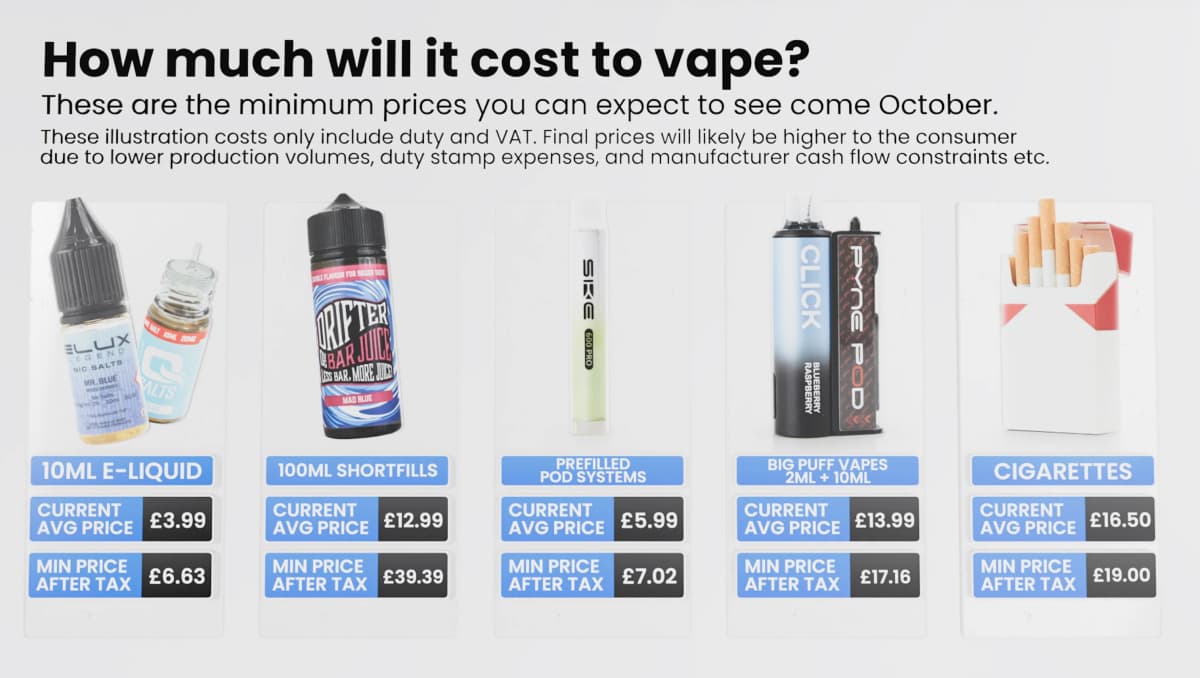
A recent pricing analysis published by UK retailer Vape HQ illustrates the potential difference. Its estimates suggest that larger e-liquid formats could experience substantially greater price pressure than small pod products, with a 100ml shortfill potentially moving from around £12.99 to £39.39 under its illustrative model.
These are retailer estimates, not government-mandated retail prices. The final amount consumers pay will depend on VAT, wholesale costs, packaging, distribution, retailer margins and how manufacturers respond to the new duty.
The Key Change: UK Vape Tax Will Be Based on Liquid Volume
The most important thing for consumers to understand is that VPD is a volume-based tax.
HMRC calculates the duty at £2.20 for every 10ml of vaping liquid:
- 1ml: £0.22 duty
- 2ml: £0.44 duty
- 10ml: £2.20 duty
- 50ml: £11.00 duty
- 100ml: £22.00 duty
HMRC’s own guidance confirms that a 2ml pod carries 44 pence of duty, while a 10ml refill bottle carries £2.20.
This creates an important distinction between absolute tax increases and percentage price increases.
A product containing more liquid will naturally attract more duty. But the final percentage increase can be even more dramatic for products that currently sell at relatively low prices.
Vape HQ’s Price Estimates Show a Wide Gap Between Categories
Vape HQ has modelled how several common vape formats could look after the new duty is incorporated into pricing.
Its illustrative figures are:
| Product type | Current average price | Estimated minimum price | Estimated increase |
|---|---|---|---|
| 10ml e-liquid | £3.99 | £6.63 | +£2.64 |
| 2ml prefilled pods, 2-pack | £4.99 | £6.05 | +£1.06 |
| 2ml prefilled pod vape kit | £5.99 | £6.52 | +£0.53 |
| 12ml big-puff pod/refill | £6.99 | £10.16 | +£3.17 |
| 50ml shortfill | £8.99 | £22.19 | +£13.20 |
| 100ml shortfill | £12.99 | £39.39 | +£26.40 |
The figures should be treated as illustrative retail scenarios, rather than predictions of exactly what every UK retailer will charge.
Nevertheless, they reveal an important feature of the new tax: the financial impact increases with liquid volume.
Why 100ml Shortfills Could Become the Biggest Price Shock
The 100ml shortfill example is particularly striking.
Under HMRC’s £2.20-per-10ml rate, 100ml of liquid represents £22 of VPD before other retail costs are considered.
Vape HQ’s model therefore estimates a potential retail price increase from £12.99 to £39.39, a difference of £26.40.
That would represent a substantial change in the economics of larger-format e-liquid.
For consumers who regularly purchase shortfills, the issue isn’t simply that each bottle becomes slightly more expensive. The tax becomes a much larger component of the product’s overall price.
This could encourage some consumers to reconsider bottle sizes or compare the cost of different formats more closely.
10ml E-Liquid May Face a Different Kind of Pressure
The situation is somewhat different for conventional 10ml bottles.
Vape HQ estimates an increase from £3.99 to £6.63, or approximately £2.64.
The absolute increase is much smaller than the £26.40 increase modelled for a 100ml shortfill. However, because the original product is relatively inexpensive, the percentage increase is still significant.
For regular consumers, moving from a product costing roughly £4 to one costing more than £6 could be much more noticeable than the raw duty figure suggests.
This illustrates why looking only at the £2.20 per 10ml headline rate doesn’t tell the whole story. The same tax formula can have very different commercial consequences depending on the underlying retail price.
Why Small Pod Products May Be Less Exposed
Small prefilled pod products contain substantially less liquid, so their direct VPD liability is correspondingly lower.
For example, HMRC calculates the duty on a 2ml pod at 44 pence.
Vape HQ’s model estimates:
2ml prefilled pod vape kit
- Current average price: £5.99
- Estimated minimum post-tax price: £6.52
- Difference: £0.53
2ml prefilled pod two-pack
- Current average price: £4.99
- Estimated minimum post-tax price: £6.05
- Difference: £1.06
The important point is that these figures don’t mean pod products are completely protected from price increases.
Retailers still have to account for factors beyond the excise duty itself. Distribution costs, packaging, VAT, compliance expenses and commercial margins can all affect the final shelf price.
The New Tax Could Change the Competitive Balance
The VPD may therefore create different pressures across the vaping market.
Large-format e-liquids have more liquid per product and consequently carry a larger fixed duty burden. Smaller pod products have less liquid and therefore a lower direct tax liability.
That could influence how manufacturers design and price products after October.
For example, brands may increasingly evaluate:
- bottle and pod sizes;
- e-liquid capacity;
- product positioning;
- wholesale pricing;
- promotional strategies;
- consumer value propositions.
This doesn’t necessarily mean consumers will immediately abandon larger e-liquid formats. Habits, flavor availability, device compatibility and overall cost per millilitre will continue to influence purchasing decisions.
But the tax introduces another variable into those calculations.
Retailers Face More Than a Price Change
The October 1 deadline also introduces new compliance requirements.
HMRC says vaping products released onto the UK market from October 1, 2026 will generally need to carry a vaping duty stamp, while businesses involved in manufacturing, importing, storing or selling products may have additional obligations depending on their role in the supply chain.
There is also a transition period for certain unstamped products already produced or imported before October 1. HMRC states that eligible unstamped stock can continue to be stored and sold until March 31, 2027, subject to the applicable rules. From April 1, 2027, unstamped products outside duty suspension cannot be sold.
That means retailers are preparing for more than a simple change to shelf prices. Inventory management, supplier documentation, duty stamps and compliance procedures are also becoming important.
What the VPD Could Mean for Consumers
The most useful way to understand the new tax is to stop thinking about it as a universal percentage increase.
There isn’t one fixed “vape price increase.”
Instead, the effect depends heavily on how much liquid a product contains and how much it currently costs.
A 2ml pod may attract only 44 pence in direct VPD, while 100ml of e-liquid represents £22 in duty before other costs.
That difference could make product comparisons more important after October.
Consumers may increasingly compare:
Price per bottle → liquid volume → price per millilitre → overall usage
rather than simply choosing the cheapest product on the shelf.
The Bigger Question: Will Consumer Habits Change?
The government says the VPD is intended to reduce the affordability and appeal of vaping products, particularly among young people and non-smokers, while maintaining an incentive for smokers to switch to less harmful alternatives.
The actual market response remains uncertain.
Possible outcomes include greater demand for smaller-capacity products, changes in e-liquid purchasing habits, stronger price competition between pod systems, and manufacturers adjusting their product portfolios.
However, those effects won’t be visible immediately. Consumers and businesses may respond differently once the tax is reflected in actual retail prices.
October 1 Is the Real Test
The headline figures from Vape HQ provide a useful illustration of what could happen, but they shouldn’t be mistaken for guaranteed future prices.
The confirmed part is the tax itself: £2.20 per 10ml of vaping liquid from October 1, 2026.
Everything beyond that—including the final retail price—is influenced by the supply chain.
For consumers, the biggest lesson is simple: liquid volume will matter more than ever when comparing vape prices.
For manufacturers and retailers, the impact of the new duty goes beyond simply adjusting shelf prices. Businesses will need to balance tax costs, regulatory compliance, inventory planning, profit margins, and consumer demand as the market adapts to the new rules.
With the October 2026 implementation date drawing closer, the UK vape sector could see greater competition around product format, e-liquid volume, pricing, and overall value. Features such as flavor and device performance will remain important, but the cost of each format may play a much bigger role in purchasing decisions.