










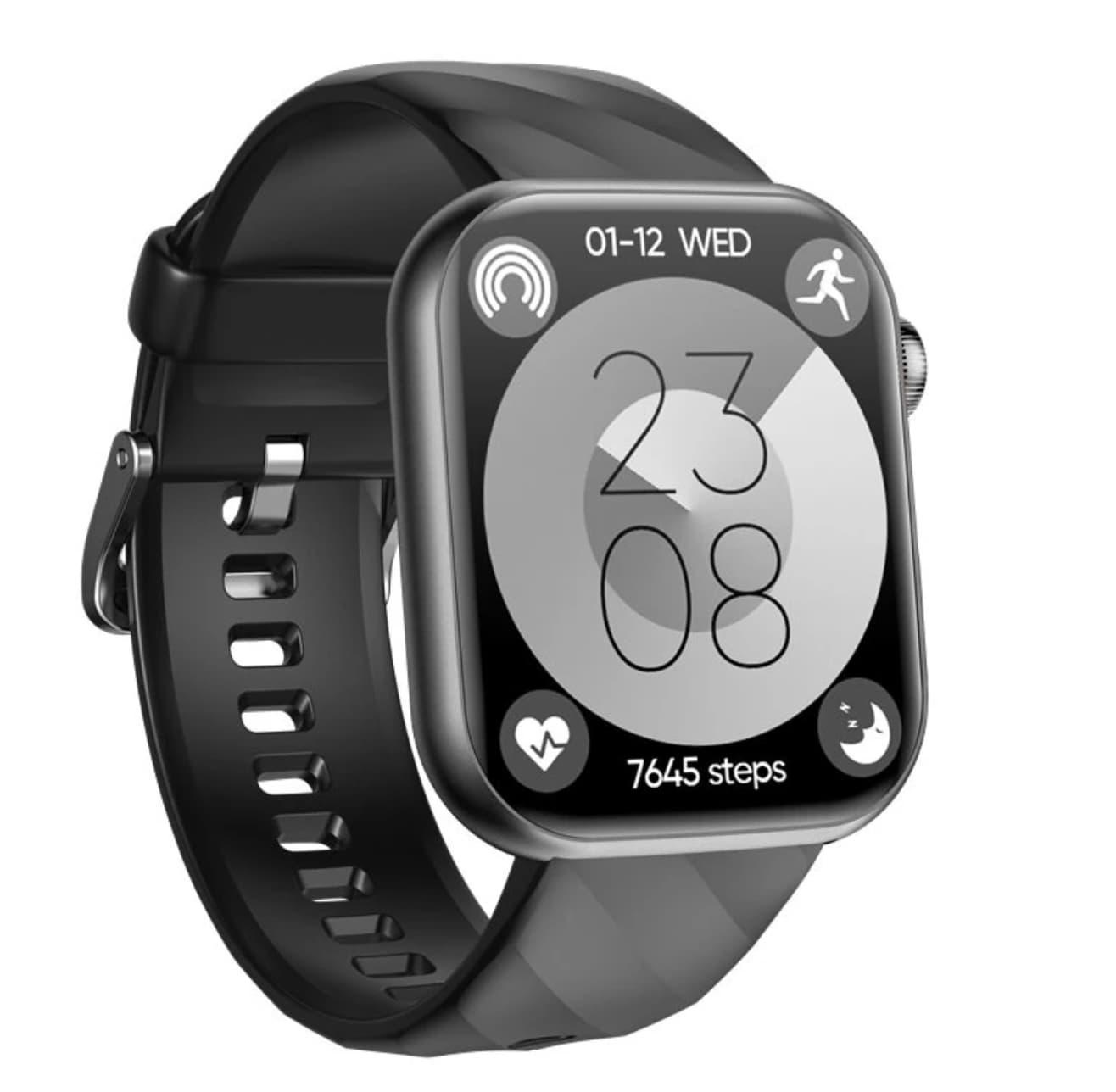
Smartwatches and heart rate monitors can both tell you how fast your heart is beating, but that does not mean they measure the heart in the same way.
An ECG smartwatch can record electrical activity associated with the heartbeat, while a conventional optical heart-rate monitor typically estimates pulse by detecting changes in blood volume beneath the skin. Some wearable devices combine both technologies, which can make the terminology confusing when you’re comparing products.
The distinction becomes particularly important if you’re shopping for a smartwatch because of its health features. A device that displays your heart rate every few seconds is not necessarily capable of recording an ECG, and an ECG-enabled smartwatch is not automatically a replacement for medical monitoring equipment.
So, what is the actual difference between an ECG smartwatch and a heart-rate monitor?
ECG vs Heart Rate Monitoring at a Glance
The simplest distinction is the type of signal being measured.
ECG measures electrical activity generated by the heart.
Optical heart-rate monitoring estimates pulse by detecting changes in blood volume.
Here’s how the two technologies compare:
| Feature | ECG Smartwatch | Optical Heart Rate Monitor |
|---|---|---|
| Main measurement | Electrical activity of the heart | Pulse/heart rate |
| Typical sensor | Electrical electrodes | LEDs and optical sensors |
| Typical output | ECG waveform or rhythm classification | Beats per minute |
| Continuous monitoring | Usually limited compared with optical HR | Common |
| Active recording | Usually required | Often automatic |
| Motion sensitivity | Can be affected by movement | Can be affected by movement |
| Main advantage | Provides electrical heart-rhythm information | Convenient everyday heart-rate tracking |
| Medical replacement | No | No |
The two technologies are therefore complementary rather than simply competing versions of the same feature.
What Is an ECG Smartwatch?
An ECG smartwatch contains electrical sensors that can record changes in electrical potential associated with each heartbeat.
When the heart beats, electrical signals travel through the heart muscle and coordinate its contractions. An ECG records these electrical changes as a waveform.
On many consumer smartwatches, the user completes an electrical circuit by touching a designated electrode on the watch with a finger from the opposite hand. The watch then records the signal for a short period.
The result may be displayed as an ECG waveform and, depending on the device, analyzed for specific rhythm patterns.
However, a smartwatch ECG is generally much more limited than the multi-lead ECG equipment used in clinical settings.
How Does ECG Work on a Smartwatch?
A typical smartwatch ECG measurement works something like this:
- The watch’s rear electrode contacts the wrist.
- The user places a finger on a second electrical contact.
- The body completes the electrical pathway.
- The electrodes detect electrical potential changes.
- The watch records the signal.
- Software processes the recording and may classify the rhythm.
The measurement is therefore fundamentally different from the optical sensor used for routine heart-rate tracking.
Because ECG requires a stable electrical connection, movement can significantly interfere with the recording. The user usually needs to remain still for the measurement to be useful.
What Is a Heart Rate Monitor?
A heart-rate monitor is designed primarily to measure or estimate how quickly the heart is beating.
Modern wearable devices often use photoplethysmography (PPG) for this purpose.
PPG uses light to detect changes in blood volume in tissue. As the heart pumps blood, blood volume in the blood vessels changes. The sensor detects these changes and uses an algorithm to estimate pulse rate.
The result is generally shown as beats per minute (BPM).
For example, a smartwatch might display:
72 BPM
That number tells you the estimated rate of your pulse. It does not provide the same electrical waveform information as an ECG.
How Does Optical Heart Rate Monitoring Work?
The back of a smartwatch typically contains LEDs and light-sensitive components.
The basic process is:
LED light → skin → blood vessels → reflected light → sensor → algorithm → estimated heart rate
The exact hardware and algorithms vary between manufacturers.
Optical heart-rate monitoring has one major practical advantage: it can operate automatically without requiring the user to touch another electrode.
This makes it suitable for continuous tracking throughout the day, including during walking, exercise, sleep, and other activities.
ECG Gives Different Information From Heart Rate
One of the biggest misconceptions is that ECG is simply a more detailed way of displaying heart rate.
If you want to understand how ECG compares with another common smartwatch health feature, read our guide on what ECG and SpO2 mean on a smartwatch, including how both sensors work and what their readings can tell you.
It isn’t.
Heart rate answers a relatively straightforward question:
How fast is the heart beating?
An ECG provides information about:
What electrical pattern is associated with each heartbeat?
Two people can have the same heart rate but different cardiac electrical patterns.
For example, a reading of 70 BPM only tells you the estimated pulse rate. It does not, by itself, describe the full electrical pattern of the heartbeat.
This is why ECG and heart-rate monitoring should be regarded as different measurements.
Why Do Smartwatches Have Both ECG and Heart Rate Sensors?
Some smartwatches include both technologies because they serve different purposes.
For a broader look at the sensors used in modern wearables, explore our guide to smartwatch health tracking and how features such as heart rate, sleep monitoring, and blood oxygen measurement work.
Optical heart-rate monitoring is well suited to frequent or continuous measurements. A smartwatch can use it throughout the day without requiring the wearer to perform a manual test.
ECG, meanwhile, can provide a more specific electrical recording when the user deliberately starts a measurement.
This combination gives a wearable two different ways to collect heart-related information:
- PPG: convenient, frequent heart-rate tracking
- ECG: short electrical recordings for supported rhythm analysis
The sensors may therefore work together rather than replace each other.
Is ECG More Accurate Than a Heart Rate Monitor?
This question sounds simple, but there is no universal “more accurate” answer because the two technologies measure different things.
If the goal is to determine heart rate, an optical sensor can provide a useful measurement without requiring an ECG recording.
If the goal is to record electrical activity associated with the heartbeat, an optical heart-rate sensor cannot perform the same function as an ECG.
Accuracy also depends on the device, sensor design, software, body position, movement, skin contact, and measurement conditions.
In other words, ECG and optical heart-rate monitoring should not be placed on a single accuracy scale when their underlying measurements are different.
Why Can Optical Heart Rate Readings Change During Exercise?
Optical heart-rate monitoring is convenient, but exercise creates challenging conditions for an optical sensor.
During running, cycling, strength training, or other activities, the wrist can move rapidly. The watch may also shift slightly on the skin.
Other factors can include:
- Loose or poorly positioned straps
- Repetitive wrist movement
- Cold skin
- Reduced blood flow at the wrist
- Sweat
- Sensor position
- Differences between individuals
Modern algorithms attempt to reduce these effects, but no optical wrist sensor is completely immune to measurement challenges.
For casual fitness tracking, the resulting data can still be useful. However, users should understand that wearable measurements are not identical to controlled clinical measurements.
Why Can ECG Recordings Be Inconclusive?
An ECG smartwatch also has limitations.
Because the recording is often performed through a small number of electrodes and requires the user to remain relatively still, several factors can interfere with the signal.
An ECG recording may be affected by:
- Movement
- Poor skin contact
- Incorrect finger placement
- Moisture
- A loose watch
- Electrical interference
- Short recording duration
Some devices may therefore produce an “inconclusive” result instead of classifying the rhythm.
This does not necessarily mean something is wrong with the user’s heart. It may simply mean that the watch could not obtain a sufficiently clear signal.
Which One Is Better for Everyday Heart Tracking?
For everyday tracking, optical heart-rate monitoring is generally designed to be more convenient.
A smartwatch can automatically collect heart-rate data while you:
- Walk
- Exercise
- Sleep
- Work
- Rest
- Travel
- Perform everyday activities
There is no need to manually complete an electrical circuit each time.
This makes optical monitoring particularly useful when the goal is to observe changes in heart rate over time rather than record a specific ECG waveform.
When Is an ECG Feature More Useful?
An ECG feature becomes more relevant when you specifically want access to an electrical recording of your heartbeat.
For example, a person may choose to record an ECG when they notice an unusual heartbeat sensation and want to capture a recording that can be reviewed or shared according to the device’s supported functionality.
Some ECG-enabled smartwatches can also analyze recordings for specific rhythm patterns.
However, the exact capabilities vary by device and region.
An ECG feature should therefore be evaluated based on the specific functions offered by the smartwatch rather than simply assuming that every ECG watch provides the same health information.
Can an ECG Smartwatch Detect Irregular Heart Rhythms?
Some ECG-enabled smartwatches can analyze recordings for certain irregular rhythm patterns.
One commonly discussed example is atrial fibrillation (AFib).
Depending on the device and applicable regulatory authorization, the smartwatch may identify a pattern that is potentially consistent with AFib and notify the user.
But this is not the same as diagnosing every possible heart condition.
A smartwatch ECG is based on a limited recording compared with the diagnostic tools available in a medical setting. A normal result also does not guarantee that no heart-related problem exists.
The device’s intended use, regulatory status, and limitations should always be considered.
Can a Heart Rate Monitor Detect the Same Things as ECG?
Not in the same way.
An optical heart-rate monitor can identify changes in pulse rate and, depending on the device, may detect patterns in pulse data.
However, PPG does not directly record the heart’s electrical activity.
This is a fundamental technical difference.
Think of it this way:
PPG observes the cardiovascular pulse signal through changes in blood volume.
ECG records electrical signals associated with the heart’s activity.
The resulting data can overlap in some ways, but they are not interchangeable.
ECG Smartwatch vs Chest Strap Heart Rate Monitor
There is another important distinction worth making.
Not every “heart rate monitor” is an optical wrist sensor.
Chest-strap heart-rate monitors can use electrical sensing technology to detect cardiac signals and are widely used for exercise tracking.
A chest strap and an ECG smartwatch may therefore both use electrical signals, but their design, purpose, sampling, algorithms, and intended applications can still differ.
For athletes, chest straps are often designed around real-time exercise heart-rate data and can maintain a stable connection with the torso during movement.
An ECG smartwatch, by contrast, is typically designed as a broader wearable device with health, communication, fitness, and lifestyle functions.
So the comparison is not simply:
ECG = accurate
heart-rate monitor = less accurate
The technology and intended use matter much more than the product category name.
What About Smart Rings and Other Wearables?
The same distinction applies beyond smartwatches.
Smart rings, fitness bands, chest straps, and other wearable devices can use different combinations of optical and electrical sensors.
Some focus heavily on continuous heart-rate tracking, while others add ECG capabilities or other physiological measurements.
When comparing devices, look beyond phrases such as “advanced health monitoring.”
Check exactly what the device measures and how it collects the data.
A product description that says “heart monitoring” does not necessarily mean that it includes ECG.
ECG vs Heart Rate Monitor for Fitness
For exercise, the right technology depends on what information you need.
If you mainly want to know your current heart rate during a workout, continuous optical monitoring can be convenient.
If you need highly responsive exercise heart-rate data, particularly for structured training, a dedicated chest-strap monitor may be more appropriate depending on the activity and equipment.
ECG is generally not designed to provide continuous workout heart-rate tracking in the same way.
Instead, its strength is recording electrical heart activity during a deliberate measurement.
What Should You Look for When Buying an ECG Smartwatch?
If ECG is one of your main reasons for buying a smartwatch, don’t stop at the word “ECG” on the product page.
If you’re comparing ECG-enabled models before buying, browse our smartwatch reviews for detailed information on health sensors, battery life, displays, connectivity, and everyday performance.
Check the following:
1. ECG Availability
Confirm that the exact model actually includes electrical ECG electrodes.
2. Regional Support
Health-related features can vary by country or region because regulatory authorization and software availability differ.
3. Supported ECG Functions
Find out what the ECG feature is designed to detect or classify.
4. Recording Process
Check how long a measurement takes and whether you need to touch a specific electrode.
5. Health App
Consider how ECG results are stored, displayed, exported, or shared.
6. Other Sensors
If you want continuous health tracking, check whether the watch also includes optical heart rate, SpO₂, sleep tracking, temperature sensing, or other relevant sensors.
7. Battery Life
Frequent health monitoring can influence battery consumption, so battery life remains important even if ECG is the feature that initially attracted your attention.
What Should You Look for in a Heart Rate Monitor?
If heart-rate tracking is your priority, consider the type of sensor rather than simply the brand.
For a smartwatch or fitness band, look at:
- Optical sensor design
- Continuous monitoring options
- Exercise tracking
- Workout modes
- Data presentation
- Phone compatibility
- Battery life
- Strap fit
- Companion app
For dedicated training, also consider chest-strap monitors and whether the device supports the connection standards used by your fitness equipment or apps.
Are ECG Smartwatches Medical Devices?
Not necessarily.
A smartwatch is a consumer electronic product, and the intended use of an individual health feature depends on the manufacturer, device, software, and regulatory authorization.
Some smartwatch ECG functions have been authorized for specific purposes in certain markets. Other health features may be intended for wellness or informational use.
Therefore, don’t assume that an ECG icon automatically means the entire smartwatch is a medical device.
Always check the official documentation for the specific model.
Should You Trust a Smartwatch Heart Reading?
Smartwatch health data can be useful, but it needs to be interpreted appropriately.
A wearable can help you observe patterns and changes over time. It may also provide information that you can discuss with a healthcare professional.
However, a smartwatch should not be used as the sole basis for diagnosing a medical condition.
If you receive an unusual result, consider whether the measurement conditions could have affected the reading. If unusual readings persist or you experience concerning symptoms, appropriate medical evaluation is more important than relying on repeated smartwatch measurements.
ECG Smartwatch vs Heart Rate Monitor: Which One Do You Need?
The choice ultimately depends on the information you want.
An optical heart-rate monitor is designed primarily for convenient and frequent heart-rate tracking. It works well for everyday activity, fitness monitoring, and observing heart-rate trends.
An ECG smartwatch adds the ability to record electrical activity associated with the heartbeat. This can provide information that a standard optical heart-rate reading cannot provide.
For many users, these technologies are not alternatives at all. A smartwatch can contain both, allowing continuous optical monitoring alongside occasional ECG recordings.
The important thing is to understand what each measurement actually represents.
Heart rate tells you how fast the pulse is. ECG provides information about electrical activity. Neither measurement, by itself, provides a complete assessment of heart health.
Once that distinction is clear, comparing smartwatches and heart-rate monitors becomes much easier—and you can choose based on the type of information you actually need rather than the number of health features listed on the box.