










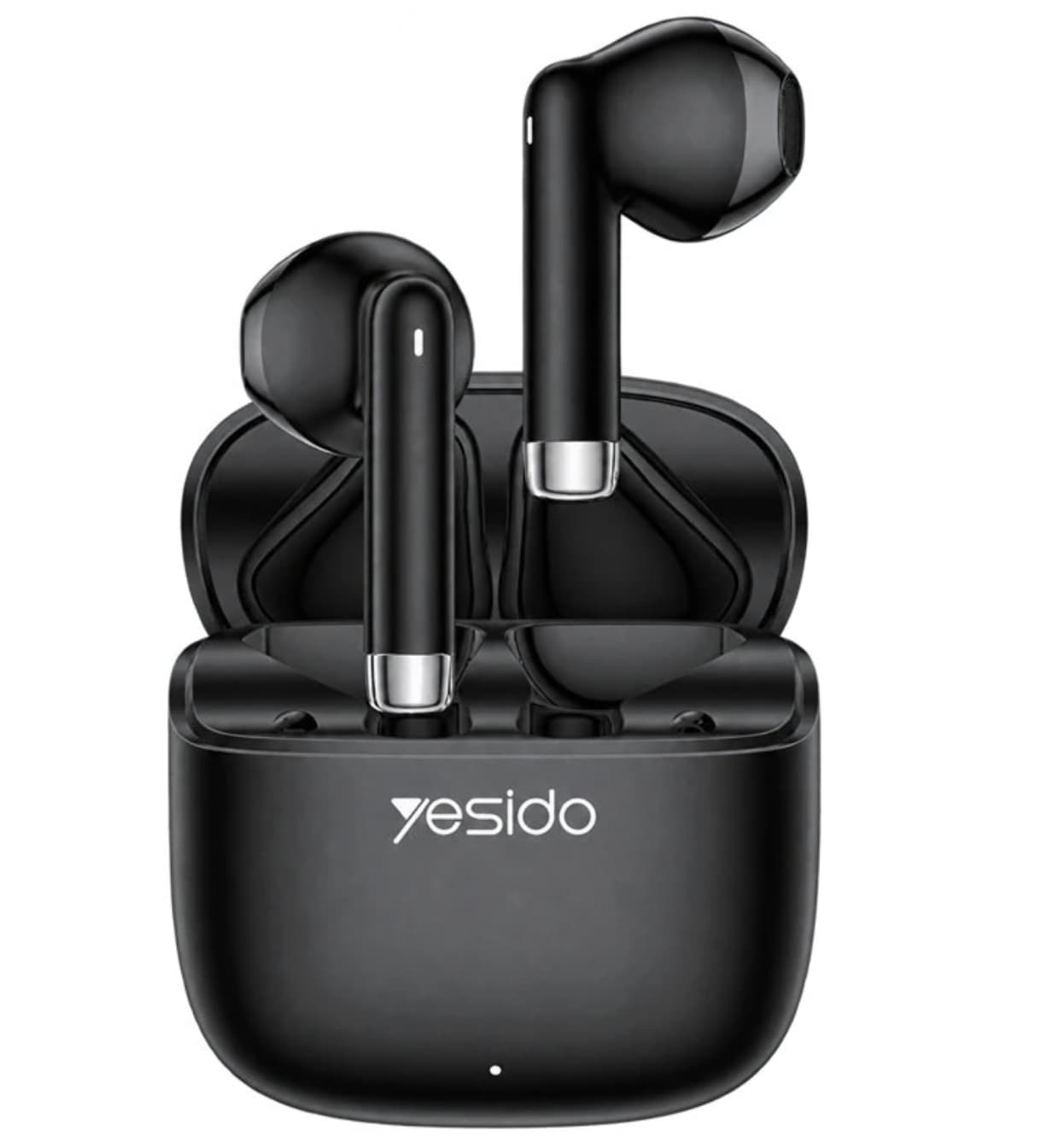
The wireless earbud market has largely settled into two familiar designs: sealed in-ear models with silicone tips and open or semi-in-ear earbuds that sit more lightly in the ear. If you’re comparing different types of wireless earbuds, our guide to the best wireless earbuds can help explain the differences between in-ear, semi-in-ear, and open-ear designs. The YESIDO TWS48 earphone chooses the second approach, pairing a semi-in-ear fit with a relatively large 13mm dynamic driver, Bluetooth 6.0, touch controls, and a compact charging case.
That combination makes the TWS48 more interesting than a specification list might initially suggest.
Rather than trying to compete through a long list of premium features, YESIDO has focused on a few practical areas: a less intrusive wearing style, wireless connectivity, everyday audio, hands-free calls, and easy controls. The official Banggood listing specifies a 10-meter transmission range, 20Hz–20kHz frequency response, 30mAh batteries in the earbuds, and a 200mAh charging case.
The result is a pair of true wireless earbuds aimed primarily at people who want something simple enough for daily use without the enclosed feeling of conventional silicone-tip earphones.
The Most Important Feature Is Not Bluetooth 6.0
For the TWS48, the semi-in-ear design arguably matters more than the Bluetooth version.
A conventional in-ear earbud creates a seal by placing a silicone tip inside the ear canal. That can help with passive noise isolation and can make low frequencies sound more pronounced, but not everyone enjoys the pressure or sensation of having an ear tip inserted into the ear.
The TWS48 takes a different route.
Its housing is designed to rest around the ear canal rather than forming the same type of deep seal. This can make the format attractive for people who listen for extended periods, work at a desk, walk outdoors, or simply dislike the sensation of sealed earbuds.
There is a trade-off, however. A semi-in-ear earbud generally does not isolate external noise as strongly as a sealed in-ear model. The TWS48 therefore makes more sense for listeners who value a lighter, more open wearing experience than for someone whose first priority is maximum noise isolation.
YESIDO also specifies a directional sound-guiding chamber intended to focus the audio toward the ear and reduce sound leakage.
What the 13mm Driver Tells Us
The TWS48 uses a 13mm dynamic moving-coil driver, which is one of the more notable specifications on the product sheet.
Driver diameter alone does not tell us exactly how an earbud will sound. Tuning, enclosure design, positioning, signal processing, and the fit inside the listener’s ear all contribute to the final result.
Still, a 13mm driver gives the TWS48 a substantial piece of hardware for a compact semi-in-ear earbud.
YESIDO lists a 20Hz to 20kHz frequency response and an impedance of 32Ω ±15%. That published frequency range covers the conventional range associated with human hearing and makes the TWS48 suitable in principle for everything from podcasts and spoken content to music and video.
It is better to interpret these numbers as an indication of the product’s intended audio range rather than as proof of a particular sound signature.
For shoppers, the more useful takeaway is that the TWS48 is not built solely as a basic hands-free calling headset. Its hardware is intended for general-purpose listening as well.
Bluetooth 6.0: Useful, but Not the Whole Story
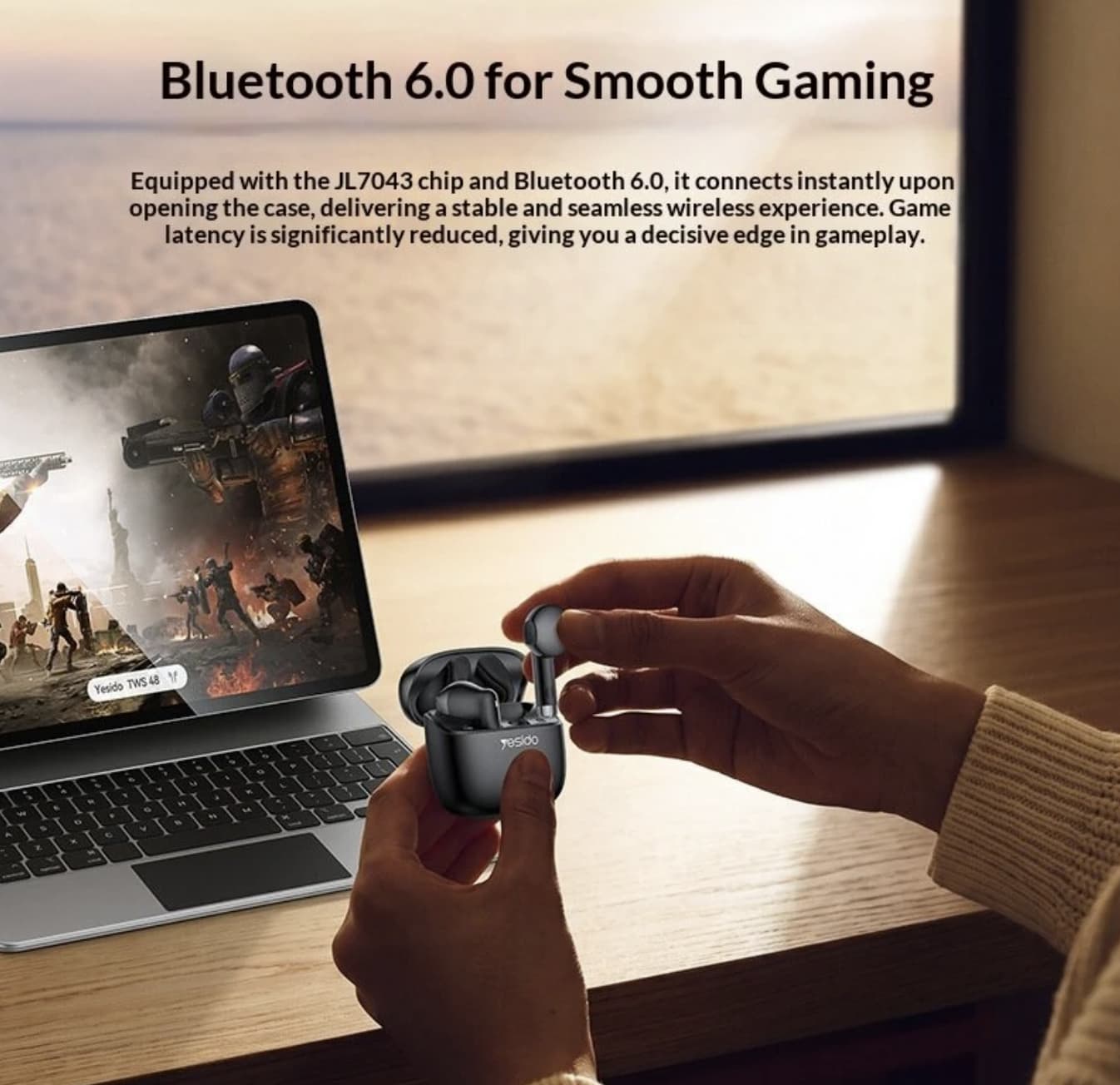
The TWS48 uses a JL7043 chip and Bluetooth 6.0. For a broader look at how Bluetooth connectivity affects wireless audio devices, see our guide to Bluetooth headphones and earbuds. YESIDO lists a transmission distance of up to 10 meters and support for HSP, HFP, A2DP, and AVRCP Bluetooth profiles.
Those profiles cover the basic functions most people expect from a wireless headset:
- Music and other media playback
- Hands-free calling
- Voice communication
- Remote media controls
The listing also promotes low-latency performance for gaming and video.
That can be useful, but latency is influenced by more than the Bluetooth version itself. The phone, computer, operating system, application, wireless environment, and implementation of the connection can all affect synchronization.
So the TWS48 is better viewed as an everyday Bluetooth 6.0 headset with a low-latency design goal rather than assuming that every game or video application will deliver identical results.
Automatic Pairing Is a Small Feature That Matters
One of the more practical details in the TWS48 specification is automatic pairing when the charging case is opened.
This is the kind of feature that does not look impressive in a product advertisement but can make wireless earbuds considerably easier to live with.
Most people do not want to think about Bluetooth every time they use their earbuds. The ideal routine is simple: open the case, put the earbuds on, and start listening.
For commuters, office workers, students, and anyone who uses earbuds several times a day, reducing those small steps can make the overall experience more convenient.
Directional Sound Gives the Semi-In-Ear Design a Purpose
The TWS48’s directional sound transmission is worth looking at separately because it addresses one of the challenges associated with semi-in-ear earbuds.
Without a strong physical seal, audio can potentially escape from the earbud more easily. YESIDO says its directional sound-guiding chamber is designed to direct sound toward the ear while limiting leakage.
In practical terms, the idea is straightforward: instead of relying entirely on a sealed ear canal, the earbud uses its acoustic structure to make the sound path more focused.
This complements the semi-in-ear design.
The goal is not to turn the TWS48 into an isolated studio monitor. Instead, it attempts to combine a more relaxed fit with a controlled sound path.
Because the current Banggood listing does not provide independent measurements of sound leakage, it would be inappropriate to treat the manufacturer’s leakage-reduction claim as a laboratory result. It is best understood as part of the product’s stated design.
Touch Controls Are Built for Movement
The TWS48 uses touch controls rather than requiring the listener to reach for a phone for basic operations.
The listed controls cover music playback, track switching, answering or rejecting calls, and activating a voice assistant.
That makes particular sense for the product’s intended everyday scenarios.
Imagine listening while walking and needing to pause a podcast. Or receiving a call while your phone is inside a backpack. Or changing a track during a workout.
In those situations, touch controls are more convenient than opening a smartphone.
They also avoid the physical pressing force associated with traditional buttons, which can be useful with a semi-in-ear design that does not lock into the ear as firmly as a sealed earbud.
Calls Are Part of the TWS48’s Practical Appeal
YESIDO includes a microphone and markets the TWS48 for HD calling, online meetings, and voice chats.
That gives the earbuds a broader role than simply playing music.
For many users, the ideal wireless earbuds are the ones that can handle several parts of the day without switching devices: music during a commute, a video during a break, a meeting at work, and a phone call later.
The TWS48 fits that general use case.
However, the listing does not provide independent microphone measurements or detailed background-noise testing. Therefore, claims about call clarity should be treated as manufacturer specifications rather than evidence of flagship-level voice isolation.
That distinction is particularly important if you regularly take calls in airports, busy streets, or crowded offices.
Five Hours of Playback: What Does That Actually Mean?
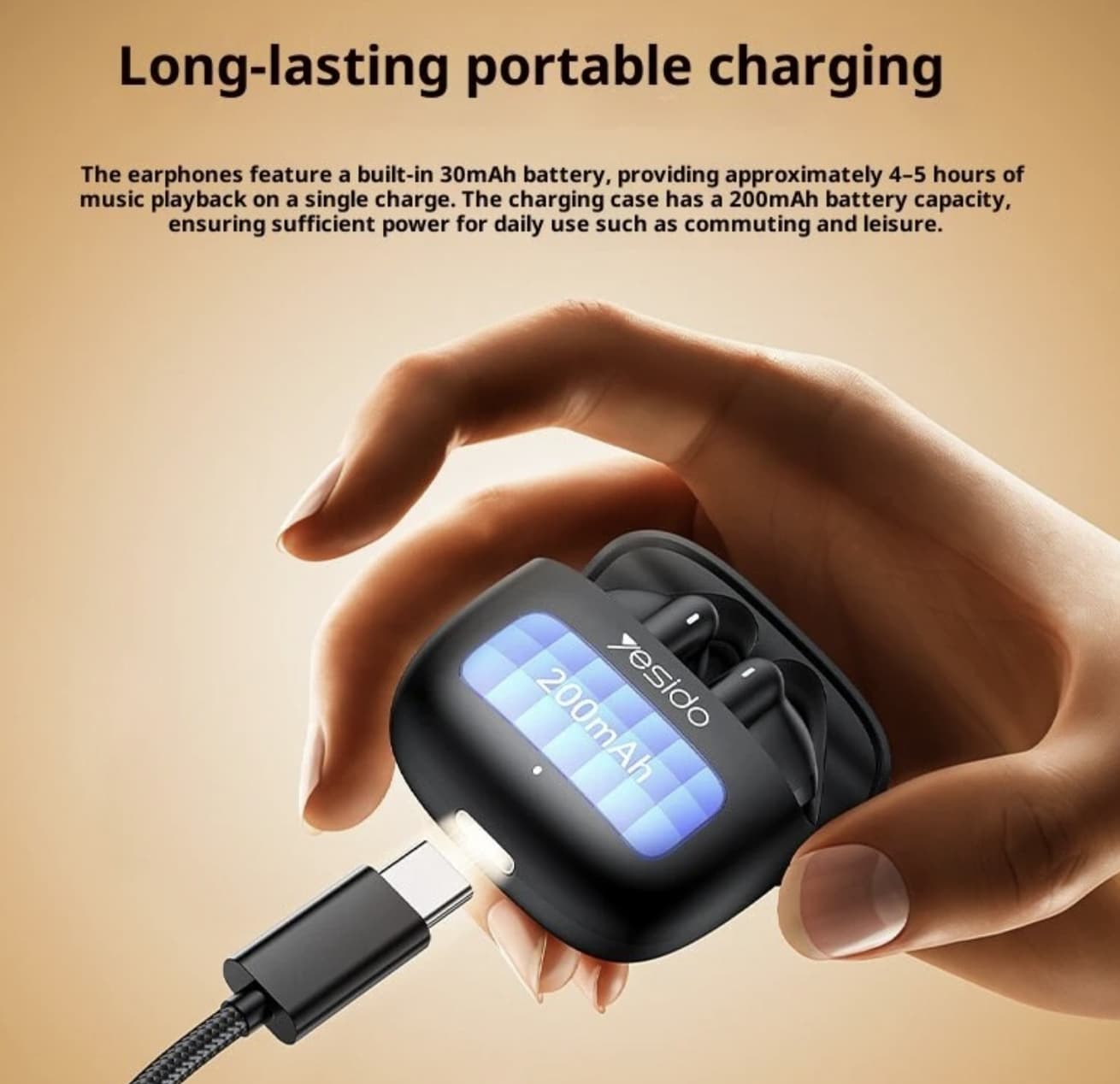
The TWS48 has a 30mAh battery in each earbud and a 200mAh charging case. YESIDO lists up to 5 hours of music playback, 3 hours of call time, and 25 hours of standby time. Charging is listed at approximately one hour.
Five hours is not an unusually high single-charge figure by current TWS standards, but the right way to assess it depends on how you use earbuds.
Someone listening continuously for most of a workday may want a model with longer single-charge endurance.
For shorter sessions, however, five hours can cover a commute, several meetings, a workout, or an evening of casual listening. Returning the earbuds to their case between sessions also changes how useful the total battery capacity feels in everyday life.
As always, the manufacturer’s playback figure should be treated as a claimed maximum. Volume level, calling, connection conditions, and other factors can change actual runtime.
Small Enough to Disappear Into a Pocket
The TWS48 has a listed product weight of approximately 31 grams and measures 46 × 48 × 25mm.
Those dimensions reinforce its role as a portable everyday accessory.
A charging case that can easily fit into a pocket or small compartment is important because convenience is one of the biggest reasons people choose TWS earbuds over larger headphones.
The TWS48 also comes with two earbuds, the charging case, a USB cable, and a manual according to the current package list.
YESIDO TWS48 Specifications
| Feature | YESIDO TWS48 |
|---|---|
| Model | TWS48 |
| Wearing style | Semi-in-ear |
| Driver | 13mm dynamic moving coil |
| Impedance | 32Ω ±15% |
| Frequency response | 20Hz–20kHz |
| Bluetooth version | 6.0 |
| Bluetooth chip | JL7043 |
| Supported profiles | HSP / HFP / A2DP / AVRCP |
| Transmission range | Up to 10m |
| Earbud battery | 30mAh each |
| Charging case | 200mAh |
| Claimed music playback | Up to 5 hours |
| Claimed call time | Up to 3 hours |
| Claimed standby time | Up to 25 hours |
| Charging time | About 1 hour |
| Microphone | Yes |
| Controls | Touch |
| Product weight | About 31g |
| Product dimensions | 46 × 48 × 25mm |
Specifications are based on the current Banggood product listing.
Who Should Consider the YESIDO TWS48?
The TWS48 makes the most sense for a particular type of listener.
If you dislike silicone ear tips but still want true wireless convenience, the semi-in-ear construction is probably the first specification to look at.
It is also relevant if your daily listening involves a mixture of music, video, calls, and voice content rather than one specialized task.
The feature combination is especially suited to:
- Commuting and everyday travel
- Office and desk use
- Casual music listening
- Watching videos
- Phone calls and online meetings
- Walking and light exercise
- Users who dislike deep-fitting earbuds
The TWS48 is less obviously suited to someone whose main requirement is aggressive noise isolation, because the product uses a semi-in-ear design rather than a sealed silicone-tip structure.

What the TWS48 Does Not Offer
A useful product review should also explain what is missing.
The current listing does not specify active noise cancellation, so the TWS48 should not be positioned as an ANC earbud. If noise reduction is one of your priorities, our comparison of ANC earbuds vs regular wireless earbuds explains what you gain and what you give up with active noise cancellation.
There is also no published independent frequency-response graph, microphone test, distortion measurement, or laboratory battery test on the listing. That means specifications such as the 20Hz–20kHz response and five-hour playback figure should not be turned into claims about measured performance.
The product page currently shows zero customer reviews, so there is also no meaningful user-review dataset from Banggood that can be used to establish long-term comfort, durability, or real-world battery performance.
That is actually useful information for potential buyers: the TWS48 can be evaluated from its design and published specifications, but real-world ownership feedback is currently limited on the listing.
The TWS48 Is About the Combination, Not One Big Number
The most interesting thing about the YESIDO TWS48 is that none of its individual specifications completely defines the product.
Bluetooth 6.0 provides the wireless foundation. The 13mm driver addresses audio reproduction. The semi-in-ear shape changes the wearing experience. Directional sound transmission attempts to make that open design more practical. Touch controls reduce interaction with the phone, while the microphone expands the earbuds into a general communication device.
Together, these features create a fairly coherent product.
The TWS48 is essentially designed around the idea that everyday earbuds should be comfortable enough to keep wearing and simple enough to forget about.
That is a different proposition from competing primarily on ANC strength, audiophile tuning, or extreme battery life.
Final Verdict: A Practical Semi-In-Ear Alternative
YESIDO TWS48 is a straightforward wireless earbud for people who prefer a semi-in-ear fit and want the basic conveniences expected from a modern TWS headset.
Its combination of a 13mm dynamic driver, Bluetooth 6.0, directional sound transmission, touch controls, microphone support, and compact charging case gives it a clear everyday-use identity.
The most important consideration is therefore not whether Bluetooth 6.0 or a 13mm driver sounds impressive on paper. It is whether the semi-in-ear wearing style matches your preferences.
If you prefer a lighter, less sealed fit and mainly need earbuds for music, video, calls, commuting, and general daily use, the TWS48’s specifications are well aligned with those needs.
If maximum isolation, ANC, or very long uninterrupted playback is more important, its design points toward a different category of earbuds.
That makes the TWS48 a product worth evaluating on fit and intended use, rather than simply comparing specification numbers with premium in-ear models.