









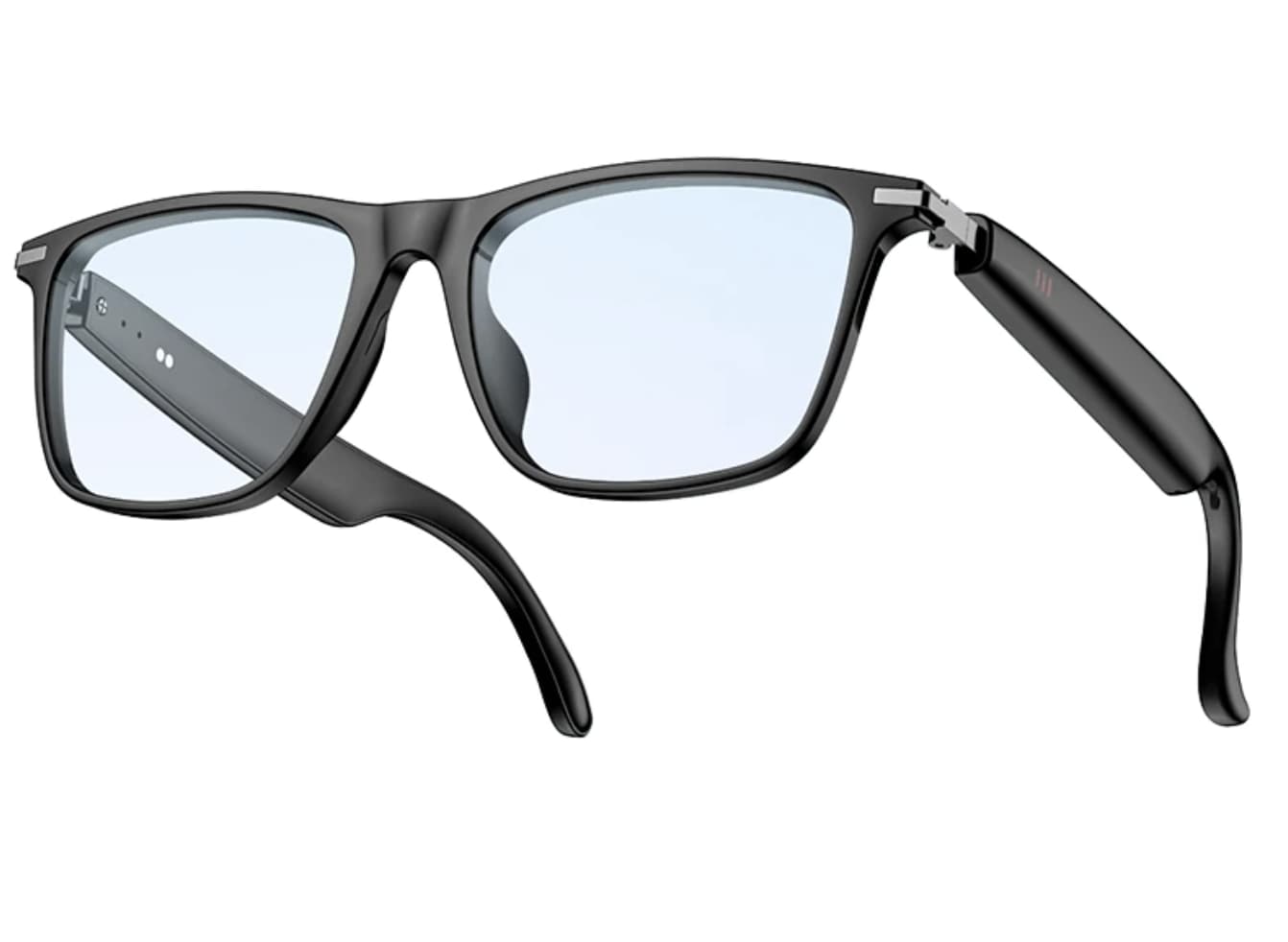
Smart glasses don’t have to include cameras, augmented-reality displays, or an AI assistant to be useful. The LOKMAT M01 takes a much simpler approach: it combines a familiar glasses frame with open-ear audio, Bluetooth connectivity, hands-free calling, and a lightweight design.
That makes the M01 interesting for a different reason.
Instead of trying to replace your phone or turn your glasses into a miniature computer, it attempts to solve a much more ordinary problem: how can you listen to audio without putting earbuds inside your ears?
The answer sounds straightforward, but there are trade-offs. Open-ear audio changes the way sound is perceived, background noise becomes part of the experience, and sound leakage can matter depending on where you use the glasses.
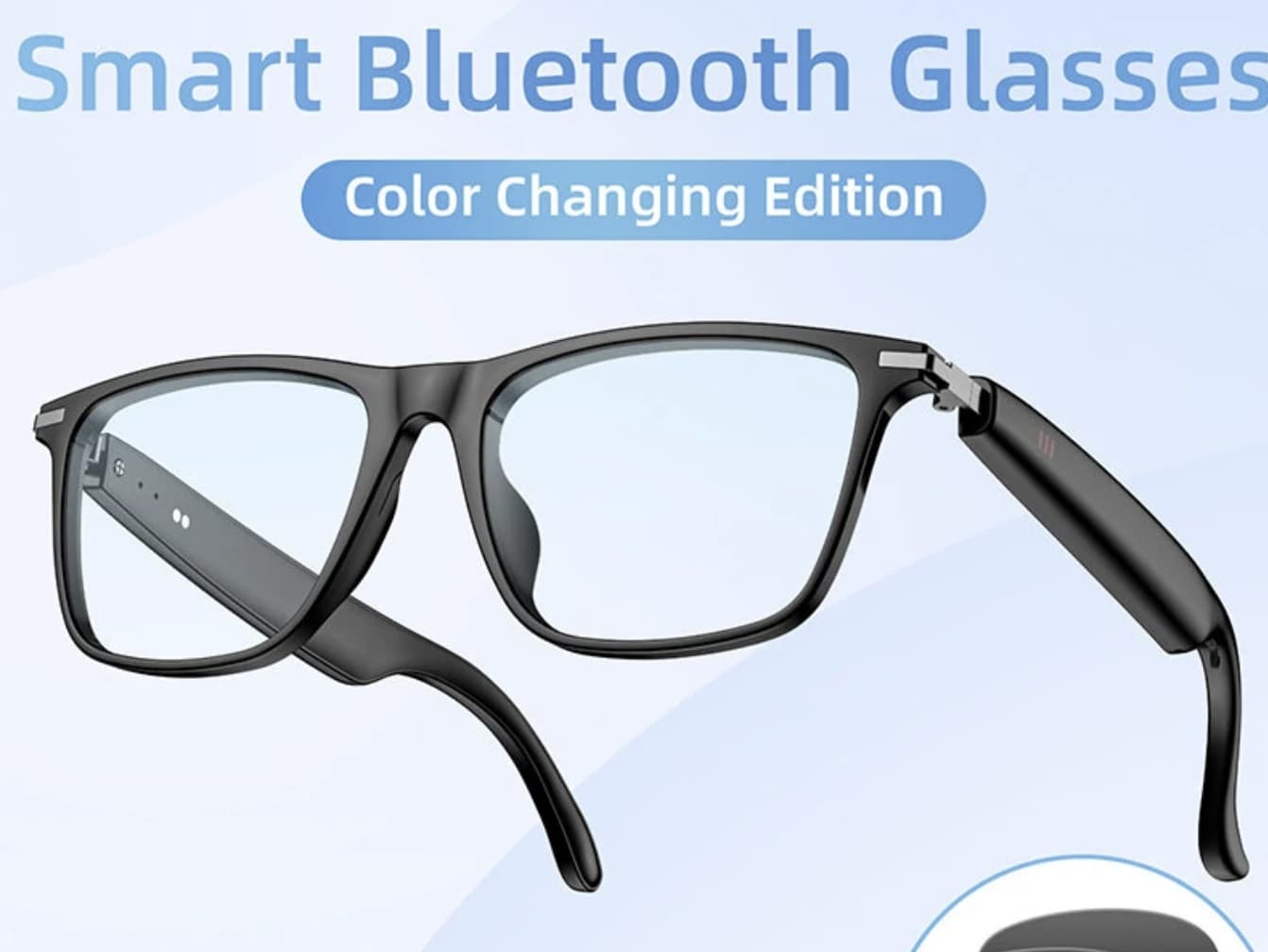
So the real question isn’t whether the LOKMAT M01 has enough features.
It’s whether those features make sense as an alternative to conventional wireless earbuds.
The M01 Is Really an Audio Device Disguised as Eyewear
The first thing to understand about the LOKMAT M01 is that its value isn’t based on turning ordinary glasses into a futuristic gadget.
Its appeal comes from combining two things people already use every day: eyewear and wireless audio.
That creates an interesting advantage.
If you already wear glasses regularly, adding audio functionality to the frame doesn’t require you to put another device in your ears.
This makes the M01 potentially useful for situations where traditional earbuds aren’t ideal.
You can listen to music, podcasts, navigation instructions, or calls while keeping your ear canals uncovered.
That difference is much more meaningful than simply calling the M01 “smart glasses.” For readers interested in a more feature-heavy approach, our DT NO.1 E06S smart glasses review explores smart eyewear with AI-focused functions and additional hardware features.

Open-Ear Audio Is the Main Reason to Consider It
Traditional TWS earbuds place their speakers directly inside or near the ear canal.
The M01 takes the opposite approach.
Its audio system is designed to deliver sound without sealing the ear canal, allowing users to remain more aware of surrounding sounds than they would with conventional in-ear earbuds.
That can be useful when walking, commuting, working at a desk, or performing other activities where completely blocking outside sound isn’t desirable.
However, open-ear audio shouldn’t automatically be described as safer.
Being able to hear environmental sounds doesn’t remove the need to pay attention to traffic, cyclists, machinery, or other hazards.
The advantage is simply that the glasses don’t require you to completely isolate your ears from the surrounding environment.
Can the M01 Replace Your Earbuds?
This depends heavily on how you use earbuds.
For casual listening, the M01 can make a compelling alternative.
Imagine listening to a podcast while walking around the city. Instead of inserting earbuds before leaving home, you simply put on the glasses.
For short calls, the same idea applies.
The glasses are already sitting on your face, so audio functionality becomes part of something you’re already wearing.
But there are situations where traditional TWS earbuds remain better.
If you want strong bass, maximum isolation, immersive music playback, or private listening in a noisy environment, in-ear earbuds still have significant advantages. For a closer look at conventional wireless alternatives, see our TWS earbuds reviews to compare different approaches to everyday audio.
That makes the M01 better described as an alternative audio format, rather than a universal replacement for earbuds.
The Sound Experience Has a Different Character
Open-ear audio and in-ear audio aren’t supposed to sound identical.
A sealed earbud can create a more isolated listening environment, making it easier to reproduce low frequencies and detailed music.
Open-ear audio takes a more relaxed approach.
Some of the sound mixes naturally with the surrounding environment, which can make listening feel less isolated.
This is particularly suitable for spoken content.
Podcasts, audiobooks, navigation instructions, and casual video playback don’t necessarily require the same level of isolation as music.
Music listeners may notice the difference more quickly, especially if they prefer strong bass or a highly immersive presentation.
So the M01’s audio design is better matched to convenience and awareness than audiophile-style listening.
Why the Glasses Format Makes Sense
The most interesting part of the M01 isn’t actually the speaker technology.
It’s the fact that the speakers are integrated into something you may already wear.
That changes the interaction model.
With earbuds:
Take them out → put them in → connect → listen → remove them → put them away.
With audio glasses:
Put on the glasses → listen.
That sounds like a small difference, but it can become useful throughout the day.
For example, someone who frequently moves between conversations and short periods of audio may find glasses more convenient than repeatedly inserting and removing earbuds.
Lightweight Construction Matters More Than It Seems
Because the M01 combines eyewear with electronics, weight becomes an important consideration.
A pair of smart glasses can have excellent audio and still be uncomfortable if the frame creates too much pressure around the ears or nose.
The M01 is designed around a lightweight form factor, making everyday wear one of the product’s more important considerations.
This matters especially if the glasses are going to be worn for several hours.
The ideal experience is for the user to gradually forget that the electronics are there.
That’s a much better measure of wearable design than simply counting features.
Everyday Comfort Is Different From Short-Term Comfort
A five-minute test isn’t enough to judge glasses.
The frame may feel perfectly comfortable initially but become noticeable after several hours.
Weight distribution matters.
So does the shape of the temples, nose bridge, and contact points around the ears.
The M01 therefore makes the most sense for users who want a wearable audio device rather than people who are only interested in maximum sound quality.
Its success depends partly on whether the frame remains comfortable during extended use.
Bluetooth Connectivity Keeps the Experience Simple
Wireless audio glasses need reliable communication with a smartphone.
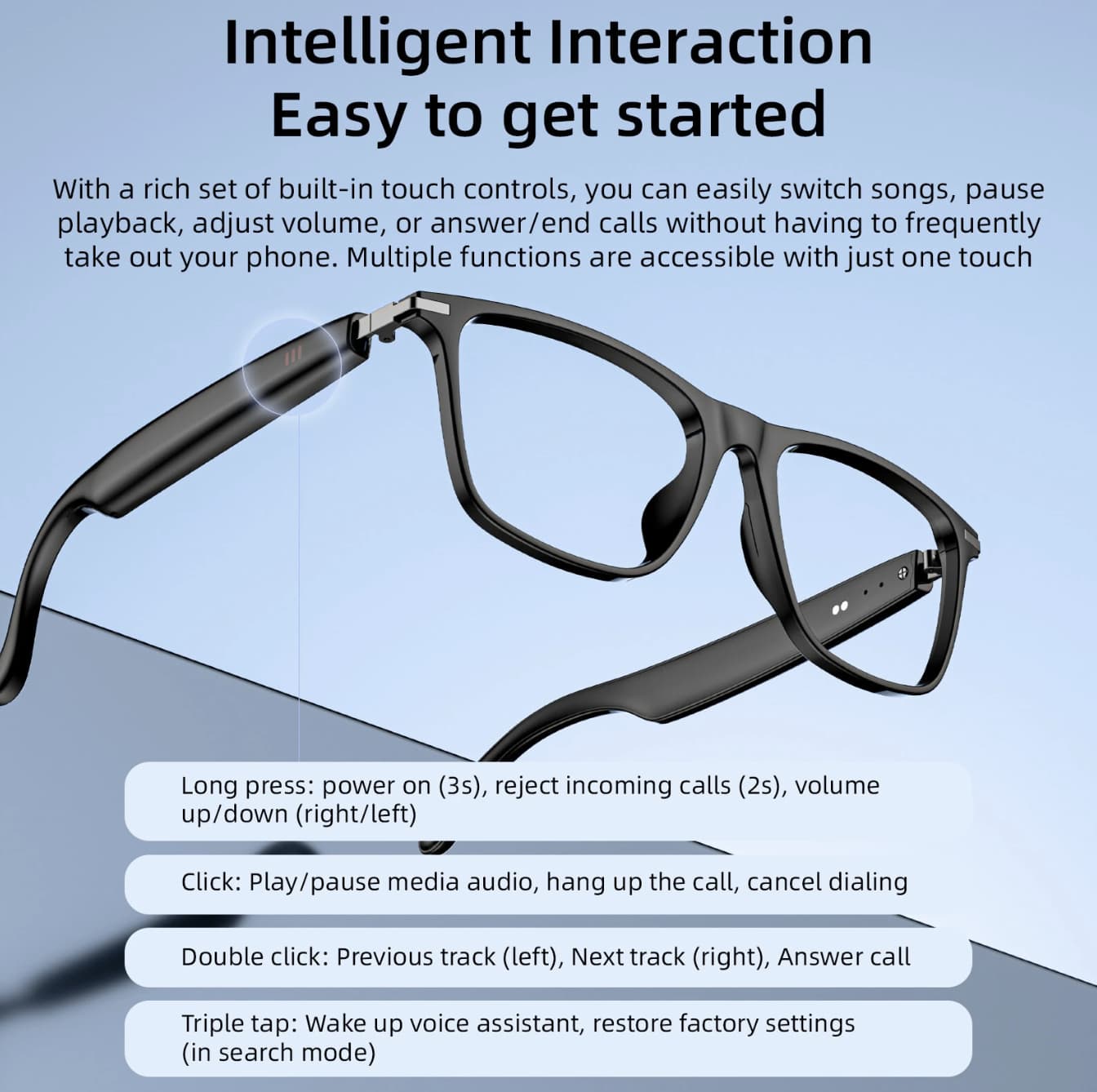
The M01 uses Bluetooth connectivity to handle audio playback and calls, allowing the phone to remain in a pocket or bag while the glasses handle the listening side.
This is one of those features that shouldn’t receive too much attention when it works properly.
Bluetooth isn’t the reason to buy the M01.
It’s the infrastructure that allows the rest of the concept to work.
For everyday users, what matters more is whether the connection remains stable when moving between rooms, walking outdoors, or carrying the phone in a pocket.
Hands-Free Calls Are a Natural Fit
Calling is arguably one of the more logical applications for audio glasses.
A traditional phone call requires holding the phone or using earbuds.
The M01 puts the audio hardware directly on the face, making hands-free communication more natural.
This can be useful while working at a desk, walking, or completing routine tasks.
Again, the M01 isn’t trying to make phone calls more technologically impressive.
It’s making them less dependent on another accessory.
The M01 Makes More Sense for Podcasts Than Bass-Heavy Music
This is an important distinction.
If your listening habits are primarily:
- podcasts
- audiobooks
- voice messages
- navigation
- online videos
- casual music
the open-ear concept makes considerable sense.
If your priority is:
- deep bass
- maximum detail
- strong passive isolation
- loud private listening
- immersive music
traditional earbuds are still likely to be the better solution.
That doesn’t make the M01’s audio system inferior.
It means the two formats prioritize different things.
Outdoor Use Is Where the Concept Becomes Interesting
The M01 is particularly suited to activities where you want some combination of audio and environmental awareness.
Walking is an obvious example.
You can listen to a podcast or music without completely isolating yourself from the world around you.
Cycling and other outdoor activities require more caution. Open-ear audio doesn’t eliminate distractions, and users should always prioritize awareness of traffic and local safety rules.
The important point is that the M01’s design makes ambient awareness part of the listening experience, rather than something the user has to sacrifice for audio.
Smart Glasses Without the Complexity
Many products marketed as smart glasses attempt to do several things at once.
They may include cameras, displays, voice assistants, translation functions, or other connected features.
The M01 takes a narrower approach.
That can actually be an advantage.
Fewer functions can mean a simpler product concept.
Instead of learning an entirely new wearable platform, the user mainly interacts with the glasses as eyewear and a Bluetooth audio device.
For someone who doesn’t need a camera or display, that simplicity can be appealing. If you want smart glasses with a stronger focus on eyewear features, our Lenovo GL2 smart glasses review looks at a different approach combining open-ear audio with photochromic lenses.
Where the M01 Works Best
Daily Commuting
The glasses can provide music, podcasts, and calls without requiring conventional earbuds.
Walking
Open-ear audio provides a less isolated listening experience.
Office Work
Hands-free audio can be useful while keeping the ears physically unobstructed.
Casual Listening
Podcasts, audiobooks, and spoken content are natural applications.
People Who Dislike In-Ear Earbuds
This may be one of the strongest target audiences for the M01.
If you don’t enjoy the pressure or sensation of earbuds inside your ears, an audio-enabled glasses frame provides a completely different approach.
Where Traditional Earbuds Still Win
The M01 shouldn’t be treated as a replacement for every pair of TWS earbuds.
Traditional earbuds remain better suited to users who prioritize:
Isolation:
In-ear designs can block much more outside noise.
Bass:
A sealed ear canal generally provides a stronger foundation for low-frequency reproduction.
Privacy:
Open-ear speakers can potentially be heard by people nearby, particularly at higher volume.
Compact storage:
Earbuds can be removed and placed inside a small charging case.
These are meaningful advantages.
The M01 wins through convenience, not by eliminating every limitation of earbuds.
The Biggest Trade-Off: Sound Leakage
Open-ear audio naturally creates a privacy trade-off.
When the speaker isn’t sealing the ear canal, some sound can potentially escape into the surrounding environment.
How noticeable that is will depend on volume, distance, background noise, and the specific acoustic implementation.
This isn’t necessarily a problem while walking outdoors.
It can matter more in a quiet office, library, classroom, or shared workspace.
Users who frequently listen to private content should keep this limitation in mind.
Who Should Buy the LOKMAT M01?
The M01 is a good fit for someone who:
- already wears glasses regularly
- dislikes traditional in-ear earbuds
- prefers open-ear listening
- frequently listens to podcasts or spoken content
- wants hands-free calling
- values convenience over maximum audio isolation
- wants a simple wearable audio solution
Who Should Skip It?
Consider traditional TWS earbuds instead if you:
- want powerful bass
- need strong noise isolation
- listen to music in very noisy environments
- require maximum privacy
- don’t normally wear glasses
- want the smallest possible audio accessory
The M01 isn’t trying to beat earbuds at everything.
Its purpose is to offer a different way of listening.
Final Verdict
LOKMAT M01 smartwatch is most interesting when viewed as open-ear audio integrated into everyday eyewear, rather than as another feature-packed smart-glasses product.
Its biggest strength is convenience.
You don’t have to put an earbud into your ear every time you want to hear a podcast or answer a call. The audio hardware is already integrated into the glasses you are wearing.
That makes the M01 particularly appealing for casual listening, commuting, walking, office use, and people who simply don’t enjoy traditional earbuds.
There are obvious compromises.
Open-ear audio can’t provide the same isolation and bass experience as a well-sealed TWS earbud, and sound leakage can become a concern in quiet environments.
But those limitations don’t undermine the concept.
The LOKMAT M01 isn’t trying to make earbuds obsolete. It offers another option for people who want personal audio without putting anything inside their ears.
And for that specific use case, the M01 makes considerably more sense than a generic pair of “smart glasses” loaded with features most users may never need.