









Apple’s first foldable smartphone, the iPhone Duo, has reportedly appeared on Geekbench 7, offering an early look at the performance of its new A20 Pro processor. The device is said to have achieved 3,986 points in single-core testing and 11,067 points in multi-core testing, placing it in a similar performance range to the iPhone 18 Pro series.
According to the report published on October 15, the iPhone Duo is scheduled to open for pre-orders on October 16, with its official release planned for October 23. If these details are accurate, the benchmark results suggest that Apple’s first foldable iPhone could deliver flagship-level processing power despite its different form factor.
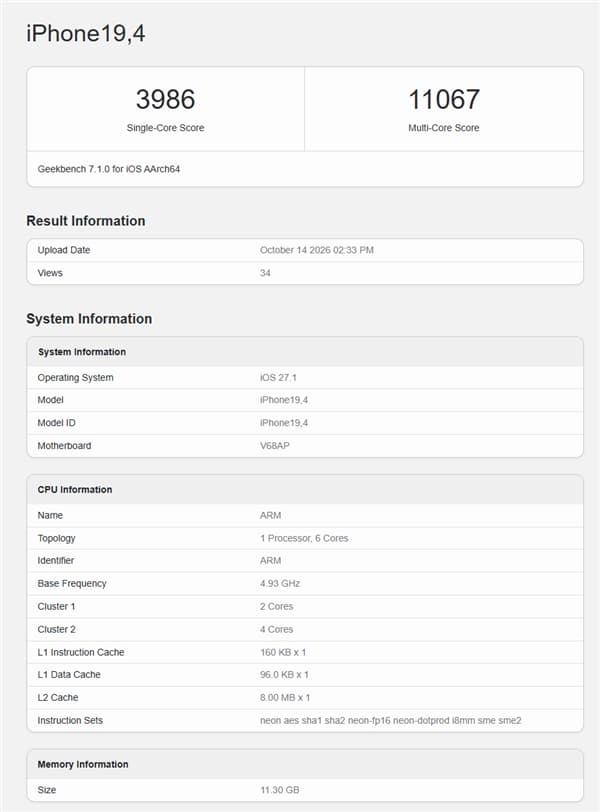
Geekbench Results Reveal Flagship-Level Performance
The reported Geekbench 7 listing shows a single-core score of 3,986 and a multi-core score of 11,067. These figures put the iPhone Duo close to the performance reported for Apple’s iPhone 18 Pro lineup.
Single-core performance is particularly relevant to everyday tasks such as opening applications, navigating menus, and handling workloads that rely heavily on one CPU core. Multi-core performance provides a broader indication of how the processor handles workloads that can take advantage of several cores simultaneously.
However, benchmark scores alone do not determine the overall user experience. App optimization, thermal management, memory behavior, and sustained performance under prolonged workloads can all affect how a smartphone performs in real-world conditions.
It is also important to remember that only one set of benchmark results has reportedly surfaced so far. A single test cannot establish the device’s final performance level, and subsequent results may differ depending on software, testing conditions, and the phone’s operating temperature.
A20 Pro Chip: Six CPU Cores and a 4.93GHz Peak Clock
The Geekbench database reportedly identifies the tested device as model iPhone19,4, running iOS 27.1 and powered by Apple’s A20 Pro processor.
The chip is said to feature a six-core CPU configuration consisting of two performance cores and four efficiency cores. Its reported maximum clock speed reaches 4.93GHz, matching the configuration attributed to the iPhone 18 Pro series.
This arrangement is designed to balance demanding workloads with energy efficiency. Performance cores handle more intensive processing, while efficiency cores help manage lighter tasks without unnecessarily consuming power.
If the specifications are confirmed, the A20 Pro could give the iPhone Duo processing capabilities comparable to Apple’s conventional flagship phones. That would be significant for a foldable device expected to support multitasking across a larger internal display.
12GB RAM and Apple’s 2nm Manufacturing Process
The benchmark listing reportedly records approximately 11.30GB of available memory, which corresponds to a device configuration advertised as having 12GB of physical RAM.
Additional memory could be useful when switching between applications, keeping more content active in the background, and running demanding software on the foldable’s larger screen. Actual memory availability may vary because the operating system and background services also use system resources.

The A20 Pro is also reported to use TSMC’s 2nm manufacturing process. According to the supplied report, the same processor powers the iPhone 18 Pro and iPhone 18 Pro Max.
A more advanced manufacturing process can provide opportunities to improve performance and power efficiency, although the final results depend on the chip’s architecture, operating frequencies, and implementation. The manufacturing node alone does not guarantee longer battery life or better sustained performance.
Apple reportedly claims that the A20 Pro delivers up to 20% higher CPU performance and up to 40% better GPU performance compared with the previous-generation A19 Pro. These are manufacturer performance claims and should be evaluated against the specific workloads and testing methods used.
Will the Foldable Design Affect Sustained Performance?
Although the iPhone Duo’s reported benchmark scores are close to those of the iPhone 18 Pro series, its foldable construction introduces a different set of engineering challenges.
A traditional smartphone has a relatively conventional internal layout, while a foldable device must accommodate a hinge, flexible display components, and a more complex internal structure. These design requirements can influence how manufacturers arrange batteries, cooling components, and other hardware.
Thermal management will therefore be an important factor in determining whether the iPhone Duo can maintain high performance during extended gaming sessions, video processing, or other demanding tasks.
A short benchmark run may show that a processor can reach a particular performance level, but it does not necessarily reveal how long that level can be maintained. Longer stress tests and real-world reviews will be needed to establish whether the foldable phone performs consistently under sustained workloads.
Battery endurance will also be worth examining. A larger internal display can be useful for productivity and entertainment, but its power consumption, combined with the demands of the processor, could affect how long the phone lasts between charges.
Beyond raw processing power, the foldable design introduces other engineering challenges, including hinge durability and display construction, as explored in our iPhone Duo vs Galaxy Z Fold8 foldable display comparison.
iPhone Duo Display Sizes and Reported Pricing
Beyond its processor, the iPhone Duo is described as Apple’s first horizontally folding, inward-folding smartphone. The reported design includes a 5.4-inch external display for everyday interactions and a 7.6-inch internal display that opens into a larger viewing area.
This format could provide a balance between conventional smartphone usability and the additional screen space associated with foldable devices. The outer screen would be suitable for quick tasks, while the larger internal panel could offer more room for multitasking, reading, gaming, and watching videos.
The reported starting price in mainland China is 15,999 yuan. At that price, the iPhone Duo would target the premium foldable segment, competing for buyers who prioritize a larger display without giving up flagship-class processing power.
Pricing, availability, and the final hardware specifications should be confirmed through Apple’s official announcements before purchase decisions are made.
For more background on Apple’s entry into the foldable smartphone market, read our earlier iPhone Fold design and specifications overview.
What the Geekbench Leak Means for Apple’s First Foldable
The reported Geekbench 7 results suggest that Apple’s iPhone Duo could offer processing performance comparable to the iPhone 18 Pro family, with the A20 Pro chip, a six-core CPU, and a reported 12GB RAM configuration forming the core of its hardware platform.
The more significant question is whether Apple can maintain that performance in a foldable chassis while delivering competitive battery life, effective cooling, and reliable multitasking on the larger display.
For now, the benchmark listing offers an early indication rather than a definitive verdict. With only one reported test available, independent reviews and sustained-performance measurements will be essential to determine how the iPhone Duo compares with traditional flagship smartphones once it reaches users.