









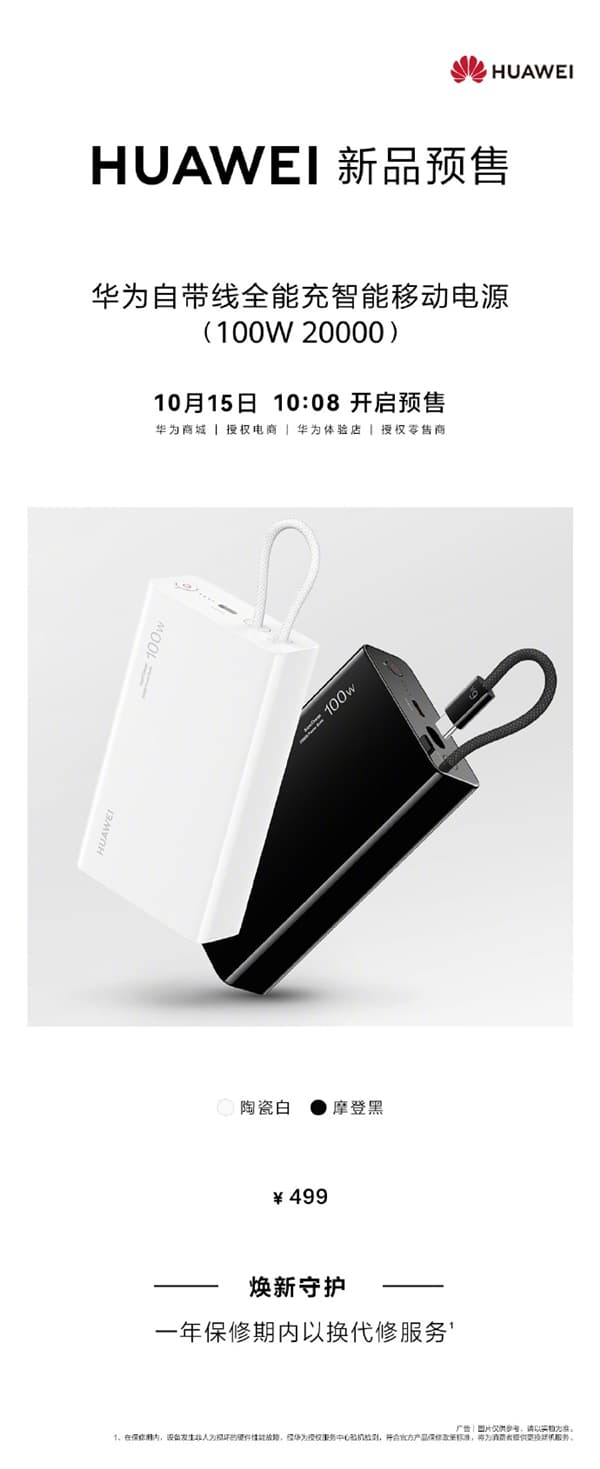
Huawei has unveiled a new high-capacity portable charger in China, expanding its smart power bank lineup with a model designed for users who need faster charging, longer battery life, and extra protection against losing their accessories. The Huawei All-in-One Smart Power Bank 100W 20,000mAh is priced at 499 yuan and was scheduled to open for pre-orders at 10:08 a.m. on October 15.
Beyond its large battery capacity, the new power bank supports 100W bidirectional SuperCharge and has received China’s updated 3C certification. It also introduces Bluetooth-connected management tools, intelligent travel reminders, and an offline-finding feature that helps users locate the device if they misplace it.
20,000mAh Capacity for Longer Trips
The biggest upgrade is battery capacity. Huawei’s first All-in-One Smart Power Bank, introduced in August, offered a 12,000mAh battery. The new 20,000mAh version increases that capacity substantially, making it better suited to extended journeys, business trips, and days when access to a wall outlet is limited.
A larger capacity can provide more charging opportunities for compatible smartphones and other portable electronics. The actual number of charges will depend on the connected device’s battery size, charging efficiency, and power consumption.
The power bank supports up to 100W bidirectional SuperCharge, allowing high-speed power transfer in both directions when used with compatible equipment. This means users can benefit from faster charging while powering supported devices and potentially spend less time replenishing the power bank itself.
Huawei has also confirmed that the product meets China’s 3C certification requirements. Buyers should still check the supported charging protocols and cable compatibility of their specific devices to determine whether they can take full advantage of the advertised charging speed.
If you are comparing high-capacity portable chargers, our Jackery 100W 31,000mAh power bank review offers another look at battery capacity, fast charging, and charging devices while travelling.
Built-In Charging Cable Gets a New Design
Like its predecessor, the new Huawei power bank features an integrated charging cable, reducing the need to carry a separate cable when travelling. This built-in design is particularly convenient for commuters and people who frequently charge their phones away from home.
The cable’s appearance has also changed. The earlier model used a flatter cable design, while the new version adopts a rounded profile. Huawei’s promotional material appears to show a braided-style finish, although the exact cable material should be confirmed through the official product specifications.
An integrated cable can make everyday charging simpler by keeping an essential accessory attached to the power bank. It also reduces the chance of forgetting a separate cable before leaving home. For users who regularly charge multiple devices, however, checking the available ports and cable compatibility remains important.
Bluetooth Connectivity Adds Smart Management Features
Huawei’s new power bank goes beyond conventional portable charging by connecting to a smartphone over Bluetooth. Through the associated management functions, users can check operating information such as the battery’s overall voltage and temperature.
The companion controls also support intelligent reminders, device finding, smart management, local device settings, and firmware updates. These features provide greater visibility into the power bank’s status than a basic model that only displays remaining charge through indicator lights.
The device can also retain historical information about abnormal battery-voltage readings and temperature irregularities. This record gives users a way to review reported operating conditions instead of relying entirely on a simple battery-level indicator.
These monitoring tools may be useful for people who carry a power bank every day and want more information about its condition. However, software monitoring is not a substitute for safe charging practices. Users should stop using a battery pack that shows signs of swelling, physical damage, unusual heat, or other obvious faults.
For a more conventional high-power charging option, take a look at our BlitzWolf BW-P23 100W power bank review to compare another portable charger designed for everyday mobile devices.
Offline Finding Helps Prevent Accidental Loss
The standout feature is Huawei’s built-in finding capability. Losing a power bank can be frustrating, particularly when it is left behind in a café, office, airport, or hotel. Huawei has added several tools intended to make recovery easier.
When the power bank remains connected to a phone through Bluetooth, users can trigger a sound to help locate it nearby. This is useful when the device is hidden in a bag, under a seat, or somewhere else within audible range.
If the Bluetooth connection is lost, the finding system can provide additional location assistance. According to the launch information, users can use online map navigation and floor-level location information to help identify where the power bank was last left.
The feature set also includes lost-item reminders and notifications when the device comes back online. Together, these functions are intended to reduce the chance of permanently losing the accessory.
The term offline finding should not be confused with guaranteed real-time GPS tracking. The ability to locate a misplaced power bank will depend on the supported finding mechanism, available location information, phone settings, and whether the relevant service can update the device’s status.
Is the Huawei 100W 20,000mAh Smart Power Bank Worth Watching?
At 499 yuan, Huawei’s new smart power bank targets users who want more than extra battery capacity. Its combination of a 20,000mAh battery, 100W bidirectional fast charging, an integrated cable, Bluetooth-based management, and lost-item finding gives it a broader feature set than a conventional portable charger.
The increased capacity is the most practical improvement over Huawei’s earlier 12,000mAh model, particularly for travellers and heavy smartphone users. Meanwhile, the built-in cable reduces the number of accessories users need to carry, and the finding features address an everyday problem that ordinary power banks generally do not solve.
Potential buyers should consider three things before purchasing: whether their devices support Huawei’s advertised fast-charging capabilities, whether the power bank’s size and weight suit their daily needs, and whether the smart-finding features are useful enough to justify the price.
For users already invested in Huawei’s ecosystem, the new model could be an appealing combination of high-capacity charging and connected accessory management. Its real-world value will ultimately depend on charging compatibility, portability, and how reliably the finding features work in everyday situations.