









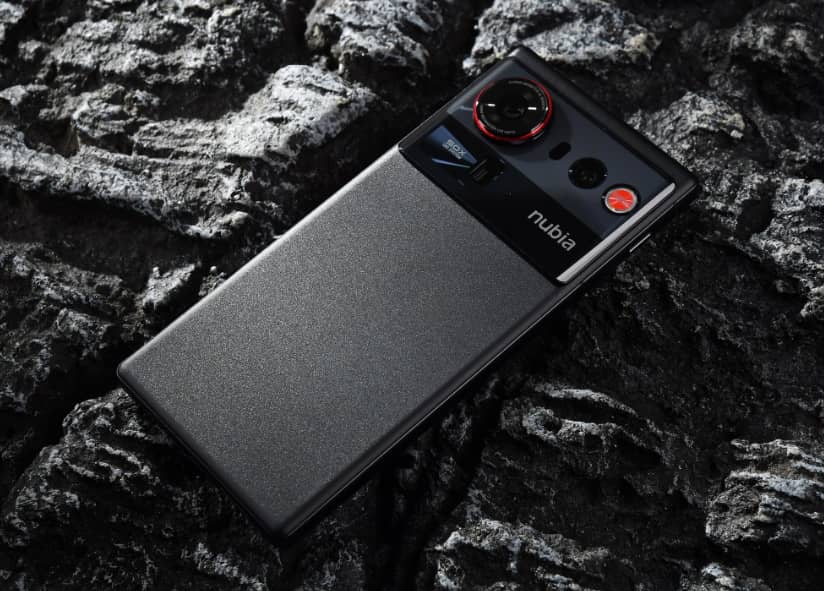
As a flagship model with image capabilities as its core competitiveness, Nubia Z80 Ultra is equipped with a 64-megapixel telephoto lens. Through innovative optical structure and AI algorithm support, it achieves seamless coverage from 2cm macro photography to 10x optical zoom. This groundbreaking design not only breaks the physical boundaries of mobile phone photography but also provides users with a professional-level creative experience through multi-dimensional parameter adjustment and scene adaptation. The following will systematically analyze how to maximize the potential of the telephoto lens from three aspects: basic operation, parameter optimization, and scene application.
I. Basic Operations: Quick Activation and Mode Switching
The core advantage of the telephoto lens lies in its flexible focal length coverage capability. At the bottom of the camera’s main interface, the default display is the “1X” main camera mode. By sliding to the right to the “3X” indicator, the telephoto lens can be activated. At this time, the image capture range is reduced to 1/9 of the main camera, suitable for capturing architectural details or stage performances. If further magnification is needed, continue sliding to “5X” or “10X”. The system will achieve digital zoom through sensor cropping. In practice, at a 10x focal length, the image usability is still maintained. For scenarios that require precise control of the focal length, enter the “Professional Mode”. Through digital sliders, 0.6X to 10X stepless zoom can be achieved. For example, when shooting the moon, adjust the focal length to 8X, combined with the “Supermoon Mode”, the system will automatically overlay multiple exposure effects, preserving the details of the moon’s craters while avoiding overexposure of the image.
II. Parameter Optimization: Shutter Stabilization, Focus, and Exposure Control
The telephoto lens is three times more sensitive to shaking than the main camera. Therefore, image stabilization and focusing accuracy are of crucial importance. The Nubia Z80 Ultra achieves a safety shutter of up to 1/30 second at a 3X focal length through the collaborative work of optical image stabilization (OIS) and electronic image stabilization (EIS). The success rate of handheld shooting is increased by 60%. When shooting dynamic subjects like birds, turning on EIS increases the continuous shooting success rate from 40% to 75%. In terms of focusing, the telephoto lens supports phase detection focusing and peak assist functions. When shooting flowers, turning on peak focusing ensures that the red highlight areas in the picture represent the focus range, allowing the petal textures to be clearly visible. If shooting moving subjects, you can long press the screen to lock the focus, avoiding blurry images caused by repeated focusing.
Exposure control needs to be adjusted according to the characteristics of the scene. When shooting buildings in backlight, separate the metering box from the focusing box, move the metering box to the highlight area to avoid the dark areas being too dark; when shooting night scenes, turn on the “tripod mode”, and the system will automatically extend the exposure to 1/8 second and enhance the picture clarity through multi-frame synthesis. If you want extreme creative effects, you can achieve them by adjusting the EV value: lower the EV to -2 to create silhouettes, and raise the EV to +2 to enhance the details of the highlights.
III. Application Scenarios: From Ecological Record to Artistic Creation
The value of the telephoto lens lies not only in “being able to capture far away”, but also in redefining visual expression through perspective compression and detail capture. In ecological photography, the 15cm closest focusing distance enables interference-free shooting of the compound eyes of insects. By using a 5X focal length combined with the AI rapid shooting function, the system will automatically increase the shutter speed to above 1/1000 second, freezing the instant of butterfly wing vibration. When shooting the internal structure of flower stamens, switch to the manual focusing mode, slowly rotate the focusing ring until pollen particles become clearly visible. Through actual testing, it can achieve a sharpness equivalent to an 800mm focal length.
In architectural photography, shooting from a low angle with a long focal length to compress the sense of space can enhance the sense of oppression of skyscrapers. Parameter suggestions: ISO 100, shutter speed 1/125 second, aperture f/2.8. By reducing the ISO, noise can be decreased and the purity of the image can be improved. In the field of humanistic creation, the telephoto lens can capture the micro-narratives of the city: capturing the contrast of details of the elderly’s hand wrinkles and rings to record the traces of time; recording the shape of coffee stains along the edge of the coffee cup to freeze the fragments of life.
IV. Advanced Techniques: Professional Kits and Post-Production Collaboration
For users who pursue the ultimate experience, Nubia Z80 Ultra supports an external professional photography kit. Through a T-mount adapter ring, it can be connected with a 35mm F1.4 prime lens to achieve a shallower depth of field effect. The cold shoe interface supports the addition of LED lighting, which can be used to illuminate from a 45-degree angle during macro photography to avoid the damage caused by direct and harsh light to details. In the post-processing stage, Nubia’s built-in imaging system provides basic color grading functions. In the HSL tool, adjusting the green saturation separately can highlight the vitality of plants. Professional users can export in DNG format and use the “Texture” slider in Lightroom to enhance details, and the “Defog” function can eliminate the blurriness of the image when shooting in the morning fog.
From hardware innovation to algorithm optimization, the telephoto lens system of Nubia Z80 Ultra has established a complete image creation ecosystem. After mastering these techniques, users can not only achieve image quality comparable to that of a DSLR, but also enjoy the convenience brought by AI assistance, truly realizing the image freedom of “one device for all purposes”.