









OpenAI has reportedly introduced GPT-6.1 Terra, a new AI model designed to combine visual reasoning, computer-use capabilities, and more natural writing in a cost-efficient package. Positioned as a mid-tier model, Terra targets everyday professional tasks such as drafting documents, interpreting technical diagrams, completing online forms, and editing video content.
According to the supplied report, GPT-6.1 Terra represents a significant upgrade over GPT-5.6 Terra. Its claimed improvements include more efficient reasoning, better accuracy on complex tasks, and faster execution, potentially making AI-assisted workflows more practical for businesses and individual professionals.
The model is reported to be available to ChatGPT Plus, Pro, Enterprise, and Edu users through ChatGPT Work and Codex. Developers can also reportedly access it through the OpenAI API using the model identifier gpt-6.1-terra.
OpenAI has continued to develop its AI models for professional productivity, as demonstrated by the earlier release of GPT-5.2 and its productivity-focused improvements.
GPT-6.1 Terra Focuses on Practical AI and Computer Automation
One of GPT-6.1 Terra’s main selling points is its ability to handle tasks that require more than generating text.
The model is designed to combine visual understanding with computer interaction, allowing it to work through multi-step processes involving applications and graphical interfaces. Potential use cases include filling out forms, analyzing technical drawings, preparing business documents, and assisting with video-editing workflows.
These capabilities could make the model useful for users who want to automate repetitive office tasks without relying exclusively on traditional software integrations.
The emphasis on computer interaction also reflects a broader shift toward AI agents that can carry out tasks within digital environments rather than simply answering questions.
For businesses, the practical value of such a model depends on how reliably it interprets on-screen information, follows instructions, handles unexpected interface changes, and completes tasks without unnecessary intervention.
OpenAI has also expanded the capabilities of its AI ecosystem through features such as ChatGPT Search, which helps users find current information through conversational queries.
Agents’ Last Exam: Lower Costs and Improved Performance
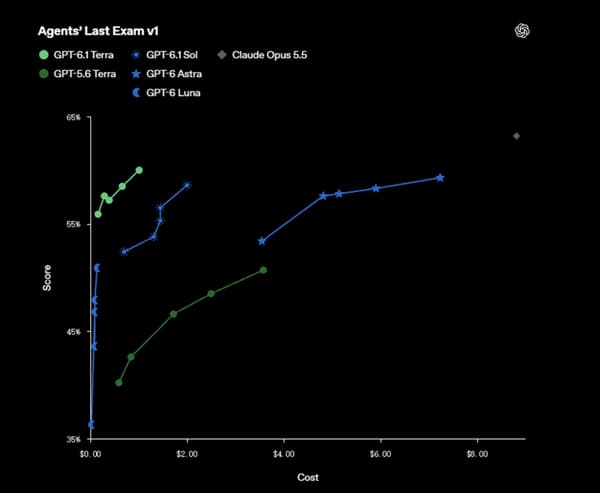
The supplied report highlights Agents’ Last Exam as one of the key benchmarks for GPT-6.1 Terra.
At medium reasoning effort, Terra reportedly scores 15% higher than GPT-5.6 Terra. Its cost per task is said to be approximately one-third that of its predecessor.
The report also claims that Terra can achieve results comparable to the flagship GPT-6 Astra on this benchmark while costing approximately one-tenth as much per token.
At the highest reasoning setting, the model reportedly delivers more than three times the token efficiency of Claude Opus 5.5. Its per-token price is said to be approximately one-quarter as high, resulting in a reported total task cost roughly nine times lower.
The same report claims that Terra completes tasks more than three times faster than GPT-6 Astra and GPT-6.1 Sol.
These figures suggest that the model’s main advantage may be efficiency rather than simply maximizing raw capability. For workloads involving many repeated AI operations, lower inference costs and faster completion times could make a meaningful difference to overall operating expenses.
However, benchmark performance does not automatically translate into the same cost or speed improvements across every real-world application.
Visual Reasoning Performance Improves on MMMU-Pro
Visual reasoning is another area where GPT-6.1 Terra reportedly improves on its predecessor.
On the MMMU-Pro benchmark, which evaluates multimodal understanding and reasoning, Terra is said to outperform GPT-5.6 Terra across all tested reasoning settings.
The report further states that the model approaches the performance of GPT-6 Astra and GPT-6.1 Sol while operating at a lower cost.
This capability could be particularly useful when working with visual information, including diagrams, screenshots, technical illustrations, and other materials that require an AI system to connect what it sees with the task it needs to perform.
For office workers and technical professionals, stronger visual reasoning could reduce the need to describe every detail manually before asking an AI assistant for help.
Nevertheless, benchmark scores alone cannot establish how accurately the model will interpret every type of document or image in daily use.
OSWorld 2.1 Highlights Better Desktop Control
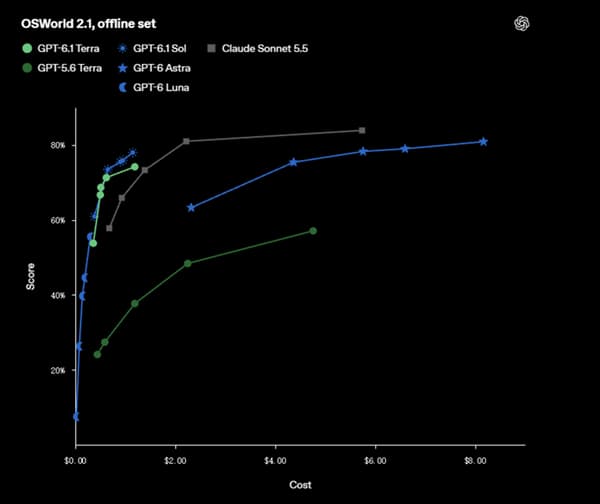
GPT-6.1 Terra is also reported to deliver improved results on OSWorld 2.1, a benchmark associated with computer-use tasks.
According to the supplied figures, Terra at medium reasoning effort exceeds the best reported result previously achieved by GPT-5.6 Terra.
This is important because computer-use agents must coordinate several abilities at once. They need to recognize interface elements, determine the next action, interact with applications, and check whether the intended result has been achieved.
Even a small error in a multi-step workflow can cause a task to fail. Better desktop-control performance could therefore improve the reliability of AI-assisted work involving spreadsheets, browser-based tools, forms, and other graphical applications.
Actual performance will still depend on the applications being used, the complexity of the workflow, and the level of human oversight required.
Fewer Factual Errors Under Difficult Prompts
The report also describes improvements in factual reliability.
In an internal OpenAI evaluation involving difficult prompts designed to encourage incorrect answers, GPT-6.1 Terra reportedly reduces its error rate at low reasoning effort from 53.6% for GPT-5.6 Terra to 16.7%.
That represents a reduction of 36.9 percentage points.
At the highest reasoning setting, Terra’s reported error rate falls to 4.3%, approaching the results attributed to GPT-6 Astra and GPT-6.1 Sol.
If confirmed, these results would suggest that Terra is better at resisting misleading instructions and avoiding certain types of factual mistakes.
However, an internal evaluation is not a universal measure of accuracy. The results depend on the test design, the prompts used, and the definition of an error. Users should continue checking important factual claims, especially when working with technical, financial, legal, or other high-impact information.
Coding Benchmarks Show Progress in Complex Tasks
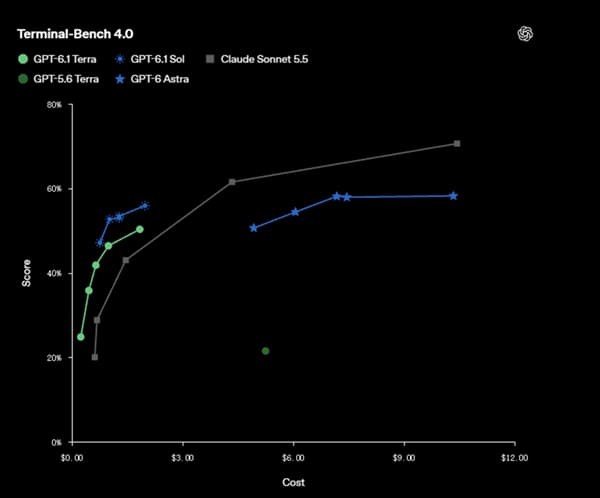
Although GPT-6.1 Terra is positioned as a cost-efficient general-purpose model, the supplied report also highlights its coding performance.
On Terminal-Bench 4.0, Terra reportedly solves 50.3% of tasks at the highest reasoning setting. This is more than twice the 21.5% public score attributed to GPT-5.6 Terra.
The report also claims that Terra outperforms GPT-6.1 Sol on Terminal-Bench-Science 0.1, finishing less than five percentage points behind Claude Opus 5.5.
These results indicate potential improvements in tasks that require an AI model to work with command-line tools, reason through technical problems, and execute multi-step coding workflows.
For developers, a more efficient model could be attractive when handling routine programming tasks, debugging, or repeated automated operations.
Still, benchmark results should be interpreted alongside practical considerations such as code correctness, execution reliability, tool compatibility, and the amount of human review needed.
Cybersecurity Safeguards and Prompt-Injection Resistance
Security is another important part of the reported release.
According to the supplied report, GPT-6.1 Terra reaches the Critical level in OpenAI’s Preparedness Framework cybersecurity assessment and inherits safeguards used by GPT-6 Astra.
The report also describes improvements in keeping tasks within their intended scope, communicating limitations, and resisting prompt-injection attempts.
These protections are particularly relevant for models that can interact with computers and external tools. An AI system with access to applications may encounter untrusted text, misleading instructions, or content that attempts to redirect it away from the user’s original request.
Better resistance to such attacks could help reduce the risk of unauthorized or unintended actions. However, no AI security measure eliminates every threat, and the effectiveness of safeguards depends on the deployment environment and the permissions granted to the model.
For organizations considering AI-driven automation, access controls, monitoring, and human approval for sensitive actions remain important.
GPT-6.1 Terra Availability and API Access
The supplied announcement states that GPT-6.1 Terra is available to ChatGPT Plus, Pro, Enterprise, and Edu subscribers through ChatGPT Work and Codex.
Developers are also reportedly able to call the model through the OpenAI API using the identifier gpt-6.1-terra.
If these access details are confirmed, the model could serve two main audiences: individuals who want an AI assistant for everyday computer-based work and developers who need to integrate AI capabilities into their own applications.
Its reported combination of computer-use skills, visual reasoning, coding performance, and lower operating costs could be especially relevant for agent-based workflows that involve multiple steps.
Availability, usage limits, API pricing, and supported features should be checked against official documentation before developers or businesses make implementation decisions.
Final Thoughts
GPT-6.1 Terra is presented in the supplied report as a model that prioritizes practical performance, efficient reasoning, and computer automation.
Its reported improvements span several areas, including visual understanding, desktop interaction, coding, factual reliability, and task execution costs. The most notable claims are its threefold speed advantage over certain flagship models, substantially lower reported task costs, and improved performance over GPT-5.6 Terra.
If these figures are verified, Terra could offer an appealing balance between capability and cost for users who need AI to complete real work rather than simply generate text.
The key question is how these benchmark gains translate into everyday reliability. Real-world testing, independently verifiable results, and confirmed pricing will be essential to determining whether GPT-6.1 Terra represents a meaningful improvement for developers, businesses, and individual users.
The development of GPT-6.1 Terra builds on OpenAI’s earlier model releases, including GPT-5 and its improvements in coding, writing, and visual understanding.