









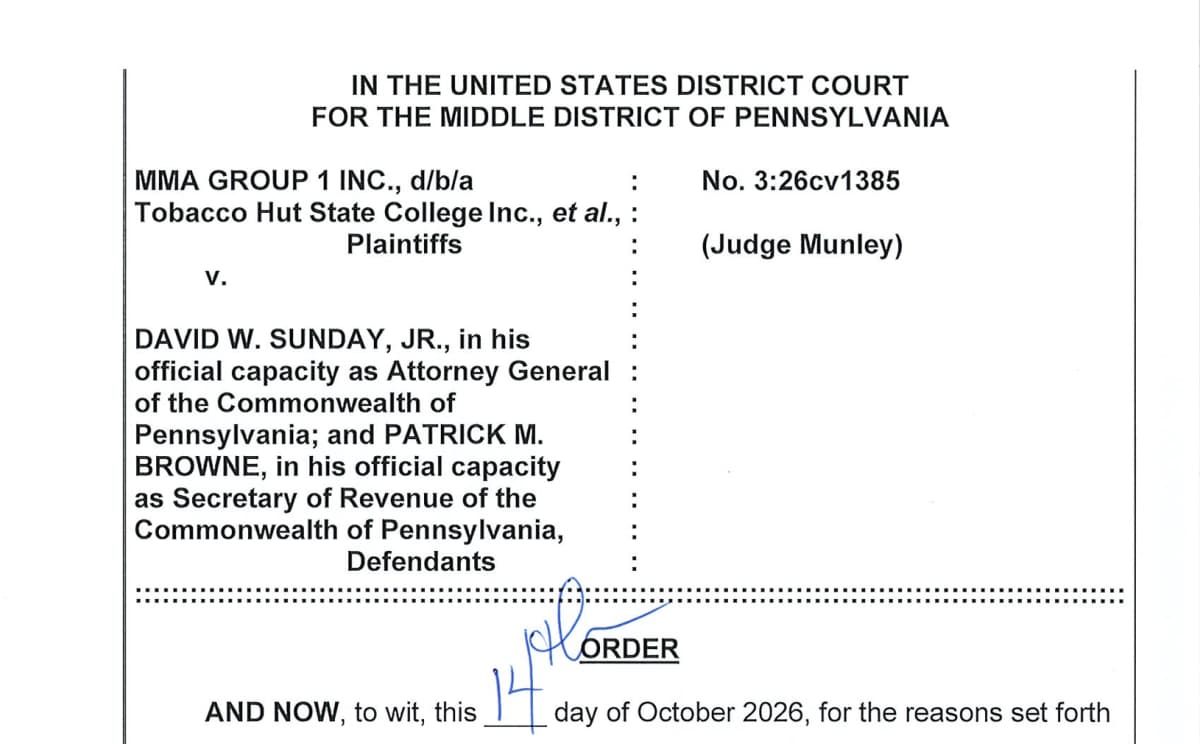
Pennsylvania has begun enforcing its e-cigarette product directory law after a federal court rejected an industry challenge to the state’s sales restrictions. The October 14, 2026, ruling found that Act 57 is not preempted by federal tobacco law, clearing a legal obstacle to enforcement that began on October 19.
The U.S. District Court for the Middle District of Pennsylvania ruled on October 14 that Pennsylvania’s Act 57 of 2025 can restrict the sale of electronic nicotine delivery system (ENDS) products that do not appear on the state’s approved product directory. The decision rejected requests for summary judgment from manufacturers, distributors and retailers challenging the law.
In MMA Group 1 Inc. v. Sunday, Jr., U.S. District Judge Julia K. Munley concluded that the law regulates the sale and distribution of vaping products, an area in which federal law preserves certain state regulatory powers. Although Pennsylvania uses information related to the U.S. Food and Drug Administration’s (FDA) premarket review process to determine directory eligibility, the court found that this does not make the state law impermissible under federal law.
The ruling supported Pennsylvania Attorney General Dave Sunday and Department of Revenue Secretary Patrick Browne. It resolved the case at the district court level, although further appellate review may still be possible.
Five days after the decision, Pennsylvania began enforcing the restrictions against covered vaping products that are not listed in the state directory.
$2 Million in Vape Inventory at Risk in Industry Lawsuit
The lawsuit was filed on May 20, 2026, by companies involved in vaping product manufacturing, wholesale distribution and retail sales. The plaintiffs included Nova Distro Inc., distributor 101 Distributors LLC, and businesses operating Tobacco Hut and Tobacco Lux stores in Pennsylvania.
Court records cited in the ruling described the potential commercial impact of the law on the retail network. Tobacco Hut reportedly employed approximately 150 to 180 full-time workers, with vaping products accounting for about 60% of its profits. As of June 2, 2026, the business held approximately $2 million in inventory that could potentially be subject to seizure under Act 57.
The stores reportedly sold between 200 and 300 types of nicotine vaping products that had not received FDA marketing authorization.
Nova Distro manufactured and distributed vaping products to Tobacco Hut stores. According to testimony cited by the court, the companies had family-business connections involving part of the retail operation. Nova Distro also produced the nicotine vape brand Hut Bar, which had reportedly been sold at Tobacco Hut locations for approximately two to three years without FDA marketing authorization.
The other plaintiff, 101 Distributors, supplied vaping products to Tobacco Hut and other convenience stores and tobacco retailers. Court materials indicated that vaping products accounted for around 40% of the distributor’s profits. The company estimated that selling its existing vape inventory at its normal pace could take between eight months and one year.
The plaintiffs argued that restrictions on unlisted products, together with potential seizures, could significantly disrupt their businesses. They warned of possible store closures and job losses.
These inventory values, profit estimates and employment figures came from the litigation record. They should not be interpreted as final findings of regulatory violations or confirmed economic losses.
Why the Federal Court Rejected the Preemption Challenge
The central legal question was whether Pennsylvania could use FDA marketing authorization and premarket tobacco product application (PMTA) status as criteria for its own vaping product directory.
The plaintiffs argued that Act 57 effectively added requirements connected to the FDA’s federal premarket review system. They maintained that the state restrictions were therefore preempted by the federal Family Smoking Prevention and Tobacco Control Act and the Federal Food, Drug, and Cosmetic Act.
Judge Munley reached a different conclusion. The court found that federal tobacco law preserves state authority over certain aspects of tobacco product sales and distribution, including related possession and reporting requirements.
Under the court’s interpretation, Act 57 does not replace the FDA’s federal review process. Instead, it uses information about federal authorization or application status as part of the eligibility criteria for sales within Pennsylvania.
The court therefore rejected the argument that the state’s directory requirements were barred by federal law. It also rejected the plaintiffs’ claim that Pennsylvania was impermissibly attempting to enforce federal tobacco law on the federal government’s behalf.
The decision establishes a legal basis for Pennsylvania to enforce the challenged restrictions at the district court level. It does not mean that every aspect of state vaping regulation is automatically immune from future legal challenges.
For background on the federal review process, read our guide to FDA marketing authorization and PMTA requirements for vaping products.
Pennsylvania Directory Included 163 Product Listings Before Enforcement
Pennsylvania enacted Act 57 on December 22, 2025. The law established an electronic nicotine delivery system product directory administered by the Office of the Pennsylvania Attorney General.
Manufacturers must provide documentation meeting the state’s requirements, including information concerning FDA marketing authorization or qualifying PMTA status, before covered products can be included in the directory.
The Attorney General’s Office announced on October 8 that enforcement could begin on October 19. Products covered by the law that are not included in the directory may face sales restrictions, seizure, financial penalties and consequences involving business licenses.
According to a directory analysis previously reported by 2Firsts, Pennsylvania had 163 product records listed as of October 18. The records represented seven manufacturers and included products associated with brands such as Vuse, JUUL, NJOY, Logic and Naked 100.
Geek Bar, RAZ, Lost Mary and Elf Bar did not appear in the directory at that time. A further 22 manufacturer certifications were reportedly still under review.
Companies associated with British American Tobacco, Altria Group, Japan Tobacco and JUUL accounted for 112 of the 163 product records, or approximately 68.7%.
A listing in Pennsylvania’s directory indicates that a product meets the state’s applicable eligibility requirements. It does not, by itself, establish that every listed product has received FDA marketing authorization.
The directory’s composition is therefore an important distinction for manufacturers and retailers assessing which products can legally be sold under Pennsylvania’s system.
Other States Face Similar Legal Challenges Over Vape Directories
Pennsylvania is part of a wider national debate over state-level vaping product directories.
A study published in JAMA Network Open in September 2026 reported that, by June of that year, 16 U.S. states had enacted laws establishing public vaping product directories or registration systems. Implementation dates across those states ranged from 2022 to 2027.
Several federal appellate courts also considered similar disputes during 2026, with rulings supporting state authority to impose certain sales restrictions at the preliminary-injunction stage.
On April 21, the U.S. Court of Appeals for the Seventh Circuit upheld the denial of a preliminary injunction in Wisconsinites for Alternatives to Smoking & Tobacco, Inc. v. Casey. The court concluded that the plaintiffs had not demonstrated a sufficient likelihood of success on their federal preemption argument to justify the requested relief.
On July 30, the Fourth Circuit upheld a lower court decision refusing to suspend North Carolina’s directory system in Vapor Technology Association v. Wooten.
On the same day, the Eighth Circuit reversed a preliminary injunction that had blocked implementation of Iowa’s directory system in Iowans for Alternatives to Smoking & Tobacco, Inc. v. Mosiman. The appellate court found that the plaintiffs had not established a sufficient likelihood of success on their preemption claim.
These cases primarily concerned preliminary injunctions, which determine whether a challenged policy should be temporarily blocked while litigation proceeds. Pennsylvania’s October 14 ruling went further at the district court level by resolving the parties’ summary judgment requests on the core dispute.
State implementation nevertheless remains uneven. On October 15, Iowa’s Department of Revenue reportedly announced another delay in publishing its vaping product directory and beginning penalties, citing the need to collect additional manufacturer information and review product eligibility.
The different timelines illustrate that a favorable court ruling does not necessarily mean every state will implement its directory or enforcement program at the same pace.
For more coverage of changing U.S. vaping rules, explore our reporting on U.S. vape regulations and compliance requirements.
Research Questions Whether Vape Directories Reduce Unlisted Product Sales
The legal debate is unfolding alongside questions about how effectively product directories change the retail market.
A study published in JAMA Network Open on September 15, 2026, examined vaping product sales in Alabama, Oklahoma and Louisiana, three states that adopted directory systems relatively early.
Researchers analyzed retail scanner data covering January 2021 through April 2025 and compared trends with states that had not adopted similar systems.
The study found no statistically significant change in overall vaping nicotine sales or product variety following directory publication in Alabama and Oklahoma. Louisiana experienced an initial decline in sales after implementation, followed by a rebound. The number of different products sold in the state also declined during the study period.
The researchers estimated that, as of April 2025, products not listed in the relevant directories accounted for the following shares of tracked e-cigarette nicotine sales:
| State | Share of tracked nicotine sales from unlisted products |
|---|---|
| Alabama | 92.1% |
| Oklahoma | 53.6% |
| Louisiana | 52.3% |
The researchers retrospectively classified products sold in April 2025 using state directories obtained in July 2026. The data covered tracked retail channels and did not represent every vape specialty shop or online sales channel.
Louisiana also conducted enforcement operations. In June 2025, the state’s tax department reportedly announced that a four-week joint operation had seized approximately 34,000 vaping-related items, including vape pens, cartridges and e-liquid.
The study’s findings suggest that publishing a directory does not necessarily eliminate sales of products that are absent from it. However, the results should be interpreted in light of differences among state laws, enforcement activity and the retail channels covered by the data.
The researchers also noted that publicly available enforcement information remains limited. Further analysis using administrative enforcement records and additional sales data will be needed to assess the relationship between directory policies and actual market changes.
What Pennsylvania’s Decision Means for Vape Businesses
Pennsylvania’s ruling removes a significant legal obstacle to enforcement of Act 57, but the practical effects will depend on how the state applies the law and how manufacturers and retailers respond.
For manufacturers, the directory creates a need to verify eligibility and documentation before distributing products into Pennsylvania. Wholesalers must consider whether their inventories contain products that fall within the law’s restrictions. Retailers, meanwhile, face the risk of carrying products that cannot legally be sold under the state’s requirements.
The court decision also reinforces the importance of distinguishing between state directory eligibility and FDA marketing authorization. The two are related under Pennsylvania’s system, but they are not interchangeable regulatory concepts.
The next indicators to watch include product removals, inspections, seizures, penalties, further litigation and changes in retail availability. Those developments will help show how the directory operates in practice and whether its effects resemble the outcomes observed in other states.
For now, Pennsylvania has moved from legal uncertainty to active enforcement. The October 14 ruling supports the state’s authority to restrict covered products absent from its directory, while the longer-term effects on businesses, employment and the availability of vaping products remain to be seen.