










SpaceX is reportedly partnering with NVIDIA on an ambitious initiative to bring high-performance artificial intelligence computing directly into space. According to reports from Chinese media, the two companies are jointly developing a satellite computing payload known as Starmind AI1, aiming to deploy data center-class AI capabilities in orbit and create what is described as the world’s first large-scale space computing infrastructure.
If realized, the project would combine SpaceX’s satellite deployment expertise and Starlink network with NVIDIA’s next-generation AI hardware, enabling satellites to process data in orbit instead of relying heavily on ground-based data centers.
AI Supercomputing in Space
According to the report, each Starmind AI1 satellite will feature a custom computing platform built around NVIDIA’s flagship Rubin GPU and Vera CPU, creating an accelerated computing architecture capable of handling demanding AI workloads.
The onboard computing system is reportedly designed for applications including:
- Large language model (LLM) inference
- Remote sensing image analysis
- Autonomous spacecraft operations
- Satellite task scheduling
- Scientific data processing
- Edge AI computing in orbit
Rather than functioning solely as communications or observation satellites, the proposed platform would effectively operate as distributed AI servers in space.
Processing Data Before It Reaches Earth
One of the project’s primary objectives is to reduce the need to transmit massive amounts of raw satellite data back to Earth.
Instead, satellites would perform AI inference directly in orbit, allowing them to:
- Filter unnecessary data
- Analyze imagery locally
- Extract important features
- Generate actionable insights
- Transmit only processed results to ground stations
This approach could significantly reduce bandwidth requirements while lowering latency for time-sensitive applications such as disaster monitoring, environmental observation, and space missions.
Solar-Powered Computing Infrastructure
The report states that the satellites will operate in sun-synchronous orbit, enabling nearly continuous access to solar energy.
Compared with traditional terrestrial data centers, an orbital AI computing platform could potentially avoid several operational challenges, including:
- Day-night power fluctuations
- Weather-related energy limitations
- Land availability constraints
- Regional power shortages
Continuous solar power could provide a stable energy source for long-duration computing workloads in space.
High-Power Satellite Design
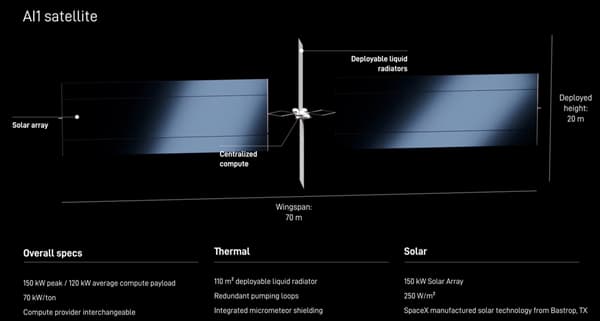
According to the reported specifications, each satellite could deliver up to 150 kilowatts of peak computing power.
The platform is also expected to incorporate several technologies designed specifically for the space environment, including:
- Space-grade liquid cooling systems
- Protective structures against micrometeoroid impacts
- High-density AI accelerator modules
- Large-scale modular satellite architecture
Production is reportedly planned at SpaceX’s Gigasat manufacturing facility in Texas, with launches supported by both Falcon 9 and Starship vehicles.
Combining Launch Expertise with AI Leadership
The reported collaboration highlights the complementary strengths of both companies.
SpaceX would contribute:
- Low-cost launch services
- Satellite platform design
- On-orbit operations
- Global connectivity through the Starlink constellation
Meanwhile, NVIDIA would provide:
- Rubin GPU architecture
- Vera CPU platform
- CUDA software ecosystem
- Aerospace AI acceleration technologies
- Hardware and software optimization for orbital computing
Together, the companies aim to create an integrated platform capable of delivering AI processing beyond Earth’s atmosphere.

Building on a Long-Term Relationship
The report notes that SpaceX and NVIDIA have collaborated for nearly a decade.
Among their earlier projects, NVIDIA reportedly supplied DGX-1 AI supercomputing systems that supported SpaceX’s terrestrial computing infrastructure, laying the foundation for broader cooperation in artificial intelligence and aerospace technologies.
Toward a Space-Based Cloud Computing Network
According to the roadmap outlined in the report, SpaceX plans to expand its orbital computing capacity to more than 2 gigawatts by the end of 2026, with a long-term goal of reaching 10 gigawatts by the end of 2027.
If achieved, such an infrastructure could support a wide range of applications, including:
- Earth observation
- Deep-space exploration
- Autonomous satellite operations
- Scientific research
- Global edge cloud services
- AI-powered communications networks
The initiative represents a vision of extending cloud computing beyond terrestrial data centers into a distributed orbital infrastructure.
Looking Ahead
Neither SpaceX nor NVIDIA has officially announced the reported Starmind AI1 program or confirmed the technical specifications described in the report. As a result, the project’s timeline, hardware configuration, and deployment plans remain unverified.
However, the concept reflects a growing industry trend toward edge AI, where computation is performed closer to the source of data rather than relying exclusively on centralized facilities. If such a space-based AI computing platform becomes reality, it could significantly reshape satellite operations, remote sensing, scientific research, and future cloud computing architectures by enabling intelligent data processing directly in orbit.