









Igeekphone News, February 3rd: Samsung has conducted numerous bold explorations in the field of biometric recognition.
As early as in 2017, when Galaxy S8 series was launched, the addition of the iris scanner was quite impressive. However, due to the subsequent products’ pursuit of the ultimate full-screen design, this technology was soon abandoned. Samsung then focused on the fingerprint recognition solution and fell into a long-term silence in the field of highly secure facial recognition.
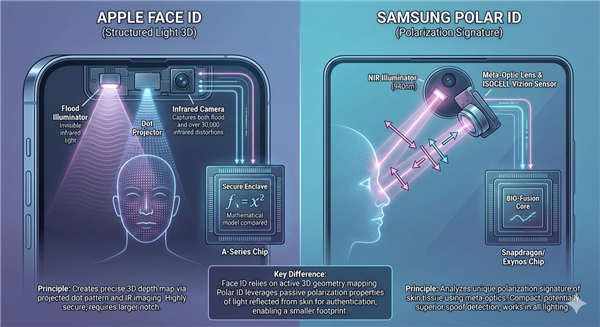
However, the latest industry rumors have broken this deadlock. It is reported that the future Galaxy S27 Ultra will introduce a more advanced solution than Apple’s Face ID, called Polar ID. This technology does not rely on the cumbersome 3D depth mapping, but uses the principle of polarized light imaging for facial recognition.
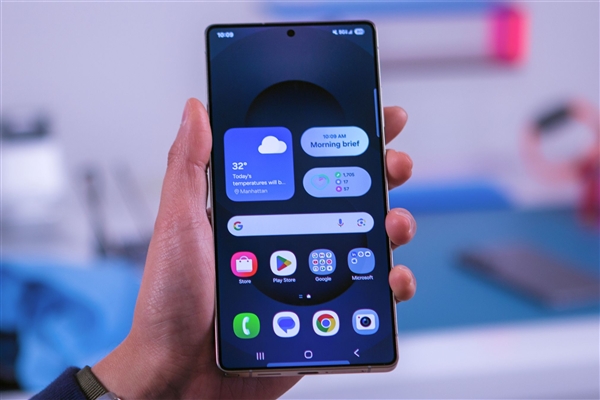
The most crucial design advantage lies in the fact that it doesn’t require “extending the screen slots” like Apple does to accommodate complex components. This enables the phone to maintain a minimalist screen design while still offering top-level security.
From the perspective of technical implementation principles, Polar ID is a highly integrated system combining software and hardware. When the device is operating, it emits infrared light onto the user’s face. The reflected light passes through specially designed metasurface optical elements for filtering. At this time, a dedicated sensor simultaneously captures visual images and specific polarization state data.
Because the reflection characteristics of polarized light by human skin and various inorganic materials such as masks, screens, and photos are completely different, after data comparison, the safety zone can accurately determine whether it is operated by a living person with extremely high precision. The possibility of cracking it is almost zero.
In contrast, Apple’s Face ID, due to the need to integrate multiple modules such as infrared cameras and dot matrix projectors, inevitably led to the design of the pill-shaped screen. However, Polar ID has reduced the component size by approximately 50%, which enables Samsung to continue using the front single-hole style on Galaxy S27 Ultra.
In terms of user experience, Polar ID also performs exceptionally well. It has been estimated that its unlocking response time is approximately 180 milliseconds, which is as fast as Face ID. Moreover, even when wearing a mask, glasses, or in extreme lighting conditions, its recognition accuracy remains stable.
More importantly, the hardware cost of Polar ID is expected to be lower, which means that this technology is likely to be gradually integrated into more mid-range devices from top flagship models in the future, making high-security facial unlocking truly widespread.