









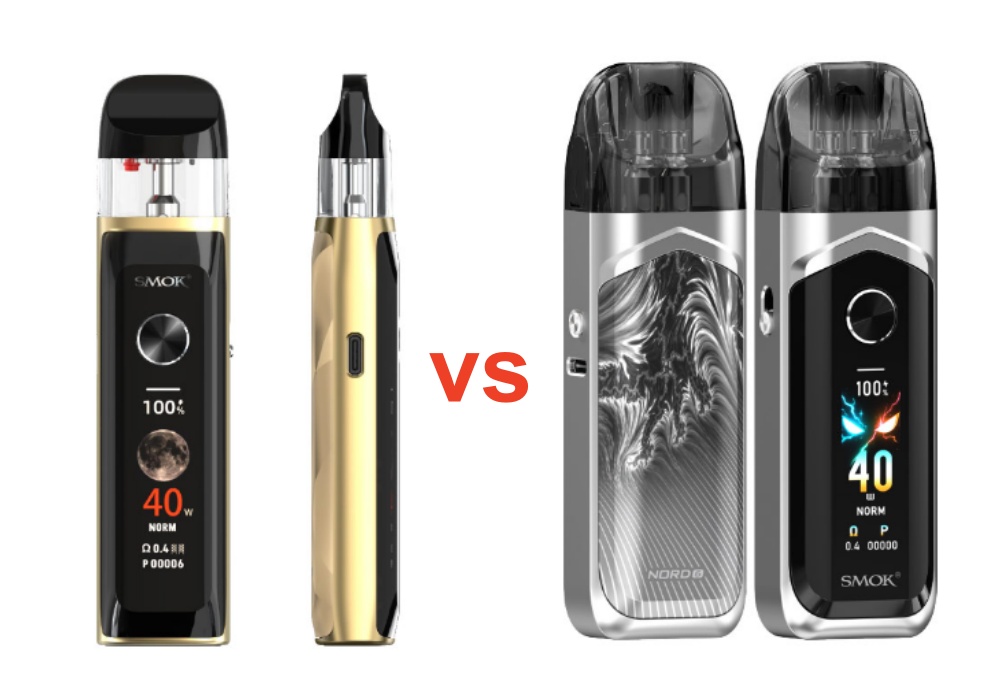
Pod system kits like SMOK Novo 6 Ultra and SMOK Nord 6 represent the latest evolution in compact vaporization hardware from SMOK. While both follow the pod-style format, they differ significantly in battery size, power range, pod capacity, and intended usage scope. Here’s a clear breakdown of how these two products differ based on manufacturer specifications and detailed spec listings.
Battery & Power Output
Novo 6 Ultra
-
Built-in 1700 mAh rechargeable battery.
-
Adjustable output from 5 W up to 40 W.
-
Designed to provide several days of operation on a single charge under moderate use. The battery supports fast Type-C charging.
Nord 6
-
Much larger 3800 mAh built-in battery, providing extended autonomy.
-
Wider power range from 5 W up to 80 W, allowing more flexibility.
-
Also supports fast USB-C charging.
Summary: The Nord 6 has significantly higher power capacity and maximum output, suited to more demanding daily usage, while the Novo 6 Ultra targets lighter to moderate power needs.
Display & Interface
Novo 6 Ultra
-
Features a 1.65-inch TFT touch display.
-
Offers customizable themes and a touchscreen control interface.
-
Includes puff tracking data up to seven days.
Nord 6
-
Also equipped with a 1.65-inch HD full-touch screen.
-
Provides settings like Norm, Smooth, and Boost output modes.
-
Displays vaping information such as puff count, power level, and battery status.
Summary: Both kits feature similar touchscreen displays that show device data and allow interactive adjustments, though the Nord 6’s interface is positioned alongside its broader power range as part of its more “advanced” presentation.
Pod & E-Liquid Capacity
Novo 6 Ultra
-
Uses the Novo 5 Pod series, with a 3 mL e-juice capacity per pod.
-
Pods combine integrated mesh coil configurations that support mouth-to-lung (MTL) and restricted direct-to-lung (RDL) styles.
-
Top-filling design helps with convenient refills.
Nord 6
-
Larger 5 mL e-liquid capacity per pod.
-
The kit includes both dual-coil and single-coil pods compatible with its system.
-
Pods support top and side fill options.
Summary: The Nord 6 has a noticeably larger reservoir size, which can mean fewer refills during extended device use. The Novo 6 Ultra, with smaller pods, emphasizes a more compact footprint.
Output Control & Modes
Novo 6 Ultra
-
Offers three main output modes — Normal, Smooth, and Boost — for varied power deliver profiles.
-
Designed to adapt between gentle MTL to slightly looser RDL styles within its power range.
Nord 6
-
Also includes Norm, Smooth, and Boost modes for preference tuning across its broader 5 W–80 W span.
-
Adjustable airflow features allow users to tailor airflow resistance to their draw preferences.
Summary: While both support similar mode nomenclature and adjustment flexibility, the Nord 6 covers more power and coil combinations, enabling a broader range of inhalation styles.
Overall Design & Target Use Case
Novo 6 Ultra
-
Compact, lightweight profile focused on portability.
-
Lower maximum power, smaller pods, and integrated display suitable for moderate daily use.
-
Pod selection emphasizes simplicity and convenience.
Nord 6
-
Larger, more robust device with a focus on extended battery life and broader adjustability.
-
Large e-juice capacity and dual pod compatibility make it more adaptable for diverse usage needs.
-
A touch screen and expanded power range give it characteristics closer to hybrid pod/mod systems.
Summary: The Novo 6 Ultra can be seen as a more compact option within SMOK’s lineup, emphasizing ease of carry and basic customization. The Nord 6 expands on that formula with higher battery capacity, more power, and larger pods, offering performance flexibility.
Conclusion
Both SMOK Novo 6 Ultra and SMOK Nord 6 Pod System Kit reflect SMOK’s evolution of pod systems, but they serve different technical niches:
-
Novo 6 Ultra: A compact, lower-power system with touchscreen control and smaller pods.
-
Nord 6: A larger, more rugged kit with higher wattage, larger pods, and broad adaptability.
This comparison focuses strictly on hardware features and specifications so you can understand the differences between the two systems without promotional claims.