








When “Can You Handle This?” Isn’t Good Enough
You hear it every day—the vague radio call: “Can someone check on aisle five?” or “Maintenance to the front desk, please.” These open-ended requests create operational black holes where tasks disappear and accountability vanishes. If your team relies on voice-only communication, you’re likely familiar with the fallout: missed tasks, frustrated staff, and service delays that impact your bottom line.
This is where a specialized category of two-way radios with integrated ticketing systems changes the game. But with any new technology, the critical question is: “Is this right for my specific operation?”
After examining deployments across multiple sectors, we’ve identified three commercial environments where the Retevis MateTalk C3‘s ticketing system delivers measurable operational improvements. Here’s where this technology transitions from being a “nice feature” to becoming an essential management tool.
The Retail Supermarket: Taming Constant Task Overload
The Environment: Large footprint stores with constant price checks, spill cleanups, inventory inquiries, and customer assistance requests across multiple departments.
Traditional Pain Points:
Price verification requests get lost in channel chatter
“Manager needed in grocery” calls disrupt all departments
No tracking of which requests have been completed
How MateTalk C3’s Ticketing System Creates Efficiency:
Structured Request Flow: Instead of broadcasting “spill in aisle 7,” a manager creates a targeted ticket assigned specifically to the maintenance team
Priority Management: High-priority tasks (like security issues) can be elevated above routine price checks
Digital Audit Trail: Managers can trace task completion history directly in the ticketing interface, verifying whether tasks were completed and identifying the responsible personnel.
Key MateTalk C3 Features That Deliver in Retail:
5W Power & Repeater Support: Ensures coverage across large-format stores, including stock rooms and parking lots
Vibration Alerts: Allows discreet notification during customer interactions
2200mAh Battery: Survives full shifts without mid-day charging
The Hotel Property: Bridging Departmental Silos
The Environment: Multi-department operations where guest requests require coordination between front desk, housekeeping, maintenance, and security across multiple floors and buildings.
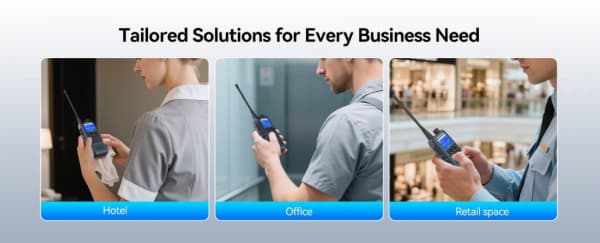
Traditional Pain Points:
Guest room maintenance requests fall between departments
No verification that turndown service has been completed
Difficulty tracking response times for guest issues
How MateTalk C3’s Ticketing System Creates Efficiency:
Cross-Departmental Workflows: Front desk can directly create tickets for engineering without channel-switching
Guest Service Verification: Housekeeping can close tickets when guest requests are fulfilled, with timestamps
Escalation Paths: Unacknowledged tickets can be automatically reassigned to backup staff
Key MateTalk C3 Features That Deliver in Hospitality:
Large 1.77-inch Display: Shows complete ticket details for accurate response
Sleek 27mm Profile: Professional appearance appropriate for guest-facing staff
Dual Band/Dual Watch: Monitors both engineering and housekeeping channels simultaneously
The Corporate Office Complex: Streamlining Facility Operations
The Environment: Multi-tenant buildings with dedicated facilities teams handling maintenance requests, meeting room setups, and security incidents across multiple floors.
Traditional Pain Points:
Difficulty prioritizing between urgent repairs and routine maintenance
No documentation of task completion for billing purposes
Communication gaps between security and facilities teams
How MateTalk C3’s Ticketing System Creates Efficiency:
Centralized Request Management: All maintenance needs enter a unified digital queue
Documentation for Chargebacks: Completed tickets with timestamps provide evidence for tenant billing
Integrated Emergency Response: Security can instantly create high-priority tickets for facilities during incidents
Key MateTalk C3 Features That Deliver in Office Environments:
Professional Aesthetics: Business-appropriate design that doesn’t look out of place in corporate settings
Flexible Charging Options: Type-C and base charging for flexibility in maintenance offices
Three Calling Modes: Single, group, and all-call functionality for different communication needs
The Common Denominator: When Do You Actually Need a Ticketing System?
Based on deployments across these environments, a ticketing system radio delivers maximum ROI when your operation has:
Multiple departments requiring coordination
Accountability requirements for task completion
Service level expectations that need measurement
Geographically dispersed teams across large facilities
Mixed-priority tasks requiring triage and organization
Retevis MateTalk C3 represents a category of professional communications equipment that has evolved beyond simple voice communication. According to facility managers who’ve made the transition, the shift from “Did you hear my call?” to “I can see you’ve accepted the task” represents one of the most significant operational improvements they’ve implemented.
Making the Right Choice for Your Operation
Not every business needs the advanced functionality of a ticketing system. But for retail operations battling constant task overload, hotels coordinating multiple service departments, and office complexes managing facility operations across multiple tenants, the transition from basic radios to smart task management systems is becoming increasingly necessary.
The question isn’t whether your team can communicate—it’s whether your communication system ensures tasks are completed, documented, and optimized. For a growing number of operations managers, that distinction is becoming the new standard for professional communications.