










Vaping has become one of the most discussed harm-reduction alternatives to smoking, yet it is also surrounded by a large amount of confusion, misinformation, and outright myths. From social media claims to outdated reports, the public conversation around vaping is often inconsistent and polarized.
So why does so much false information exist? The answer comes down to a mix of science complexity, media narratives, regulation differences, and public misunderstanding.
1. Rapidly Evolving Science and Technology
Vaping products have changed dramatically in a short time.
Early “cig-a-like” devices are very different from today’s:
- Mesh coil pod systems
- High-capacity disposables
- Temperature-controlled mods
- Nicotine salt formulations
Because technology evolves quickly, older studies are often still cited, even when they no longer apply to modern devices. This creates confusion and outdated conclusions.
2. Media Oversimplification
News coverage often simplifies complex health topics into attention-grabbing headlines.
Examples of common issues:
- Rare incidents are generalized to all vaping
- “Nicotine” is often incorrectly equated with “smoking damage”
- Lack of distinction between nicotine, smoke, and vapor
This leads to headlines that may be technically true in isolated cases but misleading in broader context.
3. Policy and Regulatory Differences
Different countries regulate vaping in very different ways:
- Some treat it as a harm-reduction tool
- Others classify it similarly to tobacco products
- Some restrict flavors, while others allow wide variety
Because of these differences, public messaging is inconsistent, and people often receive conflicting information depending on region.
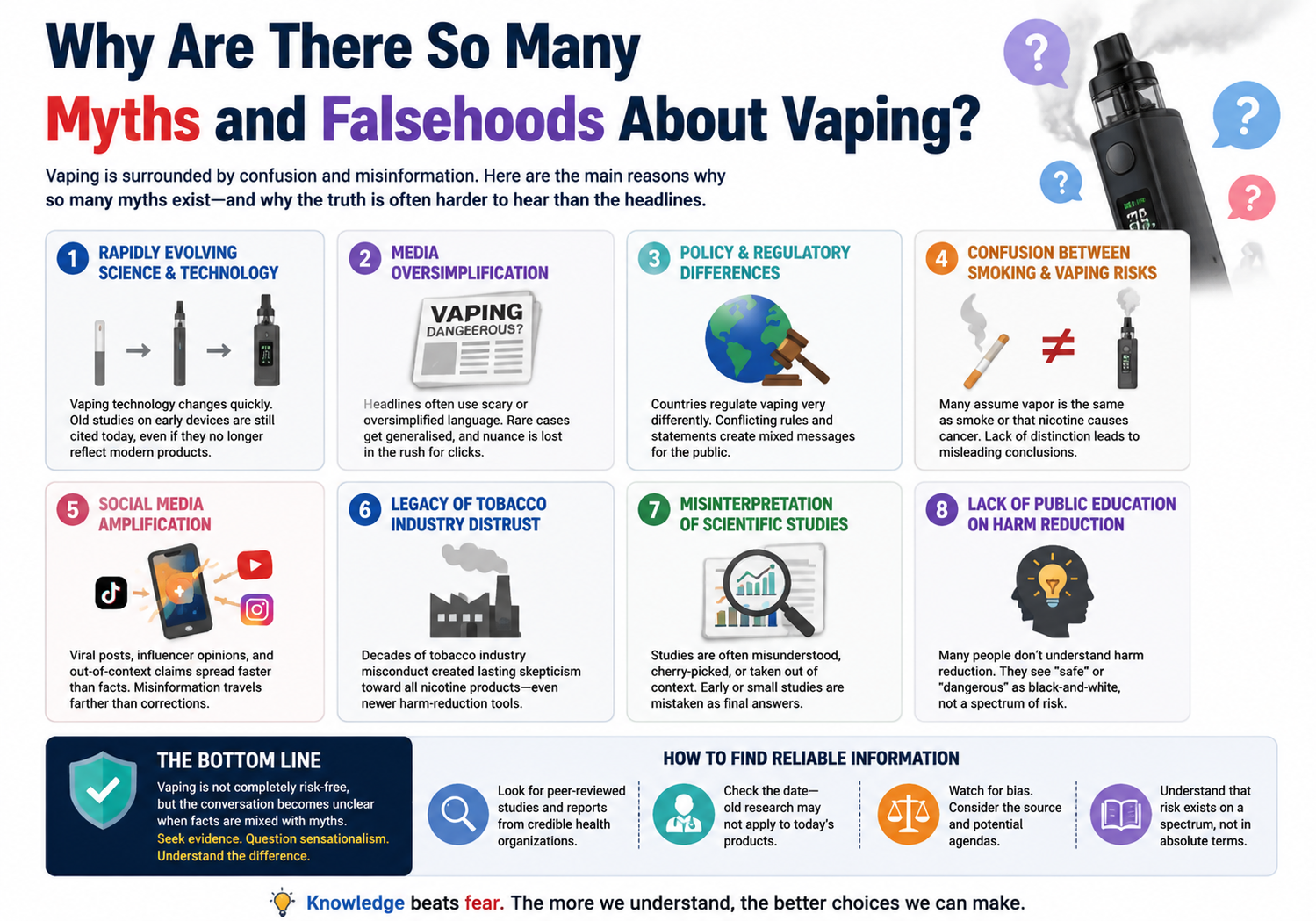
4. Confusion Between Smoking and Vaping Risks
One of the biggest sources of misinformation is the mixing of cigarette smoke risks with vapor aerosol risks.
Many myths come from assumptions such as:
- “Nicotine causes cancer” (it does not directly cause cancer in the way smoke does)
- “Vaping is just as harmful as smoking” (evidence generally shows it is significantly less harmful, though not risk-free)
- “All inhaled chemicals are equally dangerous” (toxicity depends on substance and dose)
Without clear distinctions, misconceptions spread easily.
5. Social Media Amplification
Platforms like TikTok, YouTube, and Facebook can rapidly spread both accurate and inaccurate claims.
Common issues include:
- Viral but unverified health warnings
- Influencer opinions presented as facts
- Out-of-context studies shared without explanation
- Emotional storytelling outweighing scientific nuance
Once misinformation spreads widely, it becomes difficult to correct.
6. Historical Legacy of Tobacco Industry Distrust
The tobacco industry’s past behavior has created long-term skepticism toward all nicotine-related products.
This history leads to:
- General distrust of nicotine products (even newer harm-reduction tools)
- Assumptions that all nicotine products are equally harmful
- Increased sensitivity to any health-related claims
While caution is understandable, it can also blur distinctions between products with very different risk profiles.
7. Misinterpretation of Scientific Studies
Scientific research is often complex and easily misrepresented.
Common problems include:
- Animal or lab studies being applied directly to humans
- Short-term studies being interpreted as long-term conclusions
- Cherry-picking data to support a narrative
- Lack of peer review understanding in public discussions
As a result, legitimate research can be distorted when shared online.
8. Lack of Public Education on Harm Reduction
Many people are not familiar with the concept of harm reduction, which means reducing risk rather than eliminating behavior entirely.
Without this framework, people often assume:
- “Safe” vs “dangerous” is binary
- Any risk means “equally harmful”
- Switching from smoking to vaping is irrelevant
This creates misunderstanding about relative risk comparisons.
Final Thoughts
The myths and falsehoods surrounding vaping are not caused by a single factor, but by a combination of:
- Fast-changing technology
- Media simplification
- Regulatory inconsistency
- Social media amplification
- Misunderstood science
To understand vaping accurately, it is important to separate evidence-based research from opinion, headlines, and outdated information.
Vaping is neither completely risk-free nor equivalent to smoking—but the conversation around it becomes unclear when facts are mixed with misinformation.