









The Battery Life Anxiety
You’ve been there. It’s the middle of a critical shift, and the frantic call comes over the radio: “My unit is dying!” Suddenly, coordination breaks down, tasks are delayed, and safety can be compromised. You thought you bought radios with “long battery life,” but the specs lied—or, more likely, you were never taught how to read them properly.
The truth is, not all battery claims are created equal. A high mAh number doesn’t always translate to all-day use, and “standby time” can be a misleading comfort. Choosing the right radio isn’t just about picking the biggest battery; it’s about understanding real-world performance.
But don’t worry. By the end of this guide, you’ll know exactly how to decode battery specifications and select a device that won’t let your team down. We’ll also spotlight two models—the Retevis MateTalk C3 and C4—that are engineered for real shift-long endurance.
Part 1: mAh, Talk Time & Standby – What These Numbers Really Mean
Let’s break down the terminology clearly and practically:
Battery Capacity (mAh – milliampere-hour)
This is the size of the fuel tank. A 2500mAh battery can theoretically deliver 2500 milliamps of current for one hour.
Reality Check: A bigger number is better, but it’s only part of the story. Power output, features, and usage patterns dramatically affect how quickly that “fuel” is used.
Talk Time (Hours)
This is the most important metric for active teams. It measures how long the radio can continuously transmit. This is where the drain is highest.
Pro Tip: Always prioritize talk time over standby time. A radio with 17 hours of talk time (like the MateTalk C3) will easily last multiple shifts, whereas one with only 8 hours will fail a full-day crew.
Standby Time (Hours)
This measures how long the radio can stay on while only receiving signals. It’s useful, but don’t base your purchase on it. If your team communicates regularly, talk time is king.
The Hidden Factor: Power Management
Advanced power-saving features—like those in the MateTalk series—intelligently reduce energy consumption during inactivity, significantly extending usable life beyond basic specs.
Part 2: Why Your Team’s Workflow Determines the Battery You Need
A security guard on patrol uses the radio differently from a warehouse manager at a desk. Your battery needs depend entirely on duty cycles.
| Use Case | Talk/Standby Ratio | Recommended Specs |
| High-Activity (Construction, Events) | 30% Talk, 70% Standby | 2500mAh battery + 22+ hours talk time |
| Moderate-Activity (Hotel, Retail, Security) | 20% Talk, 80% Standby | 2200mAh battery + 17 hours talk time |
| Low-Activity (Occasional Check-ins) | 10% Talk, 90% Standby | 1500–1800mAh may suffice |
Note: The figures above are for reference only, based on personal experience and practical insights from actual use of commercial two-way radios.
Part 3: Beyond the Battery – Charging Flexibility Matters Too
A great battery is useless if you can’t charge it conveniently. Modern professionals need options:
Type-C Charging: Enables quick top-ups from power banks, car chargers, or laptops. Essential for teams on the move.
Desktop Charging Cradles: Ideal for centralized overnight charging and storage.
Both the MateTalk C3 and C4 offer this dual-charging flexibility, ensuring your team is always powered up, no matter the situation.
Part 4: Two Radios Built for All-Day Missions
Here’s how the MateTalk C3 and C4 turn battery specs into real-world reliability:
- Retevis MateTalk C3 – The Task Management Powerhouse
Battery: 2200mAh
Talk Time: 17 hours
Standby: 100 hours
Charging: Type-C & Desktop Cradle
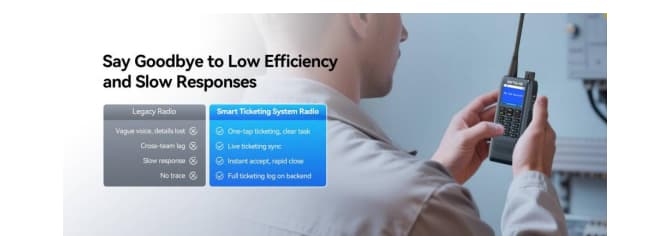
Ideal For: Hotels, retail management, property services – environments where radios are in constant use for task coordination via the Ticketing System, but not always continuously transmitting.
Why It Works: The 2200mAh capacity is intelligently managed to support the C3’s bright LCD screen and digital features without sacrificing a full day’s work. You get multi-shift endurance with modern convenience.
- Retevis MateTalk C4 – The Voice-Controlled Workhorse
Battery: 2500mAh
Talk Time: 22+ hours
Standby: Extensive
Charging: Type-C & Desktop Cradle
Ideal For: Construction, warehousing, event security – high-intensity settings where hands-free operation and longer transmit times are critical.
Why It Works: The larger 2500mAh battery is built to sustain power-hungry operations like voice control and noise cancellation, ensuring the radio lasts even on the most demanding job sites.
Part 5: Your Pre-Purchase Battery Checklist
Before you decide, ask these questions:
What percentage of the shift is spent talking? (Estimate your Talk/Standby ratio.)
Do we have access to charging during breaks? (If yes, Type-C is a major advantage.)
Are we using power-draining features? (Voice control, LCD screens, data transmission.)
What is the manufacturer’s stated talk time? (This is more important than mAh alone.)
For most professional teams, the answer leads to a device with at least 17 hours of talk time and dual-charging versatility.
Conclusion: Power with Purpose
Don’t gamble with communication. By understanding battery specs and aligning them with your team’s actual needs, you invest not just in a radio, but in uninterrupted productivity and safety.
The Retevis MateTalk C3 and C4 demonstrate how thoughtful power design—combining robust batteries, efficient management, and flexible charging—can eliminate battery anxiety for good.
Equip your team with the endurance they deserve.