










I know what you’re facing: teams spread across noisy worksites, long distances, or busy floors, and traditional radios or phones just aren’t cutting it. This kind of communication breakdown is critical, and left unchecked it impacts safety, productivity and team cohesion. Don’t worry — there is a smarter way forward.
- Construction Sites: Handling Noise, Distance and Hands-Free Needs
Construction environments come with a triple-threat: loud background noise, heavy equipment, and workers whose hands are occupied. According to industry analysis, environmental factors such as tall buildings, trees, weather and terrain significantly affect the effectiveness and communication distance of two-way radios.
In practice, that means a worker on scaffolding may struggle to switch channels quickly or even hear a message if their radio isn’t optimized for the environment. Add gloves or bulky gear, and pressing small buttons becomes inefficient or unsafe.
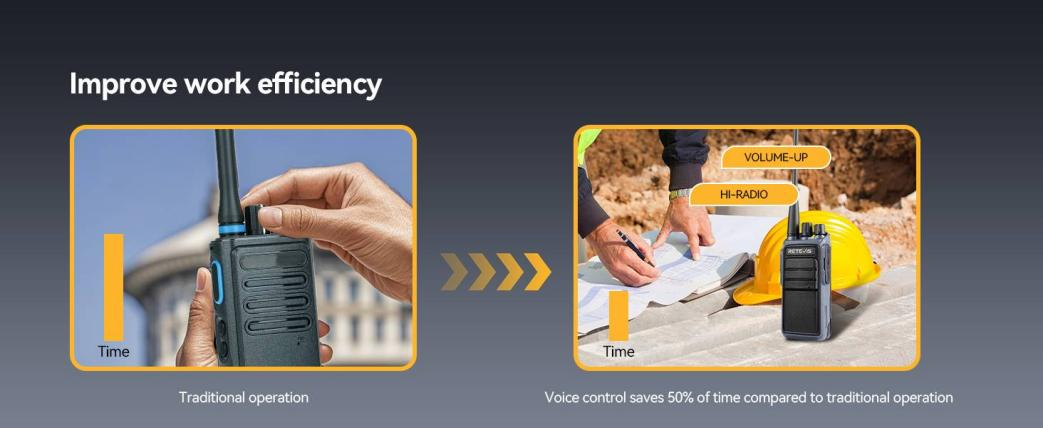
Voice-activated radios allow hands-free operation: speaking commands, changing channels verbally, staying connected without pausing work. That translates into fewer delays, less risk of mis-communication, and improved safety.
- Security & Event Teams: Reducing Response Delays and Enhancing Coordination
In security, retail events or hospitality operations, every second matters. A recent survey in the hospitality field found that about 1 in 5 employees felt unsafe at work because of faulty walkie-talkie radios, and more than 70% resorted to using their personal smartphones on the job when standard radios failed.
This indicates two major pain points: traditional radios failing to connect reliably, and teams compensating with less-ideal tools (smartphones) that introduce their own risks (battery life, distractions, network dependency).
In this context, a reliable voice-controlled radio can ensure instant group communications (no dialing or waiting) and allow security or event staff to respond rapidly to incidents, coordinate across channels, and stay connected even when network coverage is poor.
- Agriculture & Outdoor Work: Overcoming Range & Network Limitations
Outdoor operations — farms, ranches, large agricultural estates — often suffer from network dead zones and large distances between workers. As pointed out in professional analyses, a higher transmission power and well-matched antenna and battery quality significantly extend communication reach and effectiveness for two-way radios.
For example: a field supervisor may need to alert a technician several hundred meters away, or across a ranch area — relying on a cellphone or standard radio with weak power could mean missed or delayed messages. A strong voice-enabled radio system allows direct, instant communications across large sites, with fewer limitations from terrain or network gaps.
- Retail & Hospitality Floors: Seamless Communication Without Disruption
On a busy retail floor or hotel property, staff movement, background noise, and customer interactions make communication tricky. Studies show that workers often feel their tools hinder them: nearly 40% of hospitality employees reported operational issues or guest requests were delayed because of failure to connect effectively over traditional radios.
Here, voice-activated radios enable staff to respond swiftly to requests (“need extra registers”, “guest assistance needed”), without pulling out a smartphone, dialing, or switching channels manually. The result: better staff responsiveness, smoother service, fewer “I’m waiting for a reply” moments, and ultimately improved customer experience.
Why Voice-Activated Two-Way Radios Are Gaining Ground
From the scenarios above, several consistent struggles emerge: ineffective communication, device limitations, and environmental obstacles. Research from industrial communications firms shows that two-way radios “significantly enhance workplace efficiency by enabling direct, real-time, push-to-talk communication that bypasses the delays and limitations of phones, emails and traditional radios.”
Viewed objectively, voice-activated systems combine:
hands-free commands (solving manual input issues)
reliable long-range communication (mitigating distance/interference problems)
durability and battery endurance (critical in heavy-duty settings)
These enhancements align with the real-world pain points we’ve identified across sectors.
Conclusion: Aligning the Right Tool to the Right Environment
Whether you’re overseeing a construction project, managing security at a large facility, coordinating outdoor operations, or delivering premium retail/hospitality service — the communication challenges are distinct but have common roots: delay, interruption, and inefficiency.
Voice-activated two-way radios offer a built-for-purpose solution that reduces friction, enhances connection and supports teams in demanding conditions. For decision-makers exploring smarter communication tools, it’s less about “new gadget” and more about meeting the real operational pain points your teams face every day.