









July 7 Igeekphone News – Boston Dynamics’ humanoid robot Atlas made a special appearance during a FIFA World Cup event, demonstrating its growing athletic abilities by performing soccer skills and delivering the match ball to the referee before kickoff.
According to a report by CNET, Atlas took to the field during the match between Norway and Brazil, giving fans a glimpse of how far humanoid robotics has progressed.
Atlas Demonstrates Soccer Skills on the Pitch
Before officially presenting the match ball, Atlas emerged from the players’ tunnel and recreated several iconic soccer movements on the field, including dribbling and goal-scoring actions, before accurately passing the ball to the referee.
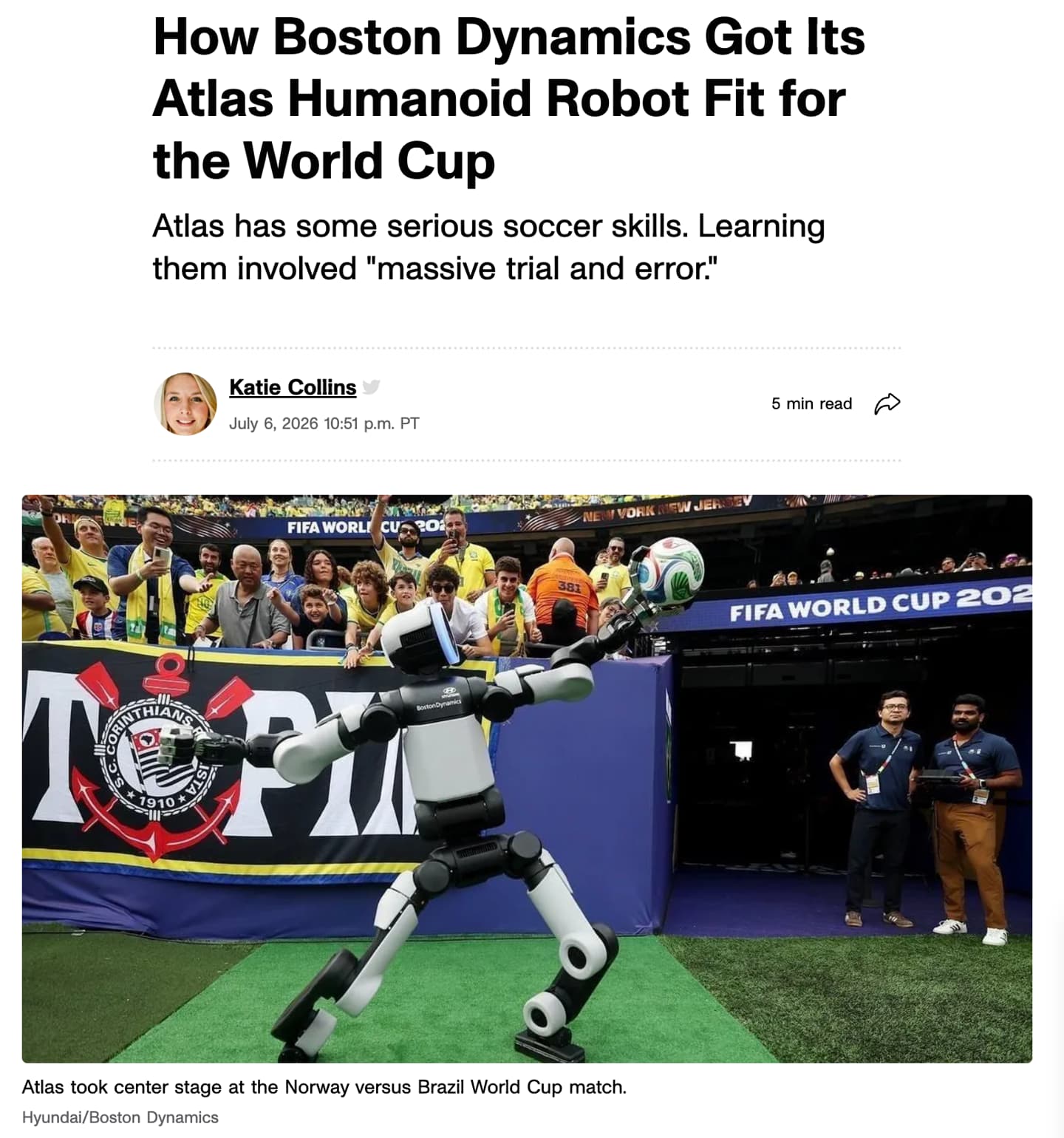
The demonstration highlighted Boston Dynamics’ continued efforts to develop robots capable of performing complex, dynamic movements in real-world environments.
From Factory Floors to Everyday Life
Boston Dynamics says humanoid robots like Atlas are expected to follow a gradual path toward widespread adoption.
The company envisions the robots being deployed first in industrial environments, followed by service and entertainment applications, before eventually becoming part of everyday life in homes.
Although that transition is still years away, Boston Dynamics believes public demonstrations like this help make embodied AI more accessible and showcase the practical potential of advanced humanoid robotics.
How Atlas Learned to Play Soccer
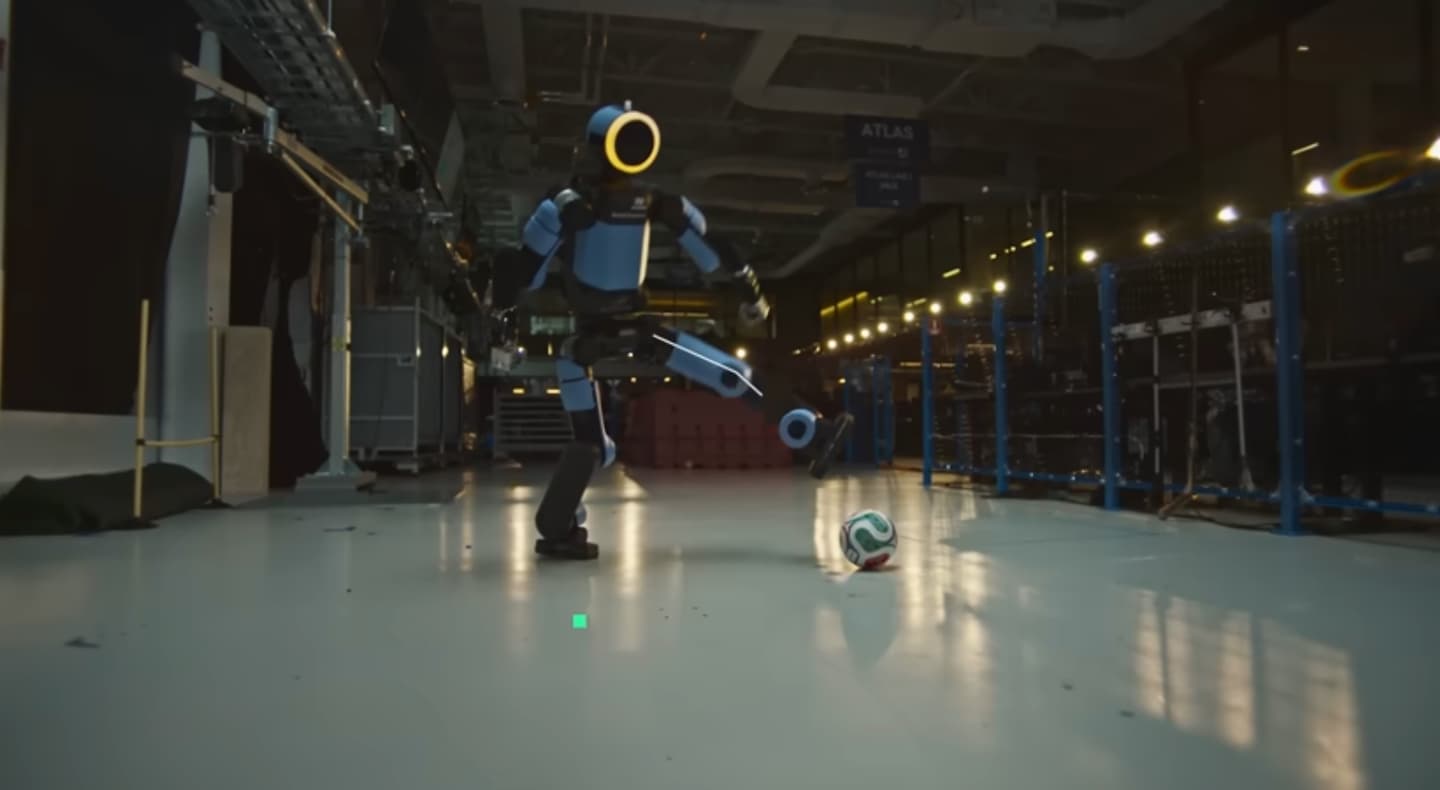
Training Atlas to perform soccer movements begins with motion capture technology.
Engineers first record human movements using motion capture systems before transferring the data into a virtual simulation environment. Inside the simulator, Atlas repeatedly practices the movements, learning through trial and error while adapting each action to match its own physical capabilities.
Only after mastering the skills in simulation are they transferred to the physical robot.
Two Stages of Learning
According to Alberto Rodriguez, Director of Robot Engineering at Boston Dynamics, teaching Atlas to play soccer involves two key stages.
The first focuses on whole-body motion control, where the robot learns to maintain balance, recover from instability, and coordinate its movements. These foundational skills serve as the robotic equivalent of muscle memory, enabling Atlas to perform advanced actions such as dancing, gymnastics, and athletic maneuvers.
The second stage is significantly more challenging—object manipulation.
For soccer, Atlas must accurately judge the ball’s position while accounting for factors such as friction, surface conditions, and the risk of slipping. Rodriguez noted that controlling a moving soccer ball is even more difficult than teaching the robot to perform a backflip.
Failure Is Part of the Training Process
Developing advanced movement skills inevitably involves countless falls.
Rodriguez explained that robots frequently enter unstable or extreme positions during training, making collisions and falls unavoidable.
Boston Dynamics has built a comprehensive maintenance and repair system to support this process, treating hardware wear and repairs as a normal part of robot development rather than unexpected setbacks.
Robot vs. Robot Matches May Be the Future
While Atlas’ soccer demonstration has sparked excitement, Rodriguez believes humanoid robots are unlikely to compete directly against professional human players anytime soon.
Instead, he sees a future where robots compete against one another in dedicated robotic sporting events, offering a new platform to showcase advances in artificial intelligence, locomotion, and autonomous decision-making.
As humanoid robotics continues to evolve, demonstrations like Atlas’ World Cup appearance illustrate how embodied AI is moving beyond laboratory research and gradually entering public life through sports, entertainment, and real-world applications.