









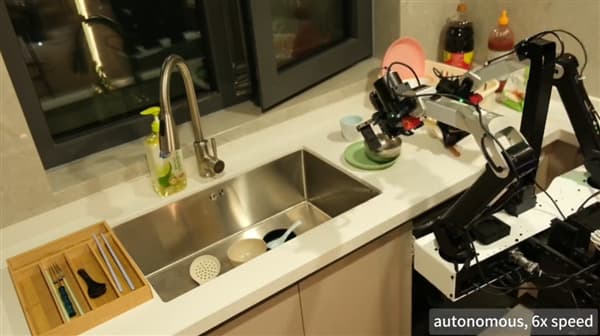
Igeekphone News, July 16th: Today, Xiaomi officially launched the robot base model “Xiaomi-Robotics-1”. This model has undergone pre-training based on 100,000 hours of real-world operation data and combined with cross-ontology post-training, truly achieving the “out-of-the-box usability” of a embodied base model.
During the pre-training stage, the research and development team utilized 100,000 hours of real-world operation trajectories.
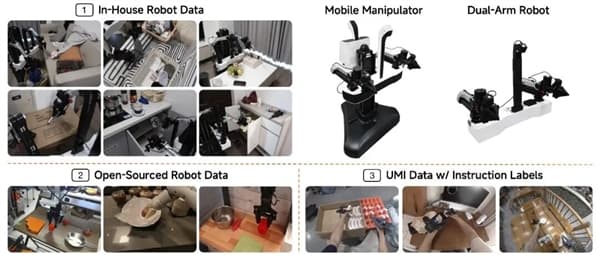
These data are collected through the Universal Manipulation Interface (UMI) device and cover various environments such as homes, commercial spaces, industrial settings, offices and outdoors. They include a large number of object interactions and operational behaviors.
To handle such a huge amount of data, the team developed a scalable automatic annotation process: Firstly, the long operation trajectories were divided into fixed-length segments, and then a visual language model was used to describe the changes in the gripper states and the states of the interacting objects within each segment.
Through this process, the model can learn to generate action sequences that can drive changes in the scene state under the current visual observation and language conditions.
It is introduced that this automatic annotation process can complete the high-quality annotation of all 100,000 hours of data within approximately two weeks, significantly improving the processing efficiency of the robot training data.
Xiaomi-Robotics-1 adopts a two-stage training paradigm of pre-training and post-training.
During the pre-training stage, the model mainly learns the ability to generate common actions. Given the current visual observation and description of state changes, the model needs to predict an action sequence that enables the scene to transition from the current state to the target state.
In the post-training stage, the main tasks are to solve the two major problems of entity alignment and instruction alignment.
Among them, the entity alignment involves transferring the action generation capability learned by the model from UMI data to the actual robot’s body.
Instruction alignment involves transforming the ability to “generate actions based on state changes description” into the ability to “execute tasks according to human natural language instructions”.
To this end, the team constructed approximately 10,000 hours of cross-ontology post-training data, which included over 7,200 hours of data from mobile operation robots and dual-arm robots, over 1,000 hours of manually annotated UMI data, as well as public robot datasets such as Bridge V2, RT-1, and DROID.
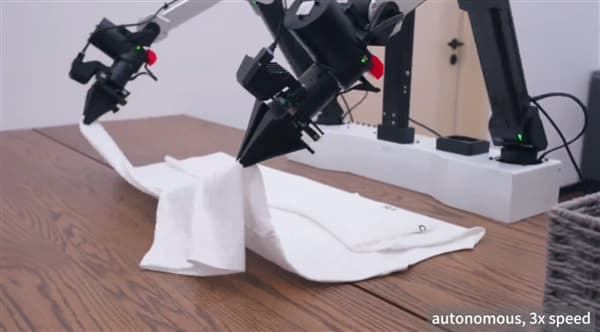
After completing the training, the Xiaomi-Robotics-1 can understand natural language instructions in real environments and directly perform various types of mobile operation tasks.
In terms of performance, the Xiaomi-Robotics-1 has achieved leading results in several robot benchmark tests.
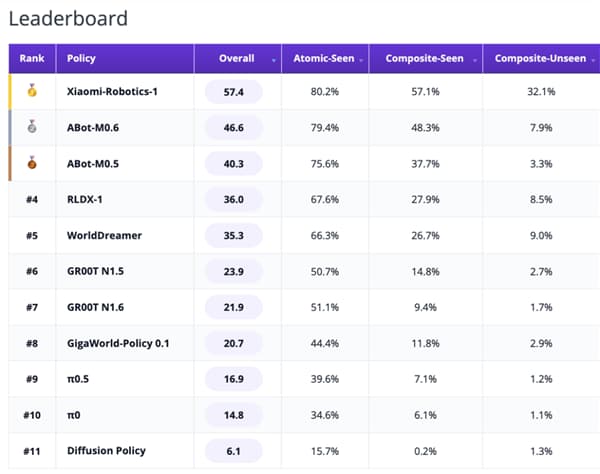
In the RoboCasa365 benchmark, the model achieved an average success rate of 57.4%, which was higher than the 46.6% of the previous optimal method; especially in the Composite-Unseen task division, it demonstrated strong task combination generalization ability.
In the RoboDojo simulation evaluation, Xiaomi-Robotics-1 topped the leaderboard with an average score of 20.07 and an average success rate of 13.93%, significantly outperforming the previous industry best method with an average score of 13.07 and a success rate of 8.80%.
In the VLABench benchmark, this model also achieved the current best performance, with an average success rate of 59.1% and an average progress score of 70.3%.
Furthermore, in the RoboCasa benchmark, the average success rate of Xiaomi-Robotics-1 was 74.5%, surpassing models such as RLDX-1, Cosmos Policy, GR00T N1.6, Pi-0.5, and Pi-0-FAST.