







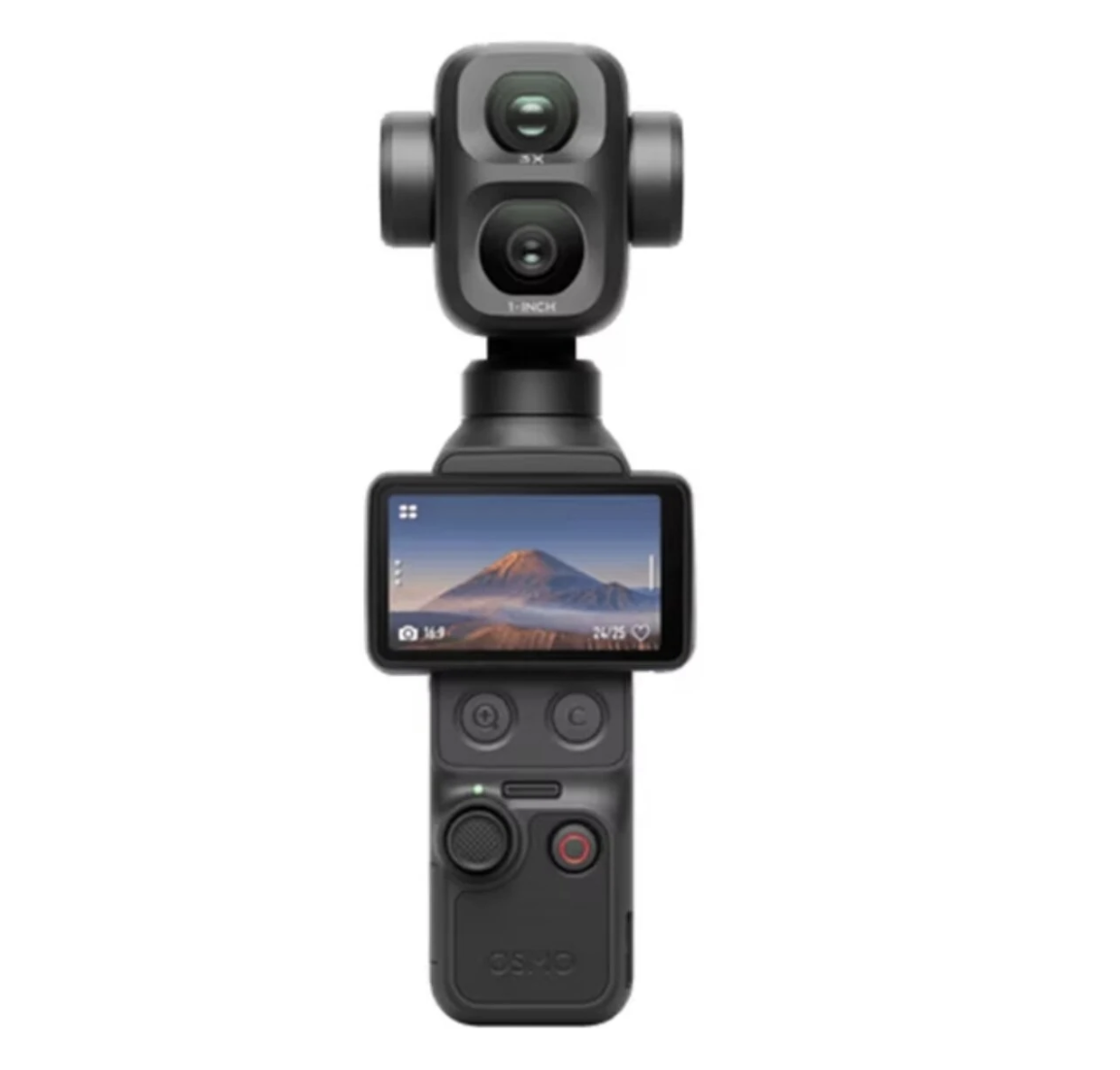
DJI Osmo Pocket 4P takes the pocket gimbal camera concept a step further by combining a three-axis mechanical gimbal with a dual-camera system. Instead of relying on a single lens, the Pocket 4P pairs a 20mm-equivalent wide-angle camera with a 60mm-equivalent medium-telephoto camera, giving vloggers, travelers and content creators more flexibility when shooting subjects at different distances.
Its main wide-angle camera uses a 1-inch CMOS sensor and offers up to 17 stops of dynamic range, while the second camera uses a 1/1.28-inch sensor with a 60mm f/1.8 lens. DJI also adds 10-bit D-Log 2, intelligent autofocus, ActiveTrack, vertical shooting and 4K slow-motion recording.
This combination makes the Osmo Pocket 4P more than a simple handheld camera. It is designed to give creators a compact system for vlogging, travel videos, portraits, social-media content and cinematic-style footage.
DJI Osmo Pocket 4P Key Specifications
| Feature | DJI Osmo Pocket 4P |
|---|---|
| Camera system | Dual cameras |
| Main sensor | 1-inch CMOS |
| Telephoto sensor | 1/1.28-inch CMOS |
| Wide-angle focal length | 20mm equivalent |
| Medium-tele focal length | 60mm equivalent |
| Main aperture | f/2.0 |
| Telephoto aperture | f/1.8 |
| Dynamic range | Up to 17 stops |
| Video | Up to 4K/240fps slow motion |
| Stabilization | 3-axis mechanical gimbal |
| Display | 2-inch OLED |
| Color profile | 10-bit D-Log 2 |
| Tracking | ActiveTrack |
| Vertical shooting | Supported |
| Built-in storage | 103GB |
| Weight | Approximately 230g |
DJI’s official specifications list a 1-inch wide-angle camera, a 1/1.28-inch medium-tele camera, 20mm and 60mm equivalent focal lengths, up to 17 stops of dynamic range and 4K/240fps recording on the wide camera.
Dual Cameras Are the Biggest Upgrade
The most noticeable difference between the Pocket 4P and a conventional pocket gimbal camera is the dual-lens design.
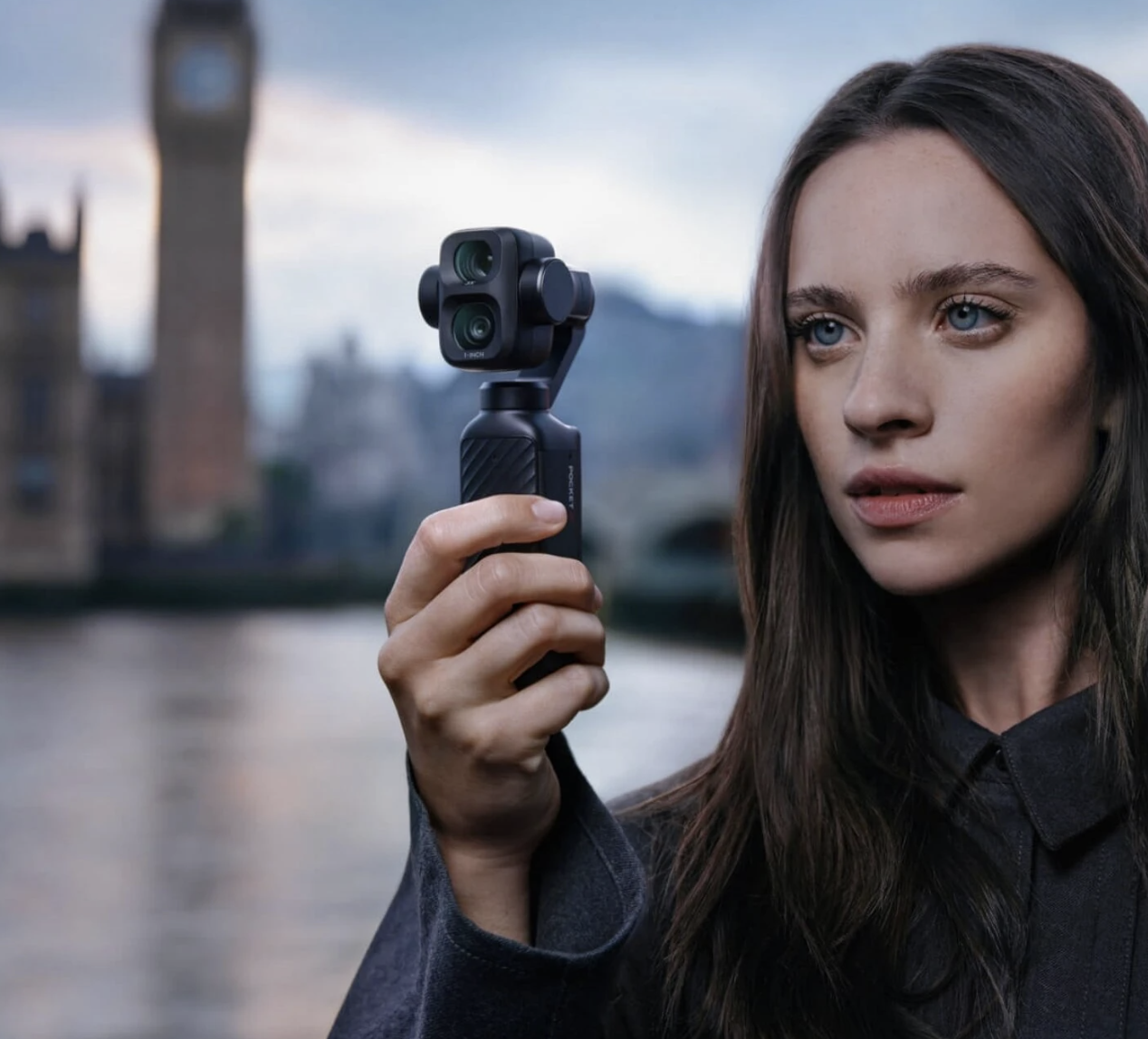
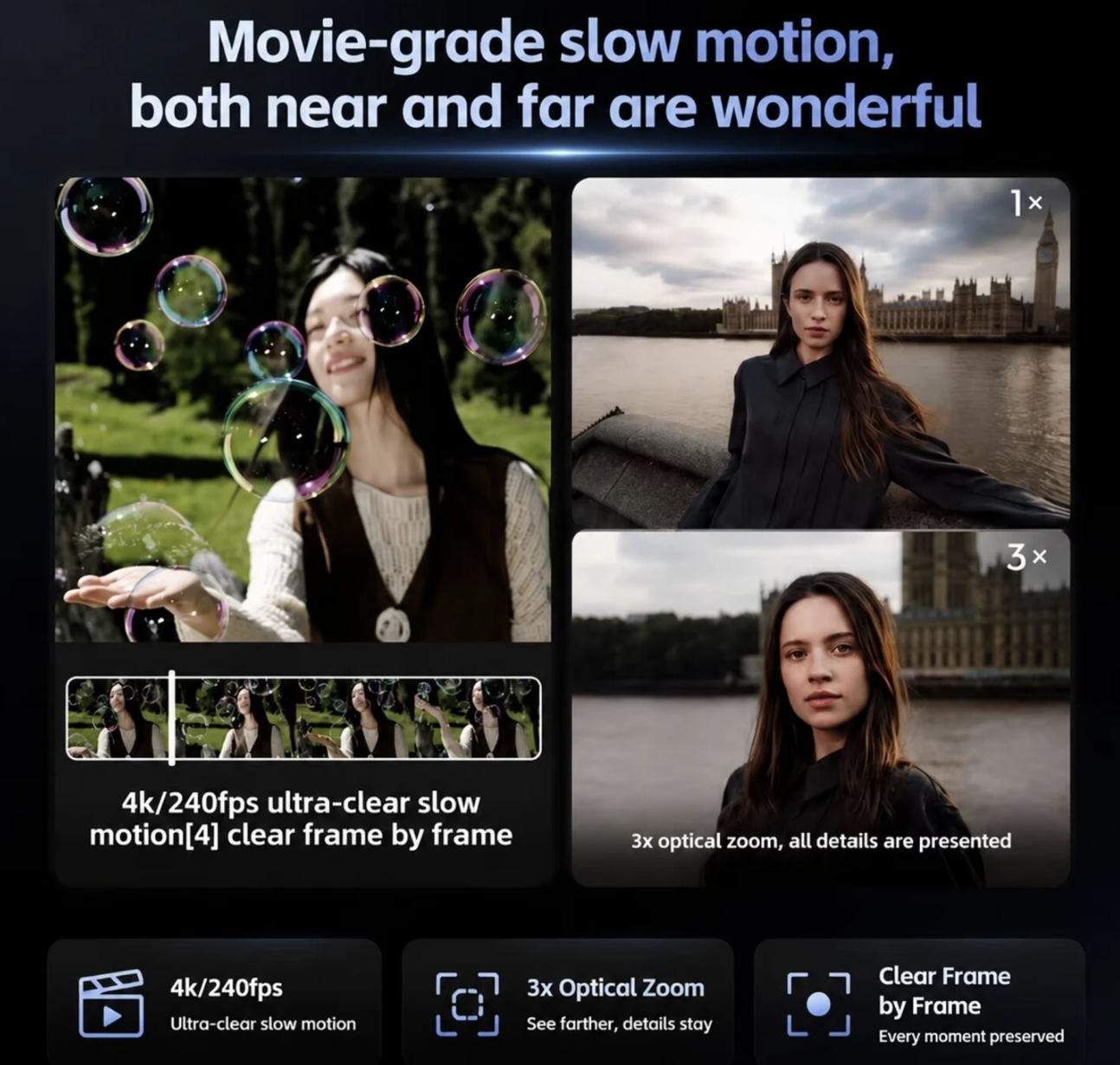
The primary camera uses a 20mm-equivalent wide-angle lens, making it suitable for landscapes, travel footage, group shots and handheld vlogging. The second camera uses a 60mm-equivalent medium-telephoto lens, which is better suited to portraits, close-ups and subjects that are farther away.
The two cameras do not record simultaneously. Instead, the system switches between the appropriate physical lens according to the selected shooting range.
This is an important distinction because the dual-camera setup is primarily about focal-length flexibility, rather than creating a conventional multi-camera recording system.
For creators who frequently move between wide environmental shots and tighter subject shots, having two dedicated focal lengths in such a small body can be extremely convenient.
1-Inch CMOS Sensor for the Main Camera
The main wide-angle camera features a 1-inch CMOS sensor.
A larger sensor can generally provide advantages in image quality, low-light performance and depth-of-field control compared with smaller camera sensors, although the final result also depends on lens design, image processing and shooting conditions.
DJI says the Pocket 4P’s new 1-inch sensor uses LOFIC technology and can deliver up to 17 stops of dynamic range on the wide-angle camera.
That makes the camera particularly interesting for scenes containing both bright and dark areas, such as sunsets, city streets, indoor environments with windows, and high-contrast landscapes.
17 Stops of Dynamic Range
Dynamic range is another major selling point.
The Pocket 4P’s wide-angle camera is rated for up to 17 stops of dynamic range, giving it more room to retain information in highlights and shadows.
This can be especially valuable for travel and cinematic video because outdoor scenes often contain dramatically different brightness levels.
For example, when filming a person standing in front of a bright sunset, greater dynamic range can help preserve more detail across the scene.
However, the 17-stop figure should be regarded as a manufacturer specification under defined conditions rather than a guarantee that every real-world shot will contain 17 stops of usable detail.
60mm f/1.8 Medium-Telephoto Camera
The second camera is where the Pocket 4P becomes particularly interesting for portrait creators.
It uses a 60mm-equivalent focal length and an f/1.8 aperture. DJI positions this camera for portraits and distant details, with the wider aperture helping create natural background separation.
A 60mm-equivalent lens also provides a noticeably different perspective from the 20mm wide-angle camera.
Instead of moving physically closer to a subject, creators can switch to the medium-telephoto camera for a tighter composition.
For travel vloggers, this means one pocket-sized camera can cover both:
- Wide environmental scenes
- Selfie-style vlogging
- Group shots
- Portraits
- Detail shots
- More distant subjects
4K Slow Motion
The Pocket 4P supports 4K slow-motion recording at up to 240fps with the wide-angle camera. The medium-tele camera can record 4K slow motion at up to 200fps according to DJI’s specifications.
High-frame-rate recording is useful for capturing fast movement and creating smooth slow-motion sequences.
Potential applications include:
- Sports
- Cycling
- Skateboarding
- Water activities
- Dancing
- Vehicle footage
- Travel scenes
- Creative cinematic sequences
It is worth noting that 4K/240fps is a slow-motion mode rather than the camera’s normal maximum frame rate for every shooting mode.
10-Bit D-Log 2 for Video Creators
For users who edit their footage, the 10-bit D-Log 2 profile is another significant feature.
DJI says D-Log 2 is designed to capture a broader range of tonal information and provide greater flexibility during post-production. The format can record more than one billion colors, helping creators achieve smoother color transitions and more control over the final look.
This is particularly useful for creators who intend to color-grade their footage rather than uploading straight from the camera.
For casual users who prefer quick social-media videos, however, a standard color profile may be more convenient.
3-Axis Mechanical Gimbal Stabilization
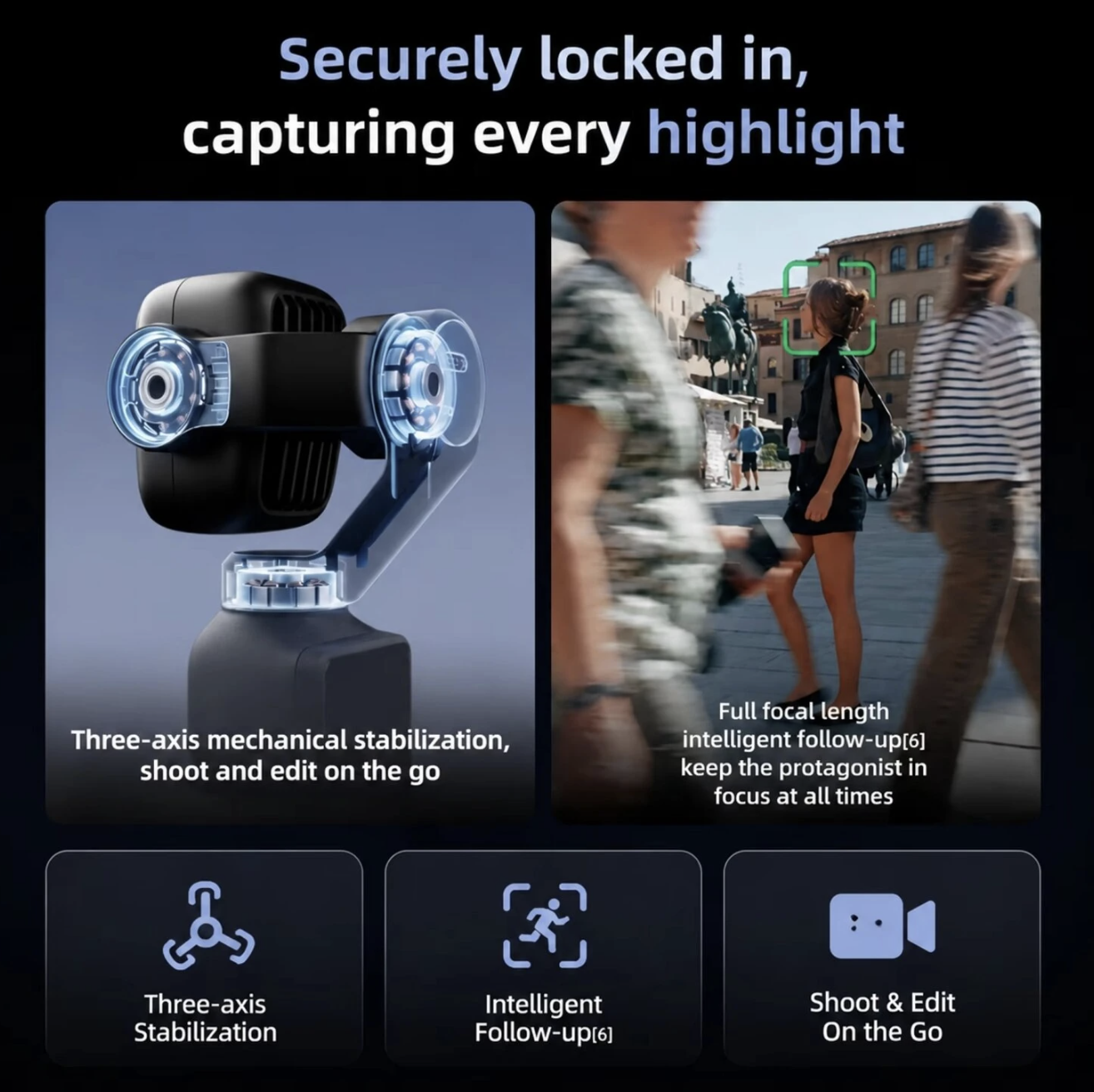
The Pocket 4P retains one of the defining characteristics of the Osmo Pocket family: three-axis mechanical gimbal stabilization.
Unlike electronic stabilization alone, a mechanical gimbal physically compensates for camera movement.
This is useful when:
- Walking while filming
- Recording travel footage
- Following a moving subject
- Shooting handheld vlogs
- Capturing smooth camera movements
The result is designed to look more stable and controlled than footage captured from a conventional handheld camera without mechanical stabilization.
ActiveTrack Subject Tracking
The Pocket 4P also includes DJI’s ActiveTrack subject-tracking system.
This allows the camera to recognize and follow a selected subject while the gimbal adjusts its orientation.
For solo creators, this can be especially useful because it reduces the need for another person to operate the camera.
A creator can set up the camera, select the subject and concentrate on speaking or performing while the gimbal attempts to keep the subject within the frame.
DJI says the Pocket 4P’s updated tracking system supports tracking at up to 12× zoom.
Tracking performance can still vary with lighting, subject movement, obstacles and shooting mode.
2-Inch OLED Touchscreen
The Pocket 4P features a 2-inch OLED display.
The screen provides access to shooting settings and allows users to frame their compositions without necessarily connecting a smartphone.
The display also supports vertical shooting, making the camera more convenient for creators producing content for platforms that favor portrait-oriented video.
This is particularly useful for TikTok, Instagram Reels, YouTube Shorts and other vertical-video formats.
Built-In Storage
Another practical advantage is the camera’s built-in storage.
DJI lists approximately 103GB of built-in storage for the Pocket 4P.
Built-in storage means users can start recording without immediately inserting a separate memory card.
For frequent shooting, however, creators should still consider their storage requirements because high-resolution and high-frame-rate video can consume storage quickly.
Battery Life and Portable Design
The Pocket 4P is designed to remain small enough for everyday carry while still offering substantial camera functionality.
DJI rates operating time at up to 210 minutes under its specified testing conditions.
Real-world battery life will vary depending on:
- Resolution
- Frame rate
- Screen brightness
- Tracking
- Wi-Fi usage
- Gimbal operation
- Environmental temperature
- Shooting habits
High-frame-rate 4K recording and intensive tracking will generally place greater demands on the battery than basic video recording.
Is the DJI Osmo Pocket 4P Good for Vlogging?
The Pocket 4P is particularly well suited to vlogging.
The wide-angle 20mm camera provides enough perspective for handheld talking-head footage, while the gimbal keeps movement smooth when walking.
The 60mm camera adds another useful option for creators who want tighter compositions or portrait-style shots.
ActiveTrack can also help solo vloggers remain centered in the frame without requiring a separate camera operator.
For travel creators, the biggest benefit may be the fact that one small camera can cover multiple shooting scenarios.
Is the Pocket 4P Good for Travel Photography?
Yes, the dual-camera design makes it particularly attractive for travel.
The 20mm-equivalent lens works well for architecture, landscapes and environmental scenes, while the 60mm-equivalent lens provides a tighter perspective for portraits and distant details.
Instead of carrying a camera body with multiple lenses, a travel creator can put the Pocket 4P in a small bag or pocket and have two useful focal lengths available.
The built-in gimbal also eliminates the need for a separate handheld stabilizer.
DJI Osmo Pocket 4P Pros and Cons
Pros
- Dual-camera system
- 1-inch main camera sensor
- 60mm f/1.8 medium-telephoto camera
- Up to 17 stops of dynamic range
- 10-bit D-Log 2
- 4K high-frame-rate slow motion
- 3-axis mechanical gimbal
- ActiveTrack subject tracking
- 2-inch OLED touchscreen
- Vertical shooting
- 103GB built-in storage
- Compact design
- Excellent versatility for travel and vlogging
Cons
- Dual-camera system does not record both lenses simultaneously
- High-end features may be unnecessary for casual users
- High-frame-rate recording can consume significant storage
- Advanced color profiles require more post-production knowledge
- Small body means controls are more compact than those on a conventional camera
- Battery life depends heavily on recording conditions
DJI Osmo Pocket 4P vs. Osmo Pocket 4
The Pocket 4P is positioned above the standard Pocket 4 mainly because of its dual-camera system.
| Feature | Osmo Pocket 4P | Osmo Pocket 4 |
| Main sensor | 1-inch CMOS | 1-inch CMOS |
| Second camera | 1/1.28-inch, 60mm | No |
| Wide-angle lens | 20mm f/2.0 | 20mm f/2.0 |
| Dynamic range | Up to 17 stops | Up to 14 stops |
| Color profile | 10-bit D-Log 2 | 10-bit D-Log |
| Max slow motion | Up to 4K/240fps | Up to 4K/240fps |
| Stabilization | 3-axis gimbal | 3-axis gimbal |
| Built-in storage | 103GB | 107GB |
| Main advantage | Dual focal lengths | Simpler single-camera design |
DJI’s own comparison confirms that the Pocket 4P adds a 60mm medium-telephoto camera and increases the advertised dynamic range from 14 stops on the Pocket 4 to up to 17 stops on the Pocket 4P.
For users who mainly shoot wide-angle vlogs, the standard Pocket 4 may be sufficient. For creators who frequently shoot portraits, close-ups and distant details, the Pocket 4P’s second camera is much more compelling.
Who Should Buy the DJI Osmo Pocket 4P?
The Pocket 4P is especially suitable for:
- Travel vloggers
- YouTube creators
- Short-form video creators
- Solo filmmakers
- Portrait creators
- Content creators who value portability
- Travelers who want multiple focal lengths
- Users who want mechanical stabilization without carrying a large gimbal
It may be less suitable for someone who primarily wants a simple point-and-shoot camera or does not plan to edit and color-grade video.
Final Verdict
DJI Osmo Pocket 4P is an ambitious pocket-sized gimbal camera that combines portability with features normally associated with more advanced video equipment.
Its defining feature is the dual-camera system. The 20mm-equivalent 1-inch wide-angle camera handles vlogging, landscapes and everyday shooting, while the 60mm f/1.8 medium-telephoto camera provides a more flattering perspective for portraits and a tighter view of distant subjects.
The addition of 17-stop dynamic range, 10-bit D-Log 2, 4K slow motion, three-axis stabilization and ActiveTrack makes it particularly attractive to serious content creators.
For casual users, some of these capabilities may be more than necessary. But for vloggers and travelers who want a compact camera capable of producing more cinematic-looking footage without carrying a larger interchangeable-lens setup, the Pocket 4P is one of the most versatile pocket gimbal cameras in its class.
In short, the DJI Osmo Pocket 4P is best viewed as a portable two-lens content-creation camera: small enough for everyday travel, but powerful enough for demanding video workflows.