









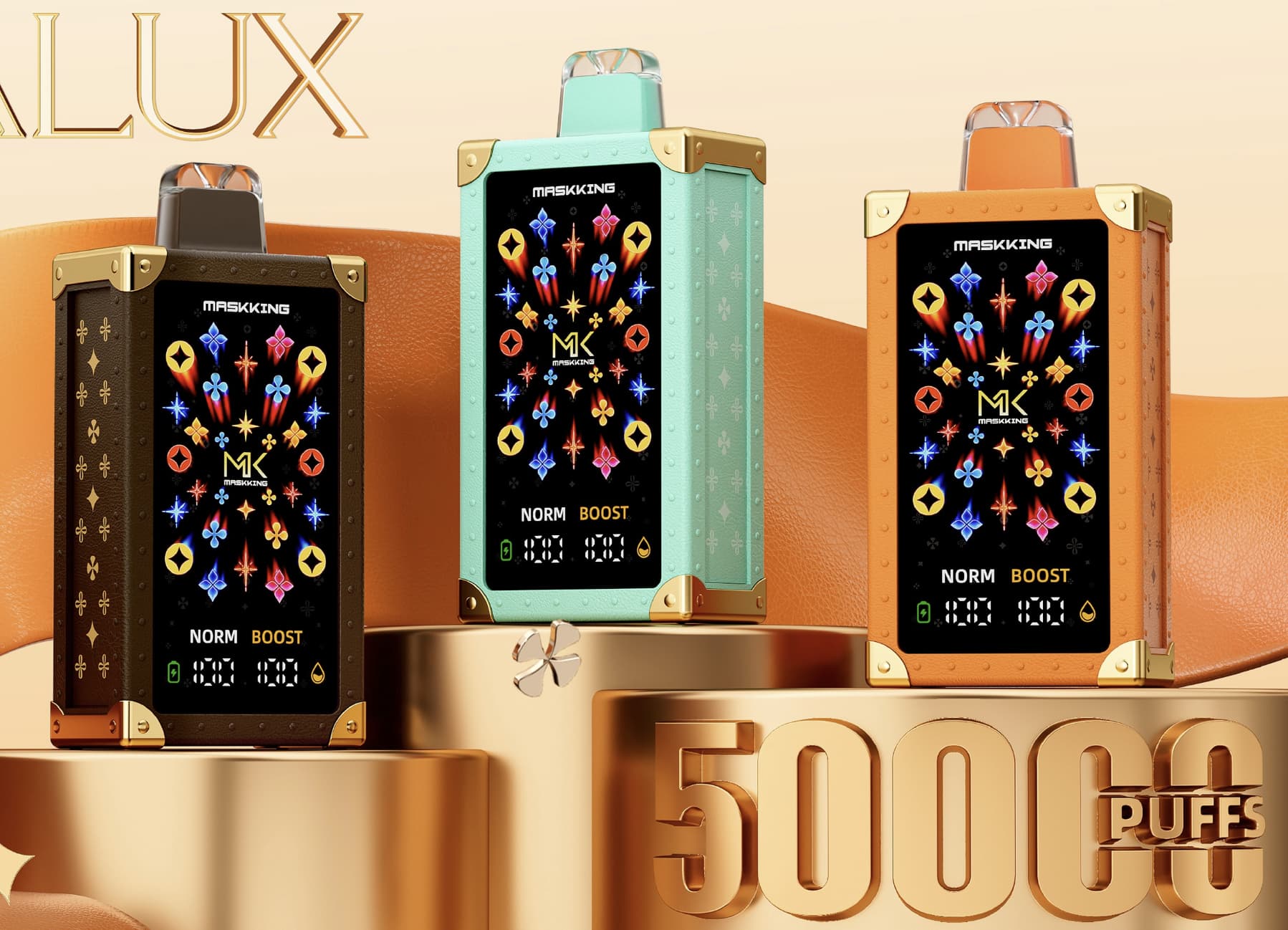
A battery rating and a puff-count figure may appear to describe the same thing: how long a vape lasts. In reality, they measure different aspects of a device. Battery capacity indicates how much electrical charge a battery can store under specified conditions, while an advertised puff count estimates how many draws a device may deliver over its intended service life.
Maskking Malux 50K disposable provides a useful example. According to the manufacturer’s published specifications, it combines a 650mAh rechargeable battery with a USB Type-C charging port, a 0.5Ω dual-mesh coil, and Norm and Boost operating modes. The product is advertised for up to 50,000 puffs. These specifications describe different parts of the hardware system, and none should be interpreted in isolation.
Understanding how these components work together helps explain why battery capacity alone cannot confirm or disprove a high puff-count claim.
1. What Does a 650mAh Battery Actually Mean?
The term mAh stands for milliampere-hour. It describes a battery’s electrical charge capacity, rather than directly stating how many puffs the device can produce.
A 650mAh battery has a nominal capacity of 0.65 ampere-hours under the relevant rated conditions. The amount of time it can power a device depends on the current drawn by its electronics and heating system, as well as operating conditions and battery characteristics.
For example, a device that draws more current will generally use its stored charge faster than one that draws less current. Actual runtime also depends on voltage, circuit efficiency, temperature, battery condition, and how frequently the heating element is activated.
This distinction matters because the heating coil is only one part of a vape’s electrical system. The control circuitry, display, sensors, and other electronics may also consume energy.
The Malux 50K’s 650mAh specification therefore describes its battery capacity, not the total number of puffs available across the device’s entire service life.

2. How Can a 650mAh Battery Support an Advertised 50,000-Puff Device?
The important distinction is rechargeability.
A rechargeable device does not need to obtain all its operating energy from one battery charge. Instead, the battery can be recharged during the device’s intended service life, allowing it to supply power across multiple charging sessions.
The Malux 50K is listed with Type-C charging. Its battery can therefore be replenished rather than being limited to a single discharge cycle, assuming normal operation and an intact charging system.
This is different from asking how many puffs a single charge can support. A device’s lifetime puff count and its per-charge runtime are separate measurements.
Consider three distinct questions:
- Battery capacity: How much electrical charge can the battery store?
- Runtime per charge: How long can the device operate before needing another charge?
- Total device lifespan: How many draws can the complete device deliver before its usable e-liquid or another essential component reaches its limit?
A 650mAh rating answers only part of the first question. It does not independently establish the answers to the other two.
The advertised 50,000-puff figure should consequently be evaluated as a separate manufacturer claim, not calculated directly from the battery’s mAh rating.
A similar battery rating appears in other high-capacity devices, including the Maskking UCEE MAX refillable pod kit, illustrating why battery capacity should be evaluated alongside e-liquid capacity and device design.
3. E-Liquid Capacity Is a Missing Piece of the Puzzle
Battery capacity is only one factor affecting how long a high-capacity vape can operate. The amount of e-liquid available is another major factor.
Each draw consumes some e-liquid as the heating element produces an aerosol. The quantity used per draw can vary with draw duration, airflow, power output, coil characteristics, and the way the device is operated.
A larger liquid reservoir can support more draws when other conditions are comparable. However, reservoir size alone cannot establish an exact puff count either, because different devices may consume different quantities of liquid per draw.
For the Malux 50K, the manufacturer’s published specifications cited above identify the battery, coil, charging connection, operating modes, and advertised puff count. A reliable calculation would also require verified liquid-capacity information and details about the conditions used to determine the puff rating.
Without those details, it would be misleading to derive a precise number of puffs from the 650mAh battery alone.
When evaluating any high-puff device, look for the liquid capacity in millilitres, the battery specification, and a clear explanation of how the puff-count estimate was obtained. If a specification is not published, treat it as unknown rather than filling the gap with assumptions.
4. Why Coil Design Matters to Energy Consumption
The heating system determines how electrical energy is used to vaporize e-liquid. Its design can therefore influence battery consumption and the quantity of liquid used during operation.
The Malux 50K lists a 0.5Ω dual-mesh coil. Resistance, measured in ohms, describes opposition to electrical current. Mesh refers to the heating-element structure, which provides a distributed heating surface.
However, resistance by itself does not tell you exactly how much power a device uses. Electrical power also depends on the voltage across the coil and the way the device’s control circuit operates.
For a resistive heating element, the relationship can be expressed as:
Here, (P) represents electrical power, (V) is voltage across the element, and (R) is resistance. This relationship illustrates why the same resistance value can correspond to different power levels at different voltages.
A dual-mesh configuration also does not automatically mean that a device uses twice the energy of a single-mesh design. The actual electrical arrangement, control settings, and operating conditions matter.
For this reason, the Malux’s 0.5Ω coil specification provides useful hardware information, but it is not enough to calculate battery runtime or verify the advertised 50,000-puff capacity.
For another example of Maskking’s dual-mesh hardware, see the Maskking FEXO 45000 specifications, which list a 0.4Ω dual-mesh coil and an 850mAh rechargeable battery.
5. Norm and Boost Modes Can Change Consumption
The Malux 50K includes two operating modes identified by the manufacturer as Norm and Boost. Different modes can affect how a device delivers power, but the precise difference depends on its implementation.
If Boost mode operates the heating system at a higher power level or for a longer effective heating period, it may consume more energy and e-liquid per draw. That could reduce the number of draws available from a given amount of liquid or between charges.
Norm mode may use a different power configuration, but the actual relationship should be established from documented output specifications or controlled measurements rather than inferred from the mode names alone.
This is another reason a single advertised puff count needs context. A device’s results can vary according to the mode used and the conditions under which its rating was determined.
For a meaningful comparison between two devices, the testing conditions should be consistent. Otherwise, a difference in advertised or observed puff counts may reflect different operating settings rather than a straightforward difference in hardware efficiency.
6. Why Advertised Puff Counts Are Not Guaranteed Results
An advertised puff count is best treated as an estimate associated with a particular product, not a promise that every user will obtain exactly that number.
Draws differ in duration and frequency. A short draw and a longer draw do not necessarily consume the same quantity of liquid or energy. Power settings, coil condition, airflow, battery performance, and the device’s design can also affect the result.
The testing method matters, too. A puff-count figure is more useful when the manufacturer explains the draw duration, interval, operating mode, and other relevant conditions used to establish it.
Without a published test method and independent verification, the advertised figure cannot be treated as a standardized measurement that guarantees identical performance across different devices.
For the Malux 50K, the most accurate wording is that it is advertised for up to 50,000 puffs. Confirming the number independently would require transparent testing and sufficient information about the device’s liquid capacity and operating conditions.
7. A Practical Checklist for Evaluating a High-Puff Vape
Rather than relying on one headline number, compare the underlying specifications.
| Specification | What it tells you | What it cannot prove alone |
|---|---|---|
| Battery capacity in mAh | Rated electrical charge capacity | Total lifetime puff count |
| Rechargeable design | Whether the battery can be replenished as intended | How many puffs one charge will deliver |
| E-liquid capacity in mL | The stated volume of available liquid | Exact number of usable draws |
| Coil resistance in Ω | Electrical resistance of the heating element | Exact power consumption or efficiency |
| Operating modes | Available power or operating configurations, as documented | Performance differences without mode specifications |
| Advertised puff count | The manufacturer’s stated estimate | Independently verified real-world lifespan |
| Published test method | The conditions behind a puff-count claim | Identical results for every user |
This checklist is useful beyond the Malux. It can help readers compare high-capacity devices without assuming that a larger battery necessarily means more puffs, or that two products with the same advertised count will perform identically.
Conclusion: Battery Capacity and Puff Count Measure Different Things
The Maskking Malux 50K illustrates why a 650mAh battery rating should not be read as a direct measure of total device lifespan. Battery capacity describes one part of the electrical system, while the advertised puff count relates to the performance claimed for the complete device.
Rechargeability, e-liquid capacity, coil design, operating modes, and test conditions all matter when assessing that claim. The battery’s mAh figure alone cannot establish whether a 50,000-puff rating is achievable under particular conditions.
The most reliable way to evaluate a high-puff vape is to examine the full set of specifications and distinguish manufacturer estimates from independently measured results. That approach gives readers a clearer understanding of the hardware without confusing battery capacity with total puff count.