










Competition in the true wireless earbud space has intensified dramatically in recent years. As a result, consumers can now enjoy high-end functionalities—including active noise cancellation, ultra-low latency for gaming, multipoint Bluetooth pairing, and customizable sound profiles via companion apps—without breaking the bank. The era of paying top dollar for basic premium features is officially over.
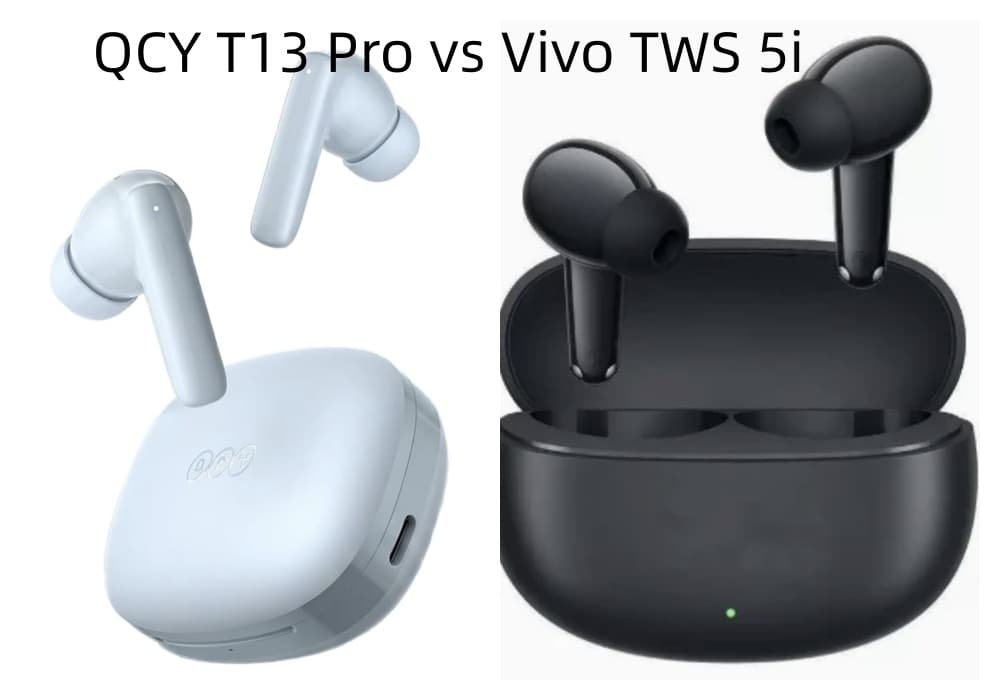
Two models that make an interesting comparison are QCY T13 Pro and vivo TWS 5i. At first glance, they appear to target a similar audience: users looking for everyday wireless earbuds that can handle music, calls, commuting, gaming, and workouts without moving into premium flagship pricing.
The QCY T13 Pro, however, takes an especially aggressive approach to specifications. It combines Bluetooth 6.0, up to 50 dB adaptive ANC, a 13 mm PET-diaphragm dynamic driver, four-microphone call processing, dual-device switching, and up to 47 hours of total playback.
That raises an interesting question: does the QCY T13 Pro offer a better overall package than the vivo TWS 5i, or does vivo’s tuning and ecosystem integration make the difference?
Rather than judging these earbuds solely by their headline numbers, this comparison looks at the areas that actually affect daily use: ANC, sound, battery life, calls, connectivity, software features, comfort, and value.
QCY T13 Pro vs vivo TWS 5i at a Glance
| Feature | QCY T13 Pro | vivo TWS 5i |
|---|---|---|
| Product type | In-ear TWS earbuds | In-ear TWS earbuds |
| Active noise cancellation | Up to 50 dB adaptive ANC | ANC |
| Main driver | 13 mm PET-diaphragm dynamic driver | Dynamic-driver design |
| Bluetooth | Bluetooth 6.0 | Bluetooth connectivity |
| Total battery life | Up to 47 hours | Depends on usage and ANC mode |
| ANC-on total playback | Up to 38 hours | Depends on usage and ANC mode |
| Single-earbud playback | Up to 10.5 hours without ANC | Depends on usage and ANC mode |
| Call technology | 4-mic clear-call system | AI-assisted call noise reduction |
| Multipoint | Yes | Model/ecosystem dependent |
| App customization | Yes | vivo companion/ecosystem features |
| Water resistance | IPX4 | Check regional specification |
| Charging port | USB-C | USB-C |
Specifications and features can vary by market, firmware, codec, and testing conditions. QCY’s published specifications confirm the T13 Pro’s Bluetooth 6.0, IPX4 rating, USB-C charging, dual-device switching, and 38/47-hour ANC-on/off battery ratings.
Design and Everyday Comfort
On paper, the two earbuds belong to the same general category: compact in-ear TWS products designed for daily listening rather than audiophile-style wired use.
But comfort is one area where specification sheets tell you very little.
The best earbuds are not necessarily the ones with the largest driver or strongest ANC. They are the ones that stay securely in your ears without creating excessive pressure after an hour or two.
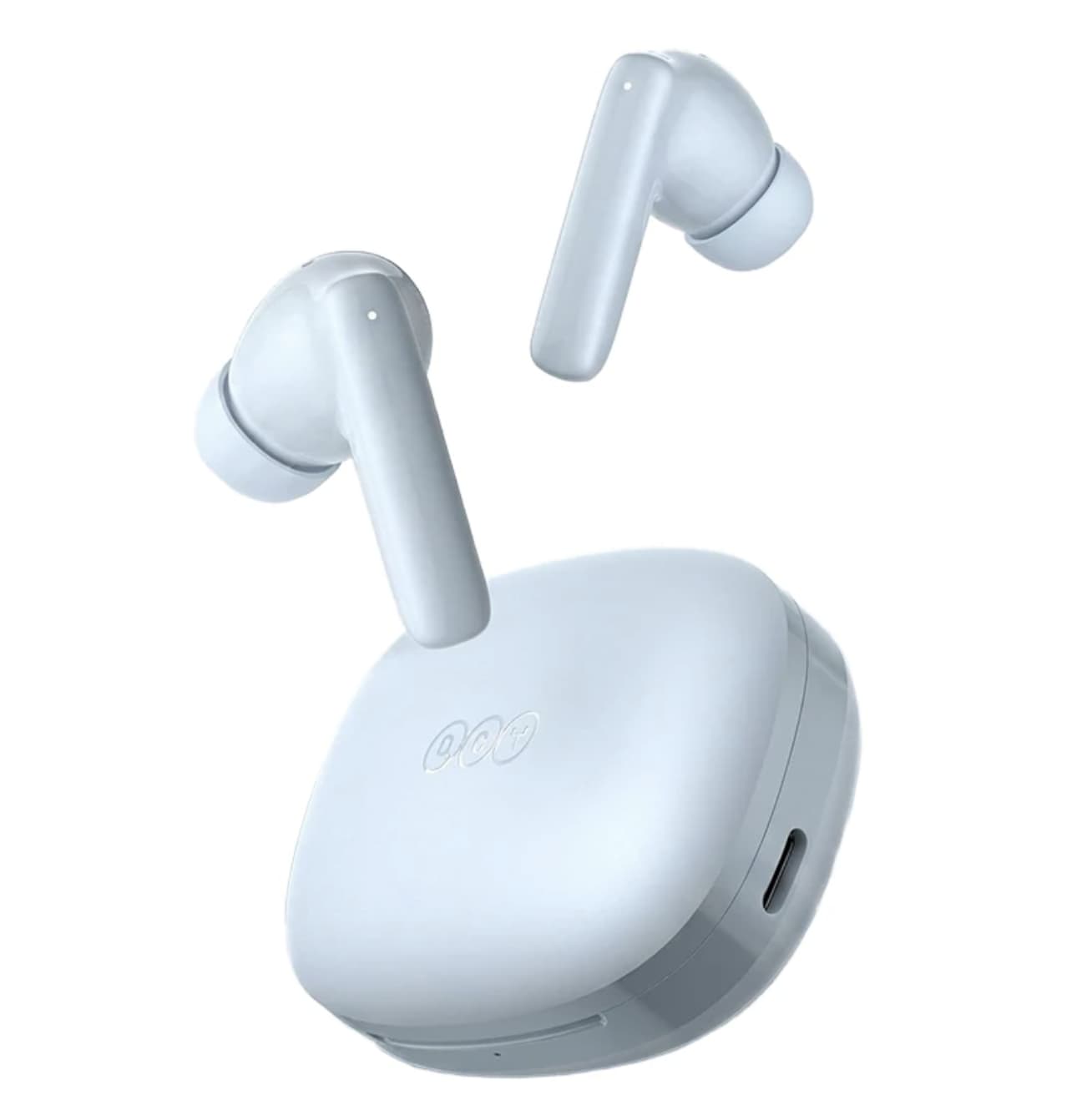
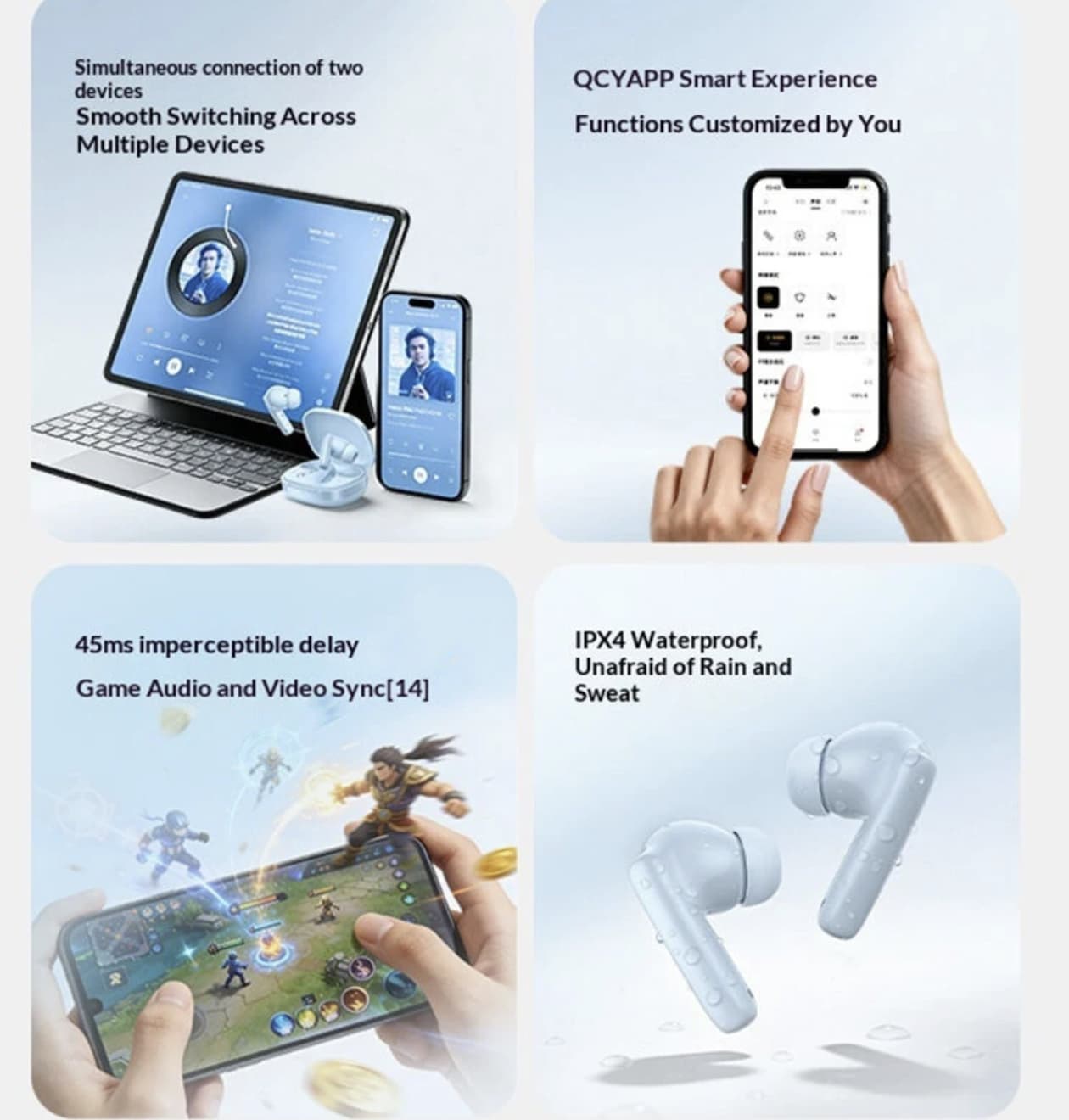
QCY T13 Pro adopts a comfortable in-ear design that helps block ambient noise naturally. To accommodate different ear shapes, the package includes two extra pairs of ear tips alongside the pre-installed set. When it comes to build quality, the earbuds boast an IPX4 rating, making them resistant to sweat, moisture, and light water splashes—ideal for workouts and light outdoor use. That said, they are not waterproof and should not be submerged in water or used in heavy rain.
That makes the T13 Pro particularly practical for commuting, walking, casual exercise, and everyday office use.
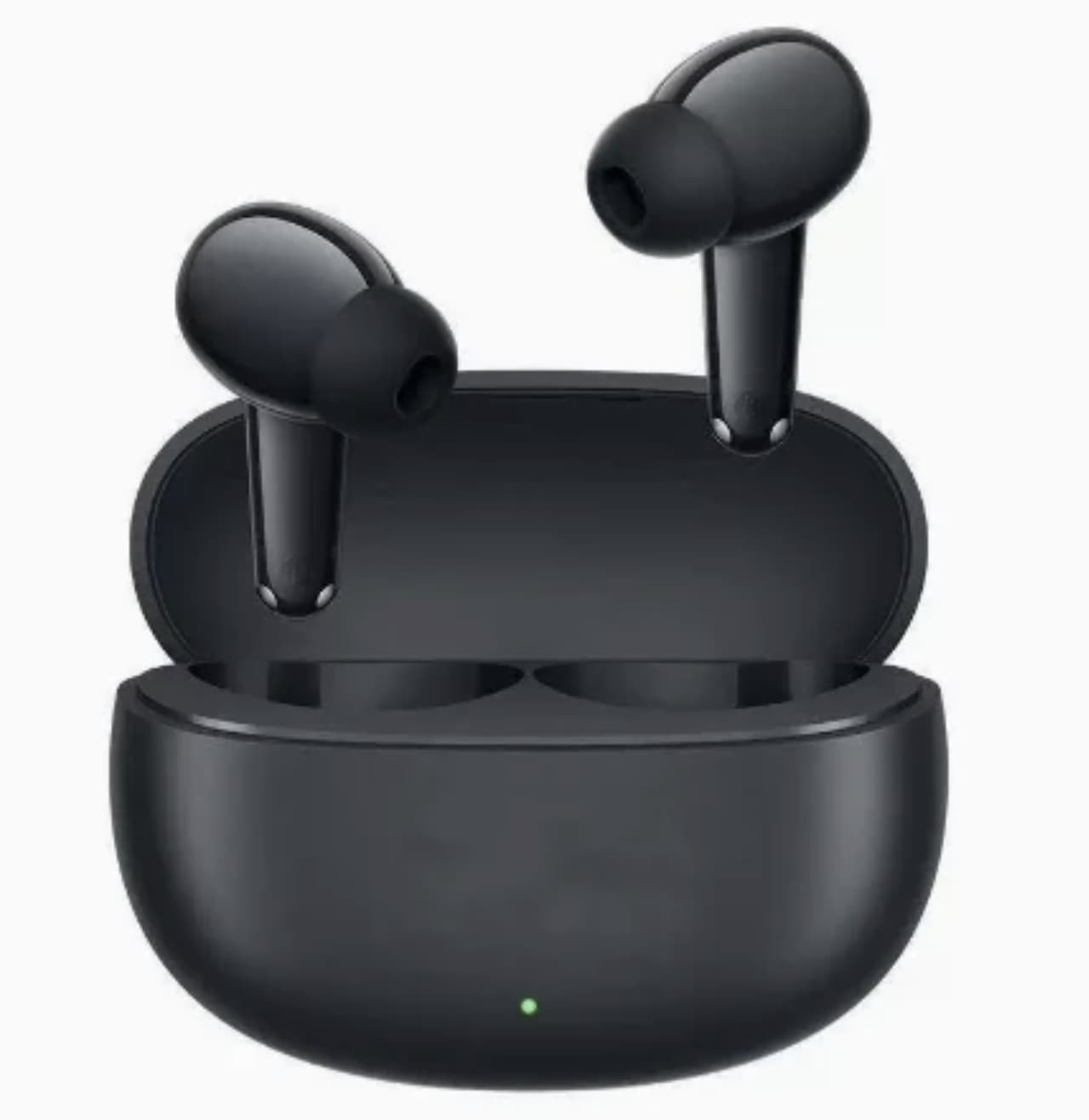
For the vivo TWS 5i, fit and comfort can be more important than the specification advantage of either model. Users should therefore consider ear shape, tip size, and how securely the earbuds remain in place during movement before deciding which model is better.
Winner for everyday practicality: QCY T13 Pro
Not because it is automatically more comfortable for every ear, but because its IPX4 rating, replaceable ear tips, and compact in-ear design make its intended use particularly straightforward.
ANC: Is 50 dB Really Better?
This is one of the most interesting parts of the QCY T13 Pro vs vivo TWS 5i comparison.
QCY advertises up to 50 dB of adaptive ANC for the T13 Pro and specifies an ANC operating range of 20 Hz to 2,000 Hz.
However, consumers should be careful with a common mistake: a higher ANC number does not automatically mean better noise cancellation in every situation.
ANC performance depends on several factors:
- The frequency of the external noise
- Ear-tip seal
- Microphone quality
- ANC processing
- Firmware tuning
- Earbud positioning
- Whether the noise is constant or unpredictable
For example, low-frequency aircraft engines and air-conditioning systems are relatively suitable for ANC. Sudden voices, keyboard clicks, children talking, or high-frequency traffic sounds can be more difficult to eliminate completely.
This is why a real-world comparison should not simply conclude that “50 dB beats a lower number.”
The QCY T13 Pro’s adaptive approach is nevertheless a significant feature. Instead of treating every environment identically, the system is designed to adjust noise reduction according to surrounding conditions.
For commuters, office workers, and people who frequently listen in noisy environments, this can make the T13 Pro particularly attractive.
ANC winner: QCY T13 Pro
The T13 Pro has a clearly stated up-to-50 dB adaptive ANC specification, giving it a strong hardware and feature proposition. Actual performance will still depend heavily on fit and environmental conditions.

Sound Quality: Bigger Driver Does Not Automatically Mean Better Sound
The QCY T13 Pro uses a 13 mm PET-diaphragm dynamic driver. QCY says the driver is designed to produce deep bass, clear mids, and crisp highs.
A 13 mm driver is relatively large for a compact TWS earbud, but driver diameter alone cannot determine sound quality.
What matters more is how the entire acoustic system is tuned.
QCY T13 Pro sound character
The larger driver gives QCY plenty of room to pursue a powerful presentation. For listeners who enjoy:
- Pop
- Electronic music
- Hip-hop
- Rock
- Movies
- YouTube videos
- Gaming
the T13 Pro’s emphasis on bass impact can be appealing.
At the same time, the midrange needs to remain sufficiently clear so that vocals do not become buried underneath the low frequencies.
The advantage of the T13 Pro is that QCY also provides app-based personalization, allowing users to adjust settings rather than being locked into a single factory sound profile.
vivo TWS 5i sound character
Audio tuning has always been a core focus for vivo. The brand invests heavily in fine-tuning the acoustic profile of its earbuds to complement the audio output of its smartphones. This hardware-software synergy delivers tangible benefits for ecosystem users: faster device recognition, lower latency during gaming or video playback, and customized sound presets that adjust automatically. For vivo smartphone owners, the pairing process and overall listening experience feel noticeably more polished compared to using third-party earbuds.
The important distinction is therefore not simply “13 mm vs smaller driver.”
A better question is:
Do you prefer a more customizable, energetic sound or a more ecosystem-oriented listening experience?
For buyers who like to experiment with EQ and sound profiles, the QCY approach has an advantage.
Sound-quality winner: Tie, depending on listening preference
QCY is particularly attractive for users who want a punchier presentation and more control over customization. vivo can appeal to listeners who prioritize a refined, easy-to-live-with tuning and smartphone integration.
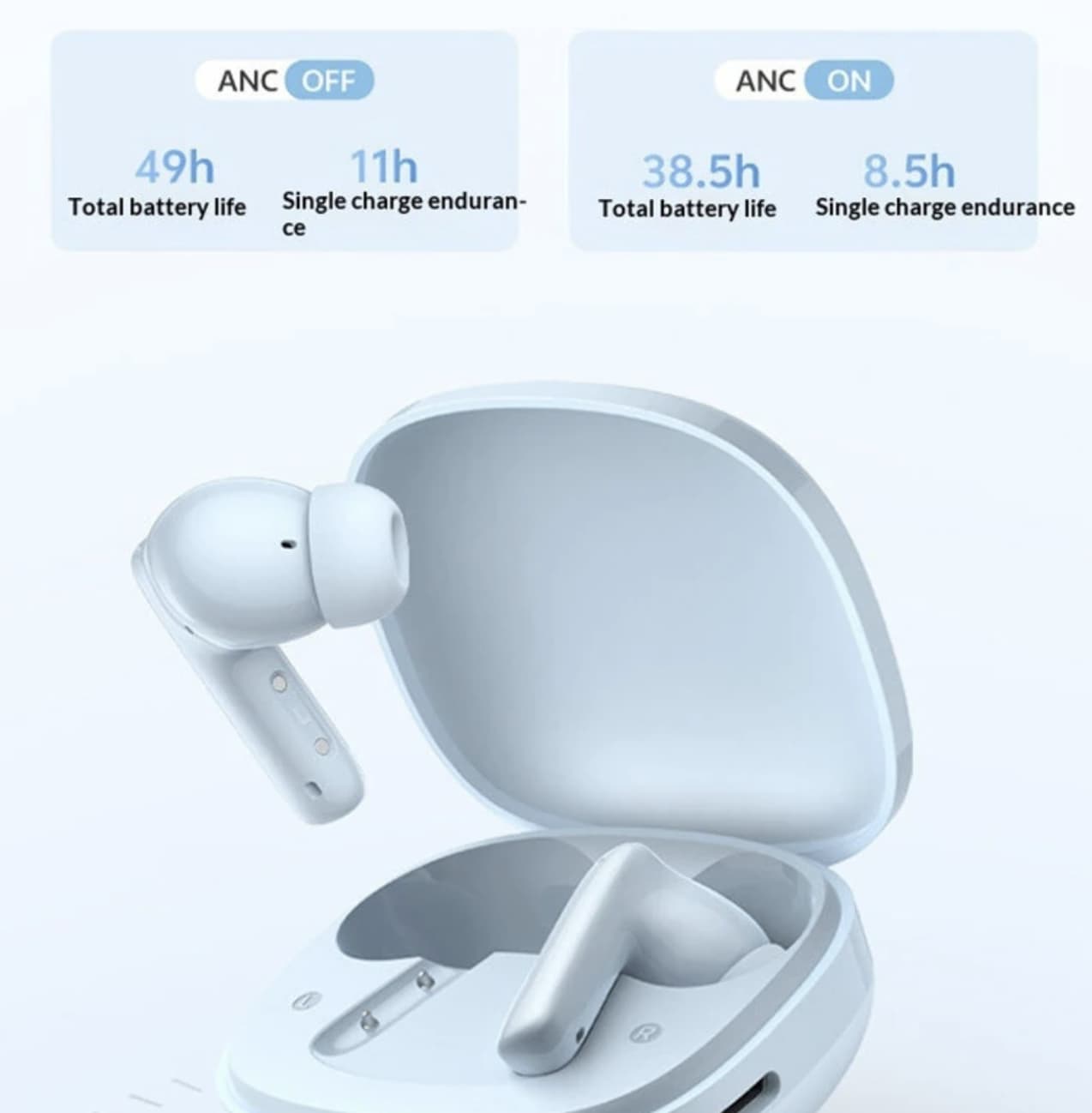
Battery Life: QCY’s Numbers Are Impressive
Battery life is another area where the QCY T13 Pro has a particularly clear advantage on paper.
QCY rates the T13 Pro for:
- Up to 47 hours with ANC off
- Up to 38 hours with ANC on
- Up to 10.5 hours from the earbuds with ANC off
- Up to 8.5 hours from the earbuds with ANC on
These figures include the charging case for the 38- and 47-hour totals.
That distinction is important because manufacturers commonly advertise the combined battery life of the earbuds and charging case. It should not be interpreted as 47 hours of continuous playback from the earbuds themselves.
For most users, the more meaningful number is single-charge listening time.
An earbud that can approach a full workday of listening without returning to the case can be much more convenient than one that needs frequent charging.
The QCY T13 Pro therefore makes a strong argument for itself as a travel and work companion.
Battery winner: QCY T13 Pro
Its published 38-hour ANC-on and 47-hour ANC-off total ratings give it a strong endurance profile.
Calls: More Microphones Are Only Part of the Equation
Call quality has become one of the most important features of modern earbuds.
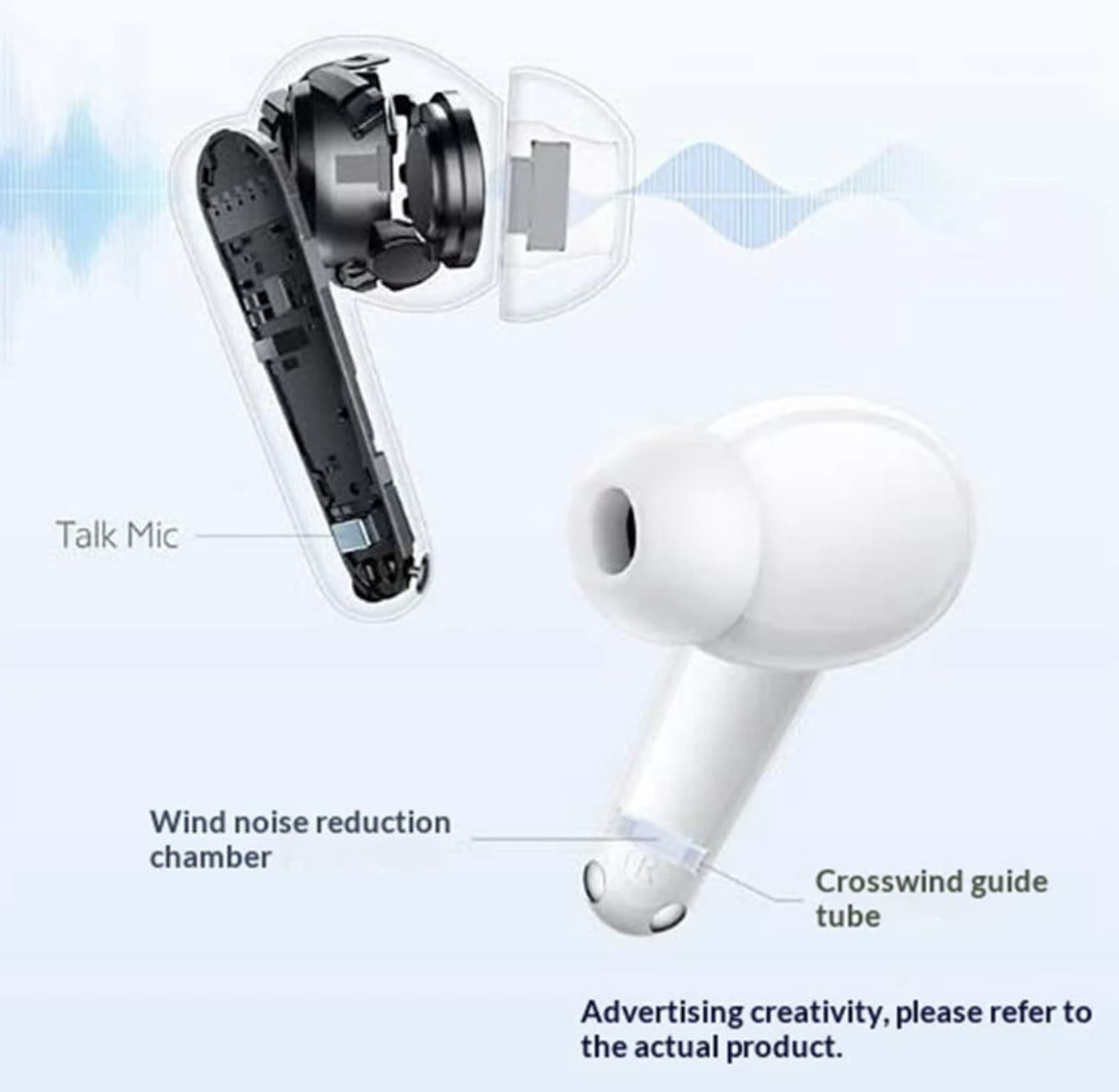
The QCY T13 Pro uses a four-microphone clear-call system designed to enhance vocals and reduce surrounding noise.
This matters when taking calls in environments such as:
- Coffee shops
- Streets
- Offices
- Public transport
- Shopping centers
However, microphone count should not be confused with microphone quality.
A good call system requires the microphones, signal processing, wind-noise handling, and voice algorithms to work together.
For normal indoor calls, either model can be perfectly adequate. In noisy outdoor conditions, the difference becomes more noticeable.
If calls are a major priority, buyers should look for independent microphone tests rather than choosing solely based on the number of microphones.
Call-quality verdict: Too close to call without identical real-world testing
The QCY T13 Pro has a well-defined four-microphone system, but microphone count alone cannot establish an overall winner.
Bluetooth 6.0: A Useful Upgrade or Marketing Number?
The QCY T13 Pro supports Bluetooth 6.0, with a stated 10-meter Bluetooth range and A2DP, AVRCP, and HFP profiles.
Bluetooth 6.0 sounds significantly newer than previous generations, but users should not assume that upgrading from an older Bluetooth version will suddenly make music quality dramatically better.
The actual experience depends on the phone, operating system, codec, wireless environment, antenna design, firmware, and implementation.
For everyday listening, Bluetooth 6.0 is best viewed as a connectivity-generation advantage, not a guarantee of superior audio quality.
The more immediately useful feature may actually be the T13 Pro’s dual-device switching.
For someone who works with a laptop and smartphone simultaneously, being able to move between two devices can save considerably more time than the Bluetooth version number itself. QCY specifically lists dual-device seamless switching among the T13 Pro’s features.
Connectivity winner: QCY T13 Pro
The combination of Bluetooth 6.0 and dual-device support makes it particularly compelling for users who regularly switch between a phone and computer.
Gaming and Low Latency
Wireless audio latency matters when playing games.
A delay between an on-screen event and the corresponding sound can make fast-paced games feel less responsive.
The QCY T13 Pro is designed with low-latency use in mind, making it a more interesting option for casual mobile gaming than ordinary Bluetooth earbuds.
However, serious competitive gamers should still understand that TWS earbuds are not equivalent to a dedicated 2.4 GHz gaming headset.
For casual gaming, video watching, and mobile games, the latency difference may be perfectly acceptable. For competitive shooters or rhythm games, a dedicated low-latency wireless system can still have an advantage.
App Features and Personalization
One of the most underrated differences between budget earbuds is the companion software.
The QCY T13 Pro supports app-based personalization, including functions such as EQ adjustment, battery information, noise-cancellation settings, finding the earbuds, touch controls, and mode switching.
This changes the value proposition considerably.
Instead of buying earbuds with one fixed sound signature, users can adjust the experience according to their preferences.
For example:
Bass lovers: increase low-frequency emphasis.
Podcast listeners: prioritize vocal clarity.
Office users: adjust the sound for spoken content.
Commuters: emphasize ANC-related modes.
This type of customization can extend the useful life of the earbuds because the same hardware can be adapted to different listening situations.
QCY T13 Pro vs vivo TWS 5i: Which One Should You Buy?
The answer depends less on the logo printed on the charging case and more on what you actually want from your earbuds.
Choose the QCY T13 Pro if you want:
- Strong advertised ANC performance
- Bluetooth 6.0
- A large 13 mm dynamic driver
- Long battery life
- Dual-device switching
- App-based customization
- IPX4 splash resistance
- A feature-rich package for everyday use
QCY’s official specifications make the T13 Pro particularly compelling on paper: 50 dB adaptive ANC, 13 mm driver, Bluetooth 6.0, up to 47 hours of playback, and IPX4 protection.
Choose the vivo TWS 5i if you prioritize:
- The vivo ecosystem
- Familiar integration with vivo smartphones
- A more ecosystem-oriented user experience
- A sound profile that matches your personal preference
- Features that work particularly well with your existing vivo devices
The best choice can therefore change depending on the smartphone you use every day.
The Bigger Question: Which Earbuds Offer Better Value?
The QCY T13 Pro is interesting because it challenges the assumption that advanced TWS features require a premium price.
QCY currently lists the T13 Pro at $24.99 USD on its official website, while offering features that would have been associated with substantially more expensive earbuds a few years ago.
That does not mean every aspect of the T13 Pro will outperform a more established competitor.
Instead, its value comes from how many useful features QCY has packed into one product.
The combination of ANC, long battery life, Bluetooth 6.0, multipoint-style dual-device switching, app customization, a large driver, and splash resistance makes the T13 Pro a particularly strong all-rounder.
For a buyer who wants premium-style features without spending heavily, that combination is difficult to ignore.
Final Verdict
QCY T13 Pro vs vivo TWS 5i comparison is not simply a contest of specifications.
The QCY T13 Pro stands out for its aggressive feature set. Its 50 dB adaptive ANC, 13 mm dynamic driver, Bluetooth 6.0, 38-hour ANC-on battery rating, 47-hour ANC-off total battery rating, IPX4 protection, dual-device switching, and app customization give it a strong advantage for users who want maximum functionality from an affordable pair of TWS earbuds.
The vivo TWS 5i can still make sense for users who already rely heavily on vivo smartphones and prefer the consistency of an integrated ecosystem.
For everyone else, the QCY T13 Pro is arguably the more interesting choice because it focuses heavily on features per dollar rather than brand prestige.
In other words, the T13 Pro does not need to win every individual category to be compelling. Its strength is that it combines noise cancellation, battery endurance, connectivity, customization, and everyday durability into one balanced package.
-
QCY T13 Pro: Best for ANC, battery life, customization, connectivity, and overall value.
-
vivo TWS 5i: Best for vivo smartphone users who prioritize seamless ecosystem integration.
Remember: Regional specifications vary. Check local listings for codec support, pricing, and included features before purchasing.