







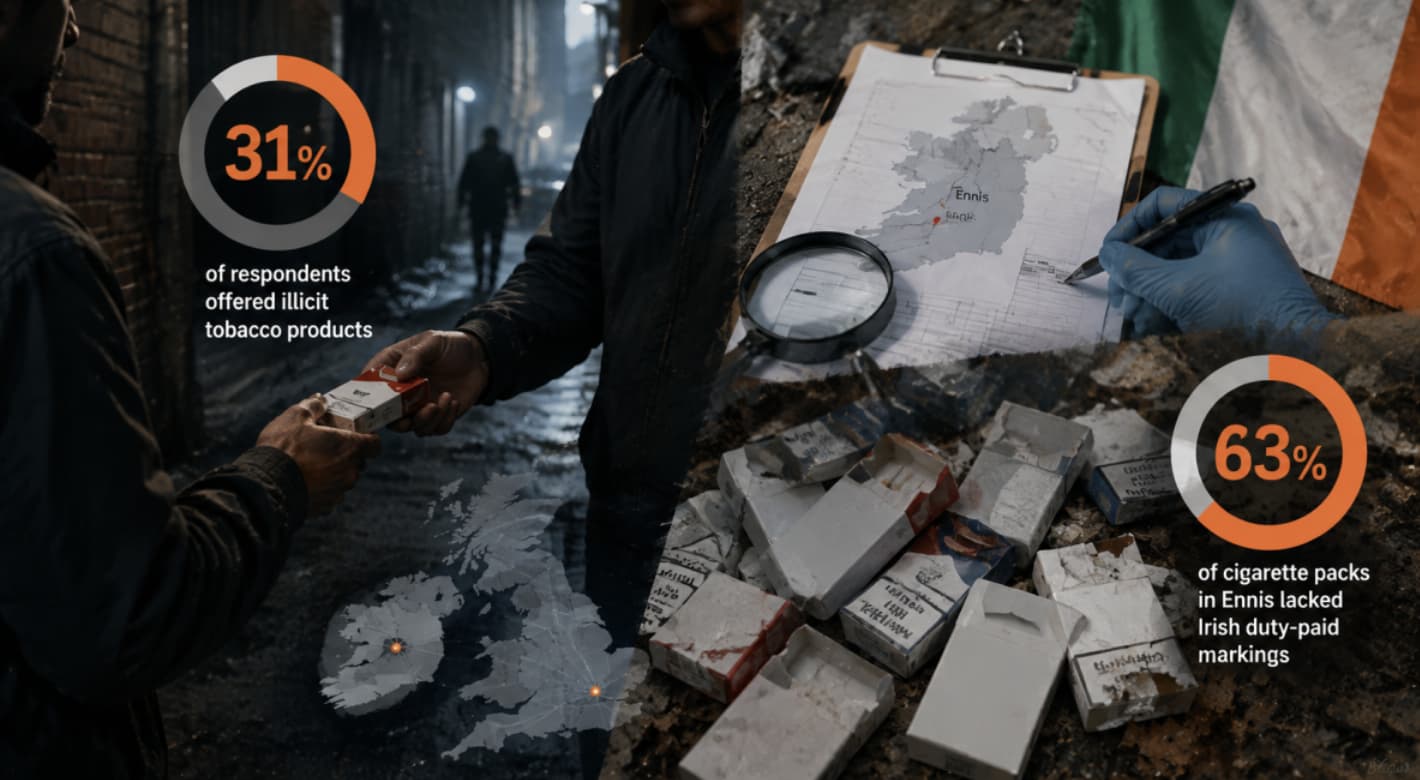
New research commissioned or supported by JTI highlights the continued presence of illicit tobacco across parts of the UK and Ireland. Two separate studies shed light on the issue from different perspectives. In the UK, 31% of respondents reported having been offered illicit tobacco products. Meanwhile, an empty-pack survey in the Ennis area of Ireland found that 63% of the cigarette packs examined lacked Irish duty-paid markings.
The figures draw attention to the continued presence of tobacco products outside normal tax-paid retail channels. However, they should be interpreted carefully. Both findings come from industry-related research and are not equivalent to official estimates of the size of the illicit tobacco market across either country.
Instead, the studies provide snapshots of two specific aspects of the issue: consumer exposure in the UK and the composition of discarded cigarette packs in one Irish locality.
UK Research: Almost One in Three Respondents Reported Being Offered Illicit Tobacco
Research cited by JTI UK research found that 31% of respondents said they had been offered illicit tobacco products.
The finding is significant because it measures reported consumer exposure rather than attempting to calculate the total volume or market share of illicit tobacco.
According to JTI, the result illustrates how illegal tobacco can become visible through informal sales and personal networks rather than remaining confined to highly concealed distribution channels.
The company has used the findings as part of its “It Costs More Than You Think” campaign, which seeks to draw attention to the wider consequences associated with illicit tobacco.
Those consequences can extend beyond lost excise revenue. From a regulatory perspective, illegal tobacco can complicate age-control measures, product traceability and enforcement efforts because products sold outside legitimate supply chains may not be subject to the same controls as legally marketed tobacco.
Why Consumer Exposure Matters
The 31% figure should not be interpreted as meaning that 31% of UK tobacco sales are illicit.
Instead, it answers a narrower question: how many people surveyed reported being offered illicit tobacco?
That distinction is important when interpreting industry research.
A person may be offered an illicit product without purchasing it, while repeated offers to the same consumer do not necessarily indicate the size of the underlying market. Survey results can also vary according to methodology, sample composition and how respondents understand the term “illicit tobacco.”
Nevertheless, reported exposure can provide useful information about how visible illegal products may be within communities.
Ireland: Ennis Empty-Pack Survey Finds 63% Without Irish Duty Marks
A separate JTI Ireland-commissioned Empty Pack Survey examined discarded cigarette packaging collected in the Ennis area.
The survey reported that 63% of the sampled packs did not carry Irish duty-paid markings.
Empty-pack research measures something different from a consumer survey. Instead of asking people whether they encountered illicit products, researchers examine cigarette packaging found in a particular location and assess whether the packs display the markings associated with domestic duty payment.
The Ennis result therefore provides a local snapshot of the types of cigarette packs circulating in the sampled environment.
It should not be treated as evidence that 63% of cigarettes consumed throughout Ireland are illicit.
What a Missing Duty Mark Can—and Cannot—Tell Us
Duty markings can help distinguish products intended for a domestic market from products that may have entered through other channels.
However, the absence of an Irish duty-paid marking does not automatically establish that every individual pack was illegally sold or illegally imported.
Products can move across borders for different reasons, and determining whether a particular product violates Irish tax or customs rules requires more information than the packaging alone.
This is why empty-pack surveys are most useful when viewed as indicators of market composition, rather than standalone measurements of national illicit-trade levels.
The geographic scope also matters. Findings from Ennis cannot automatically be extrapolated to Dublin, Cork, Galway or Ireland as a whole.
Two Studies, Two Different Measurements
The UK and Irish findings are often discussed together because they concern the same broader issue, but they measure different things.
| Research | What it measures | Reported finding |
|---|---|---|
| JTI-related UK consumer research | Reported exposure to illicit tobacco | 31% offered illicit tobacco |
| JTI Ireland Empty Pack Survey | Duty-mark status of sampled discarded packs in Ennis | 63% lacked Irish duty-paid markings |
This distinction is important for anyone attempting to assess the scale of illicit tobacco.
The UK research provides information about consumer encounters, while the Irish survey provides information about discarded-pack characteristics within a defined geographic sample.
Neither figure, by itself, establishes the national market share of illicit tobacco.
Why Illicit Tobacco Matters to Legitimate Retailers
The illicit market can create a difficult environment for legitimate retailers.
Licensed businesses must operate within the country’s tax, product, age-verification and regulatory framework. Sellers operating outside those requirements may be able to offer products at significantly different prices.
That creates a competitive problem when consumers compare a legally sold product with one that has avoided some or all applicable duties.
The issue is particularly sensitive in high-tax markets, where the difference between regulated and unregulated prices can become more noticeable.
For legitimate retailers, effective enforcement is therefore not simply a public-policy issue. It can also affect pricing competition, customer retention and confidence in the legal retail channel.
The Tax Connection
Tobacco taxation is an important part of the discussion.
Governments use tobacco duties both to generate revenue and as part of broader public-health policy. However, higher taxes can also increase the financial incentive for illegal suppliers when substantial price differences emerge between duty-paid and non-duty-paid products.
This creates a policy challenge.
Authorities need to maintain effective tobacco taxation while also limiting opportunities for criminal networks to exploit price differences and gaps in enforcement.
JTI’s research focuses heavily on this connection, arguing that illicit tobacco can contribute to lost government revenue and support wider criminal activity.
Those claims should be distinguished from independently measured government estimates, which use different methodologies and data sources.
Industry Research vs. Official Market Estimates
One of the most important considerations when reading these findings is who conducted the research and what question it was designed to answer.
Industry-sponsored research can provide useful information about consumer experiences, local market conditions and product availability. However, it may have a particular purpose or perspective.
Government agencies generally use broader datasets when estimating illicit tobacco activity, including customs seizures, tax gaps, consumer surveys, legal-market sales and other economic indicators.
As a result, a company-sponsored survey and an official government estimate should not be treated as interchangeable measurements.
The strongest interpretation of the JTI findings is therefore not that they establish the size of the UK or Irish illicit tobacco market, but that they highlight continued exposure to products outside normal domestic duty-paid channels.
Enforcement Remains a Key Issue
The findings also underline why illicit tobacco continues to attract attention from regulators, customs authorities and legitimate retailers.
Effective enforcement requires more than confiscating products at the point of sale. Authorities may need to identify supply networks, monitor distribution routes, strengthen border controls and cooperate across agencies.
Public awareness can also play a role. Consumers who understand the potential consequences of buying illicit products may be less likely to view unusually cheap tobacco as simply a bargain.
For retailers, meanwhile, consistent enforcement can help narrow the competitive gap between regulated and unregulated sellers.
What the Latest Findings Tell Us
Taken together, the JTI-related studies present two useful but limited snapshots of illicit tobacco activity.
The UK research suggests that consumer exposure is relatively visible, with 31% of surveyed respondents reporting that they had been offered illicit tobacco. The Ennis survey, meanwhile, found that 63% of sampled discarded cigarette packs lacked Irish duty-paid markings.
Neither number should be used as a direct measure of the national illicit tobacco market.
What they do show is that illegal or non-domestic tobacco products remain a subject of concern in both markets—and that the problem can be examined from several different angles.
For policymakers, the key challenge is to curb illicit tobacco supply while preserving effective regulation of the legal market. For legitimate retailers, the focus remains on protecting businesses from unfair competition driven by lower-priced illegal products. Consumers, meanwhile, have an important role to play by understanding the origin of tobacco products and whether they have entered the market through legitimate, regulated channels.
As taxation and tobacco regulations continue to develop across the UK and Ireland, the scale of illicit trade, enforcement efforts, and its economic impact on legitimate retailers are likely to remain central issues in the wider policy debate.