










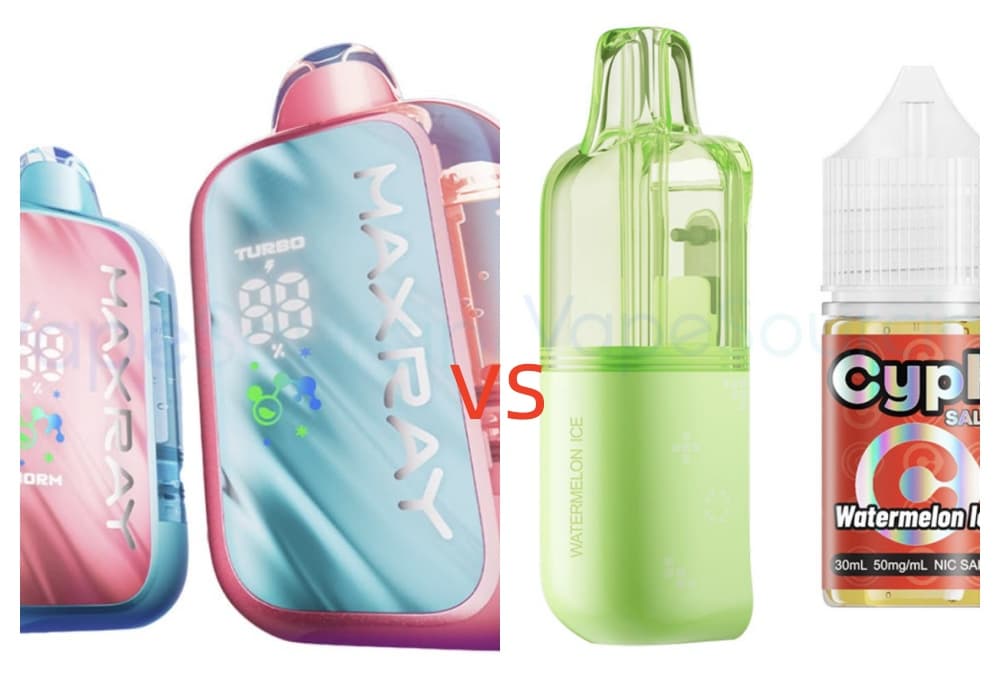
MAXRAY RUSH 80K and VOOPOO NAVI x Cyph 80K share the same headline number, but they are not really trying to solve the same problem.
Both are built around an advertised 80K vape / high-puff vape guide figure, rechargeable batteries, adjustable airflow, dual-mesh technology and multiple power modes. Yet their designs take noticeably different routes. The MAXRAY RUSH 80K is essentially a large-capacity disposable-style device, combining a 25mL e-liquid reservoir with a rechargeable 900mAh battery. The VOOPOO NAVI x Cyph 80K instead separates the reusable battery from its refillable/replaceable pod and includes a 30mL bottle of Cyph nicotine salt e-liquid.
That difference is more important than the “80K” branding itself.
So, in this MAXRAY RUSH 80K vs VOOPOO NAVI x Cyph 80K comparison, we will look beyond the puff claims and examine how their liquid systems, batteries, airflow, displays, coil technology, portability and day-to-day operation actually differ.
MAXRAY RUSH 80K vs VOOPOO NAVI x Cyph 80K: At a Glance
| Feature | MAXRAY RUSH 80K | VOOPOO NAVI x Cyph 80K |
|---|---|---|
| Format | Disposable-style rechargeable device | Reusable pod system |
| Advertised puff count | Up to 80,000 | Up to 80,000 |
| E-liquid system | Integrated 25mL reservoir | 12mL pod + 30mL included e-liquid |
| Battery | 900mAh rechargeable | 1500mAh rechargeable |
| Coil | Dual mesh | 0.6Ω dual mesh |
| Power modes | Normal / Turbo | Normal / Turbo |
| Airflow | Adjustable | Adjustable |
| Display | Battery/mode information | 1.6-inch curved color screen |
| Charging | USB-C | USB-C |
| Refillable | No | Yes |
| Main design idea | Large-capacity disposable alternative | Disposable-style reusable pod |

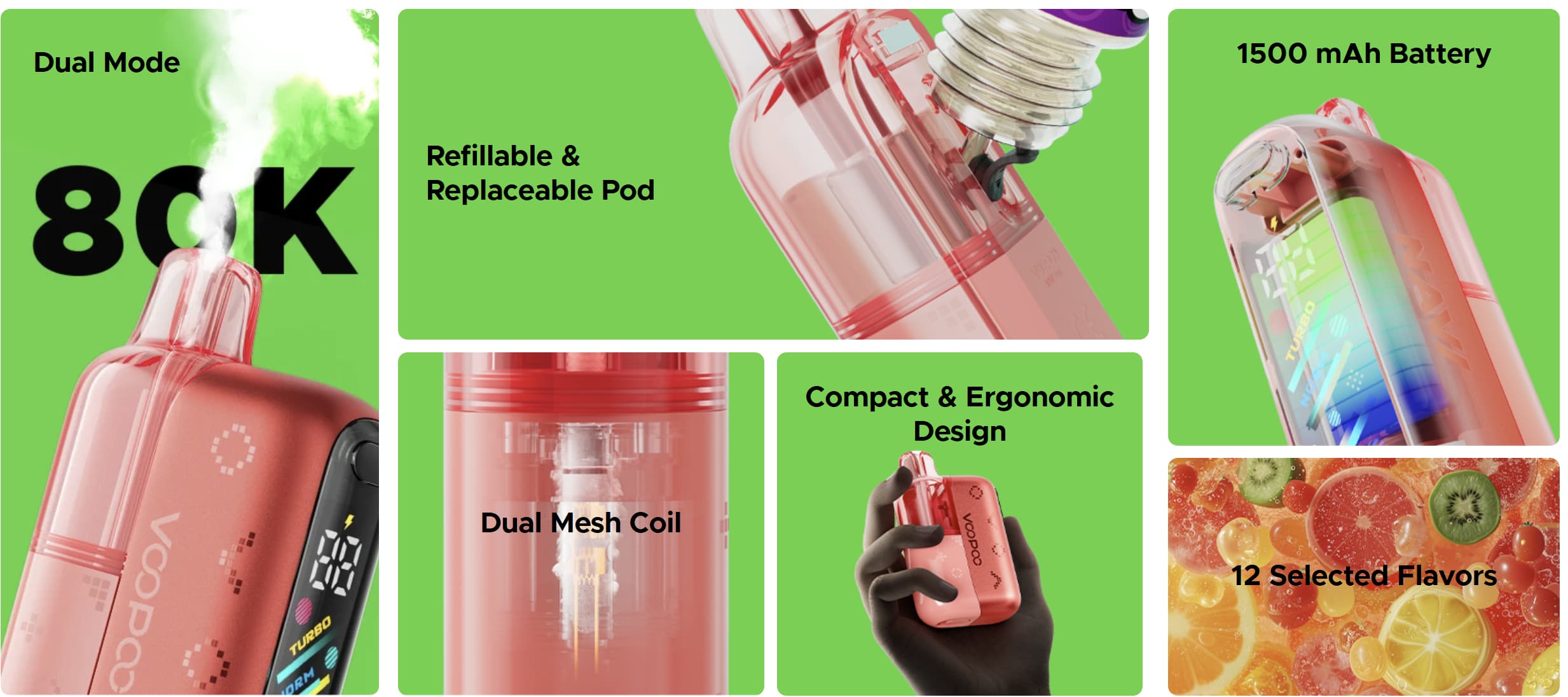
The specifications reveal the fundamental distinction: MAXRAY puts more e-liquid directly inside the device, while VOOPOO divides the system into a reusable battery, pod and separate e-liquid supply.
The 80K Number Does Not Tell the Whole Story
An advertised 80,000 puffs sounds like the obvious starting point, but it should not be treated as a guaranteed number of real-world draws.
Puff-count figures depend on factors such as draw duration, power mode, airflow, coil condition and individual vaping habits. Independent testing of the NAVI x Cyph has also produced substantially different real-world consumption figures from the headline claim, illustrating why an advertised puff count should be treated as a manufacturer’s rated figure rather than a personal-use guarantee.
The same principle applies to the MAXRAY RUSH.
Interestingly, MAXRAY specifies up to 80,000 puffs in Normal mode and 50,000 in Turbo mode, according to current product information. That means the maximum number is connected to how the device is operated rather than representing one fixed result for every user.
For buyers comparing high-capacity devices, therefore, e-liquid capacity and battery capacity are often more useful specifications than the puff number alone.
MAXRAY RUSH 80K: The High-Capacity Disposable Approach
The MAXRAY RUSH 80K takes the more traditional disposable-style route, but expands the hardware considerably.
Its standout specification is the 25mL e-liquid reservoir, paired with a rechargeable 900mAh battery. The transparent tank is not merely decorative; it makes the large liquid supply visible while also contributing to the RUSH’s distinctive appearance.
Instead of requiring a separate bottle or regular refilling, the liquid is already inside the device.
That makes the RUSH concept particularly straightforward: charge it, select the preferred power mode, adjust the airflow and vape.
Juicy Guard Is the Interesting Part
The most distinctive feature of the RUSH is not actually its 80K branding.
It is the Juicy Guard liquid-control system.
The system is designed to regulate the amount of e-liquid reaching the coil. According to product information and independent testing, the purpose is to maintain appropriate coil saturation while reducing the likelihood of flooding and leakage. The mechanism is also visible through the transparent reservoir.
This gives the RUSH a slightly different engineering focus from many high-capacity disposable-style devices.
Instead of simply increasing the size of the tank, MAXRAY has also concentrated on how that large amount of liquid is delivered to the coil.
That matters because a large reservoir is only useful if the coil can continue receiving liquid consistently throughout the device’s usable life.
VOOPOO NAVI x Cyph 80K: A Disposable-Style Pod System
The VOOPOO NAVI x Cyph 80K approaches the same category from the opposite direction.
Rather than putting everything into one sealed disposable unit, VOOPOO uses a two-part system consisting of a reusable battery section and a refillable/replaceable pod. The pod holds up to 12mL, while the kit includes a separate 30mL bottle of Cyph nicotine salt e-liquid.
That makes the NAVI much closer to a conventional pod system in terms of ownership.
Once the supplied e-liquid is used, the battery does not automatically become waste. The pod can be refilled with compatible e-liquid, and the battery itself can be recharged and reused.
The concept essentially sits between two categories:
disposable simplicity + reusable pod hardware.
That is arguably the most important characteristic of the NAVI x Cyph 80K.
Battery Comparison: 900mAh vs 1500mAh
Battery capacity is one of the clearest differences.
The MAXRAY RUSH uses a 900mAh rechargeable battery, while the NAVI x Cyph uses a substantially larger 1500mAh battery.
On paper, the NAVI therefore has a larger battery reserve.
However, battery capacity should not be considered in isolation.
The actual runtime also depends on output power, draw length and whether the device is operated in Normal or Turbo mode. Independent testing of the NAVI found that actual battery performance did not completely match the manufacturer’s claimed runtime, although the tester still obtained substantial use between charges.
The RUSH, meanwhile, has a smaller battery but also offers pass-through charging according to independent testing, allowing it to remain usable while connected to power.
So the battery comparison is more nuanced than simply saying “1500mAh is better than 900mAh.”
The NAVI has the larger battery reserve, while the RUSH offers the convenience of a simpler integrated system and pass-through charging.
Coil and Flavor: Two Different Implementations of Dual Mesh
Both devices use dual-mesh technology, but the specifications are not identical.
The RUSH uses a dual-mesh coil system, with current product information listing a 1.0Ω resistance.
The NAVI x Cyph uses an integrated 0.6Ω dual-mesh coil. VOOPOO says the design is intended to increase vapor production and flavor intensity while supporting both Normal and Turbo modes.
That resistance difference helps explain why the two devices have somewhat different performance characteristics.
The RUSH’s 1.0Ω configuration is paired with its liquid-management system and high-capacity disposable format.
The NAVI’s 0.6Ω dual mesh is built into its reusable pod and works with the included Cyph salt e-liquid.
Independent reviews of the NAVI have highlighted its flavor production and the ability of its integrated coil to remain usable over a relatively large amount of e-liquid.
For the RUSH, the Juicy Guard system becomes particularly relevant because consistent liquid delivery is central to maintaining flavor over a large 25mL reservoir.
Airflow: Similar Feature, Different Role
Both devices provide adjustable airflow, which is useful because the same hardware can be tuned toward a tighter or more open draw.
The RUSH uses an adjustable airflow system alongside its Normal and Turbo modes.
The NAVI x Cyph also has an airflow slider. Independent testing found that it can move the draw between a relatively restricted direct-to-lung style and a more open mouth-to-lung experience, although the airflow control has been described as somewhat difficult to fine-tune at the tightest end.
This is an area where personal preference matters considerably.
A more open airflow generally pairs naturally with greater vapor production, while restricting airflow can produce a tighter sensation.
The important point for this comparison is that neither device locks the user into one fixed draw style.
Display and Controls: NAVI Has the More Visible Interface
The RUSH keeps its user interface relatively understated.
Its display provides information such as battery level and operating mode, while the transparent tank provides a direct visual indication of the remaining e-liquid.
The NAVI takes a much more visual approach.
It uses a 1.6-inch curved color screen that displays battery information and power mode, with animated graphics during operation.
This gives the NAVI a more conventional electronic-device feel.
The RUSH, by contrast, remains visually closer to a disposable, despite its larger internal hardware.
For users who enjoy seeing battery percentage and mode information clearly, the NAVI’s larger color display is a significant part of the experience.
Refillable vs Integrated: The Biggest Ownership Difference
This is probably the most important section of the entire comparison.
The MAXRAY RUSH 80K contains its 25mL e-liquid supply directly inside the device.
The NAVI x Cyph separates the liquid from the reusable battery platform. Its pod can hold 12mL, while the original kit includes a 30mL bottle of Cyph e-liquid.
That creates two distinct ownership models.
MAXRAY RUSH 80K
The experience is closer to a traditional disposable:
Open → use → charge when necessary → continue using → replace the device when finished.
There is no need to carry a bottle of e-liquid or perform regular refilling.
VOOPOO NAVI x Cyph 80K
The experience is closer to a pod system:
Charge → fill the pod → vape → refill → eventually replace the pod.
The battery section can continue to be reused.
That distinction could matter more over time than the difference between 900mAh and 1500mAh.
Portability and Physical Design
The two products also differ in how they approach portability.
The MAXRAY RUSH has a tall, substantial form because its body has to accommodate a 25mL reservoir. Current product information lists dimensions around 96.8mm × 27.8mm × 52.8mm, although published measurements can vary slightly by source.
The NAVI x Cyph measures roughly 86mm in overall height and weighs around 89–90g with the pod and e-liquid, according to independent product measurements.
The NAVI’s two-piece construction is particularly interesting because the battery and pod connect magnetically while maintaining a relatively compact overall shape.
This makes it look more like a disposable at first glance than a conventional refillable pod system.
The RUSH, meanwhile, uses its large transparent reservoir as a major part of its visual identity.
MAXRAY RUSH 80K vs VOOPOO NAVI x Cyph 80K: What Really Separates Them?
After looking past the shared 80K branding, the difference becomes much clearer.
MAXRAY RUSH 80K is built around:
- 25mL integrated e-liquid capacity
- 900mAh rechargeable battery
- Juicy Guard liquid-control technology
- Dual-mesh coil
- Normal and Turbo modes
- Adjustable airflow
- Transparent reservoir
- Disposable-style operation
- Pass-through charging according to independent testing
VOOPOO NAVI x Cyph 80K is built around:
- Reusable battery hardware
- 1500mAh battery
- 12mL refillable/replaceable pod
- Separate 30mL Cyph e-liquid bottle in the kit
- 0.6Ω dual-mesh coil
- Normal and Turbo modes
- Adjustable airflow
- 1.6-inch curved color display
- Magnetic two-part construction
- Refillable pod architecture
This is why the two devices should not really be viewed as direct copies of one another.
They use the same headline category but approach longevity differently.
Which 80K Design Makes More Sense?
Instead of judging these devices only by their advertised puff numbers, consider what you actually want from a high-capacity vape.
The MAXRAY RUSH 80K is centered on convenience. Its 25mL integrated tank means less interaction with bottles and refilling, while the Juicy Guard system is designed to manage liquid delivery. Its Normal/Turbo modes and adjustable airflow add some flexibility without turning the device into a complicated pod system.
The VOOPOO NAVI x Cyph 80K is more interesting if you want disposable-style simplicity without treating the whole device as single-use hardware. Its 1500mAh battery, refillable 12mL pod, larger display and replaceable pod concept give it more of a reusable-system identity.
There is also an important difference in e-liquid flexibility. The RUSH comes with its liquid supply integrated into the device, whereas the NAVI’s refillable pod can be topped up after the included Cyph e-liquid is consumed, assuming the replacement liquid is compatible with the pod and device. Independent reviewers have reported continuing to use the NAVI pod with other e-liquids after the supplied bottle was finished.
MAXRAY RUSH 80K vs VOOPOO NAVI x Cyph 80K: Final Review
MAXRAY RUSH 80K vs VOOPOO NAVI x Cyph 80K comparison is ultimately less about which device has the bigger number and more about how each product defines long-term use.
MAXRAY takes the large-capacity disposable route. The RUSH combines a 25mL reservoir, rechargeable 900mAh battery, adjustable airflow, dual power modes and Juicy Guard liquid management in one self-contained device.
VOOPOO takes a reusable pod-system route. The NAVI combines a 1500mAh rechargeable battery with a 12mL refillable/replaceable pod, a 0.6Ω dual-mesh coil, Normal and Turbo modes, adjustable airflow and a large color display, while the original kit includes 30mL of Cyph e-liquid.
The shared “80K” label therefore hides two very different product philosophies.
If the priority is a large integrated liquid supply and minimal refilling, the RUSH’s architecture is built around that idea.
If the priority is a reusable battery platform with a refillable pod and a more conventional electronic interface, the NAVI x Cyph takes the more pod-oriented approach.
That is the useful takeaway from this comparison: 80K does not automatically mean two products are interchangeable. Looking at the battery, liquid system, coil design and replacement strategy gives a much clearer picture of what each device is actually designed to do.