









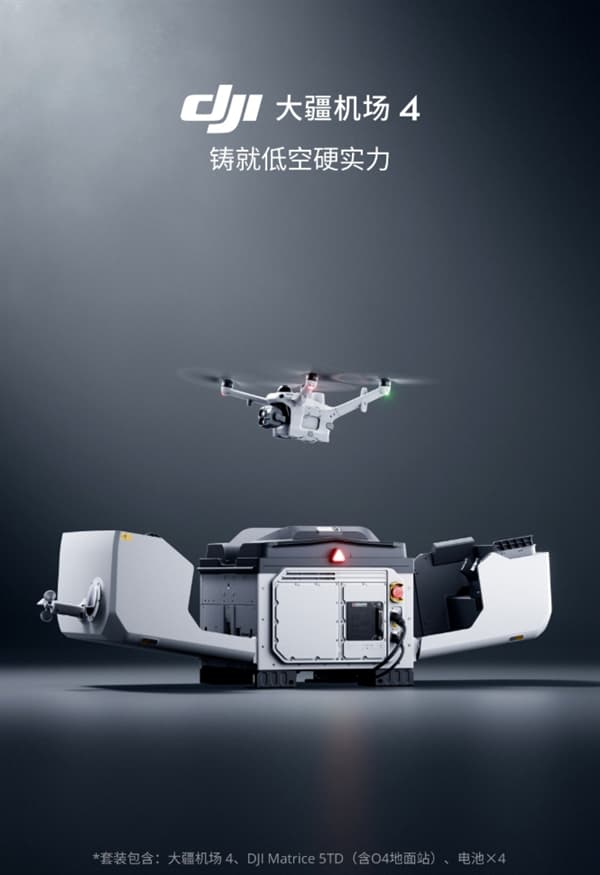
DJI has officially introduced the DJI Dock 4, its first unattended drone platform featuring fully automated battery swapping. Announced on October 15, the new system is designed to keep enterprise drones operating with minimal downtime, making it suitable for demanding applications such as emergency response, power-line inspections, and security patrols.
The complete package is priced at ¥167,999 (approximately US$23,600) and includes the DJI Dock 4, a DJI Matrice 5TD drone, a DJI O4 ground station, and four batteries. However, the advertised price covers the hardware only. Software subscriptions, maintenance, and other service costs are charged separately.
25-Second Battery Swapping Reduces Downtime
The DJI Dock 4’s standout feature is its automated battery-swapping mechanism, which completes a battery change in approximately 25 seconds. Traditional charging can take around 30 minutes between flights, so the new approach significantly reduces the waiting time before a drone can return to work.
The system can also upload mission data while replacing the battery. This allows the drone to prepare for its next assignment without having to remain at the dock while its battery recharges.
Building on its earlier automated drone systems, DJI introduces the DJI Dock 2 unattended drone platform as useful background for understanding how the new Dock 4 advances remote deployment and continuous operations.
This capability could be particularly valuable for organizations that need drones to operate repeatedly throughout the day, including emergency services, utility companies, and teams responsible for securing large public events.
Remote Deployment Without an On-Site Pilot
The DJI Dock 4 supports a rapid-deployment workflow that allows operators to launch a drone remotely without sending a pilot to the launch site. Once a mission is initiated, the aircraft can travel toward the target location at speeds of up to 21 meters per second while transmitting live aerial footage.
At the center of the system is the DJI Matrice 5TD, which offers a claimed maximum flight time of up to 59 minutes per battery. Its endurance helps expand the area that can be inspected during an individual flight, while automated battery replacement supports repeated missions.
The dock is designed to operate in temperatures ranging from -40°C to 50°C. For larger sites requiring continuous surveillance, two docking locations can also be configured to alternate automatically, helping maintain coverage as individual drones return for servicing.
Multi-Sensor Imaging for Day and Night Operations
The Matrice 5TD combines several imaging and measurement technologies, including a telephoto camera, thermal imaging, laser ranging, and full-color night vision. Together, these features are intended to support infrastructure inspections, nighttime security, mapping, and surveying.
According to the published specifications, mapping accuracy can reach 10 centimeters when using the specified 12-megapixel imaging configuration. The drone also features an 11x telephoto camera designed to help operators examine distant objects without bringing the aircraft unnecessarily close to them.
DJI claims the camera can distinguish vehicle license plates from distances of up to 400 meters and identify small components, such as bolts and pins, from approximately 100 meters. Actual recognition performance will depend on factors including lighting, viewing angle, atmospheric conditions, and the target itself.
Thermal imaging is another major part of the package. The thermal camera has a native resolution of 1280 × 1024 pixels, with an enhanced mode capable of producing images at up to 2560 × 2048 pixels. It also supports 2K video recording and 32x digital zoom.
For another example of DJI’s industrial drone technology, the DJI Matrice 400 enterprise drone focuses on extended flight endurance and long-range image transmission for demanding inspection missions.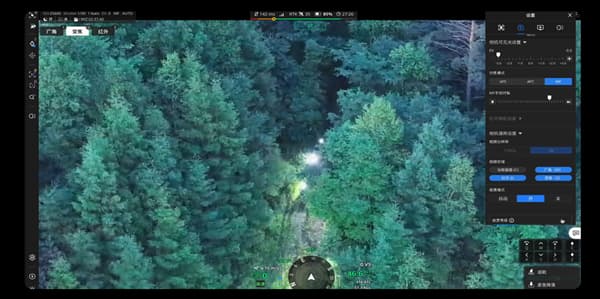
These capabilities can help inspection teams identify abnormal heat patterns in electrical equipment and investigate potential defects involving components such as insulators. Thermal images can reveal temperature differences, although suspected faults may still require additional inspection or confirmation.
For nighttime work, the aircraft supports high-frame-rate 4K full-color night vision. This allows operators to capture color footage in suitable low-light conditions without necessarily switching on a spotlight. An additional near-infrared illuminator can provide black-and-white night vision when required.
Payload Support and Expanded Flight Safety
The Matrice 5TD supports a maximum effective payload of 450 grams and provides three external accessory mounting positions. Compatible equipment can include a loudspeaker, spotlight, or parachute system, depending on the supported configuration.
Its flight-safety package combines millimeter-wave radar, lidar, and a six-direction visual sensing system. These technologies are intended to improve obstacle detection, including during nighttime operations.
The aircraft also incorporates anti-interference and anti-spoofing capabilities. If wind speeds exceed permitted operating limits, the drone can respond by reducing altitude and returning to its designated location, according to the described safety functions.
For organizations operating in challenging environments, the combination of automated deployment, environmental tolerance, obstacle sensing, and remote monitoring could reduce the amount of routine on-site intervention required. Operators will still need to follow applicable flight regulations and mission-specific safety procedures.
AI Target Recognition and Automated Alerts
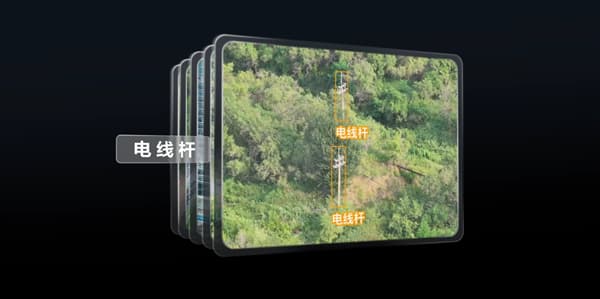
Artificial intelligence is another key component of the new platform. The Matrice 5TD’s onboard AI can identify 17 categories of targets, including vehicles, boats, and fire-related objects. The system also supports integration with third-party custom AI models, allowing organizations to adapt detection capabilities to particular operational requirements.
When connected to DJI FlightHub 2, the platform provides additional tools for searching aerial footage and mission data. Operators can describe a target using text or an image to help locate relevant objects, potentially speeding up search-and-rescue work and large-scale inspections.
The system can also automate responses when it detects an abnormal situation. Depending on the configured workflow, it can send alerts by SMS, email, or through the management platform, then trigger actions such as taking photographs, recording video, tracking a target, or hovering for closer observation.
After a mission, AI-assisted analysis can compare newly captured aerial images or 3D models with historical data. The software can highlight detected changes and generate analytical reports, helping inspection teams identify areas that may need further attention.
What the DJI Dock 4 Means for Enterprise Drone Operations
DJI Dock 4 focuses on reducing the operational gaps between consecutive drone missions. Its 25-second battery-swapping system, remote launch capability, multi-sensor Matrice 5TD aircraft, and AI-assisted analysis tools are designed to make unattended aerial operations more practical for organizations with demanding monitoring requirements.
At ¥167,999 for the listed hardware package, it is aimed at professional and enterprise customers rather than casual drone users. Prospective buyers should also account for maintenance, software, deployment, and other recurring costs when evaluating the total investment.
For power infrastructure inspections, emergency response, industrial monitoring, and security patrols, the most important benefit may be the combination of rapid turnaround and automated workflows. By reducing battery-related downtime and simplifying data collection, DJI’s new platform aims to help teams maintain more consistent aerial coverage with less manual intervention.