









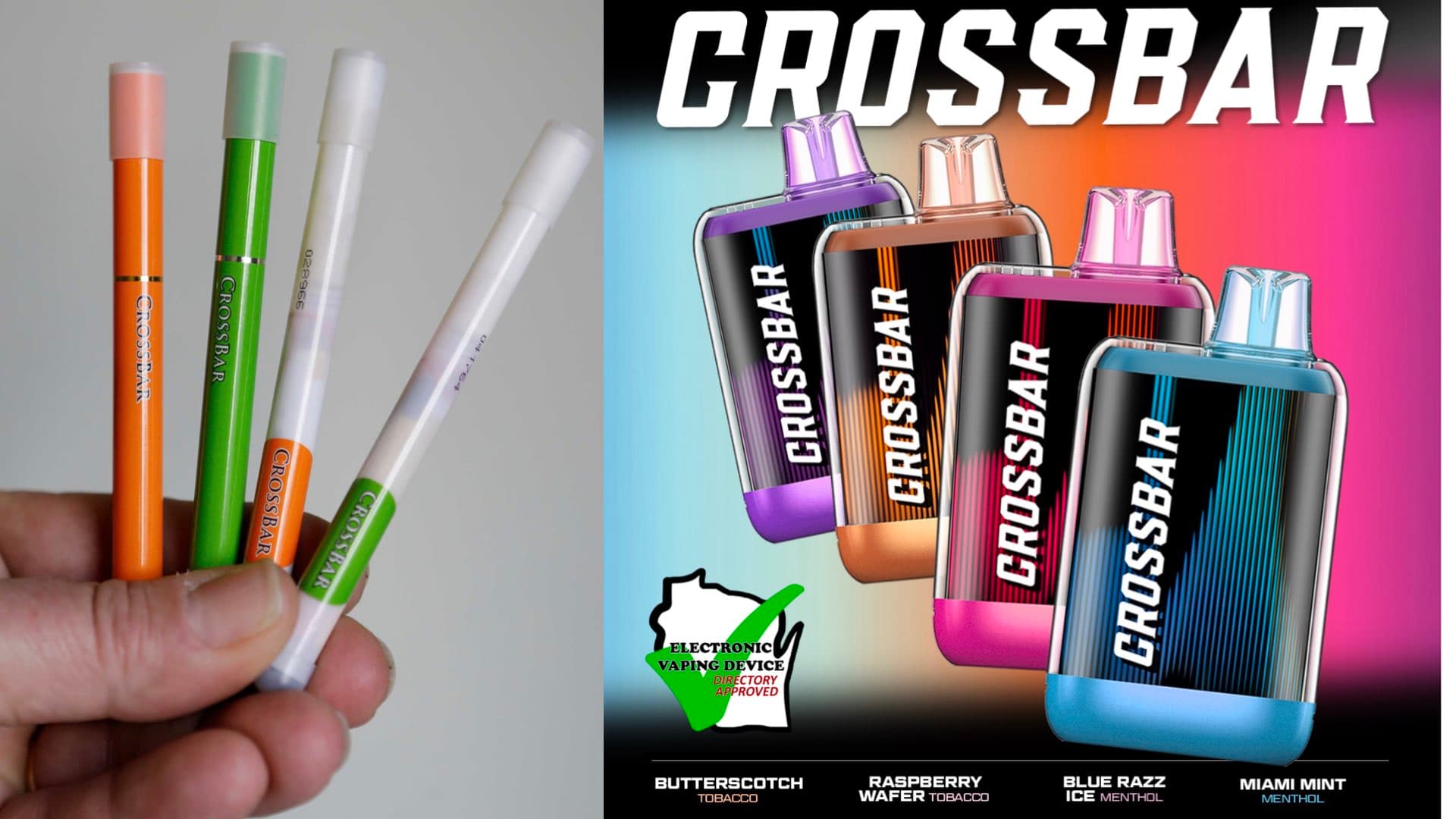
CrossBar 20K has attracted attention in the US vaping market after four variants appeared in Pennsylvania’s electronic nicotine delivery system (ENDS) product directory. The products stand out because they combine a reported 13 mL e-liquid capacity with a claimed maximum of 20,000 puffs, a format that differs considerably from the smaller closed-system devices listed alongside them.
The listing has also raised questions about the regulatory history behind the products. Earlier CrossBar records referenced devices with a 1.3 mL capacity and a pending Premarket Tobacco Product Application (PMTA) associated with Romo LLC. Newer CrossBar 20K records identify other companies as the applicants for the products listed in several states.
However, publicly available information has not established whether the newer products are covered by an earlier application or whether an application or related business assets were transferred. The distinction matters because a state directory listing and FDA marketing authorization are not the same thing.
Pennsylvania’s Vape Directory Includes 163 Product Records
Pennsylvania began enforcing sales restrictions under its new ENDS directory framework on October 19, 2026. According to 2Firsts’ review of the directory published on October 18, the list contained 163 product records associated with seven manufacturers.
The records covered products connected to major industry names, including Vuse, NJOY, JUUL and Logic. British American Tobacco, Altria, Japan Tobacco and JUUL accounted for 112 entries, or approximately 68.7% of the total.
The directory included 68 cartridge products, 40 bottled e-liquids, 24 kits, 16 devices and 15 disposable e-cigarettes.
Four of the disposable entries were CrossBar 20K variants. Their specifications differed from those of many other products in the directory, particularly older closed-system devices with relatively small liquid capacities.
The four listed variants were:
- Butterscotch Tobacco
- Raspberry Wafer Tobacco
- Blue Razz Ice Menthol
- Miami Mint Menthol
Product packaging information cited in the report identifies a 13 mL liquid capacity, a nicotine concentration of 50 mg/mL and a claimed maximum of 20,000 puffs for these variants.
These are reported product specifications, not independent evidence of actual usage or nicotine delivery. Puff counts can vary with device design and individual use.
For more details about the new restrictions and the brands missing from the state’s list, read our report on the Pennsylvania vape directory and the products facing sales restrictions.
How CrossBar 20K Differs From Other Listed Products
The size of the liquid reservoir is one of the clearest differences between CrossBar 20K and several established closed-system products in Pennsylvania’s directory.
The CrossBar 20K has a reported capacity of 13 mL. By comparison, the records cited by 2Firsts list 0.9 mL for NJOY DAILY, 1.8 mL per Vuse Alto pod and 0.7 mL per JUUL pod.
That means the CrossBar 20K reservoir is approximately 14.4 times the size of the cited NJOY DAILY device’s capacity, 7.2 times the capacity of a Vuse Alto pod and 18.6 times the capacity of a JUUL pod.
These comparisons illustrate differences in product format. They should not be interpreted as direct comparisons of total nicotine exposure, safety or real-world lifespan.
CrossBar also differs visually from many traditional closed-system products, using a flatter disposable-device design rather than the smaller form factors associated with earlier generations of e-cigarettes.
The directory’s composition is noteworthy for another reason: several popular disposable brands were absent from the October 18 list. The Pennsylvania Attorney General’s Office said that manufacturer certification applications were still under review and that the directory would be updated as products received approval.
CrossBar 20K Appears in Multiple State Records
Pennsylvania is not the only state where CrossBar 20K has appeared in publicly available product records.
According to 2Firsts’ review, the four variants were listed in records for Pennsylvania, North Carolina, Virginia, Nebraska, Tennessee and Mississippi. The associated applicant names included Blue Nine LLC and VR Products I LLC.
The four variants also used matching Universal Product Codes (UPCs) across multiple state records, providing a way to identify the same products in different listings.
North Carolina records reportedly showed that Blue Nine’s four CrossBar variants were added to the state list on May 1, 2025. Nebraska records also identified the products’ 13 mL capacity.
Historical records in Louisiana and Arkansas referenced earlier CrossBar products with a much smaller 1.3 mL capacity. Wisconsin had previously listed four newer variants in May 2025, although those records were removed in February 2026, according to the report.
These records show that CrossBar products have appeared in different state-level regulatory systems over time. They do not, by themselves, establish that every listing remains active or that the products have received FDA marketing authorization.
State directories operate under their own legal requirements, and a product’s eligibility for inclusion may depend on the specific conditions of the relevant law.
From 1.3 mL to 13 mL: The Regulatory Question Behind CrossBar
One of the central questions concerns the relationship between earlier CrossBar products and the newer CrossBar 20K range.
Historical records cited by 2Firsts reference CrossBar Tobacco and Menthol products with a 1.3 mL capacity. Those records identified Romo LLC and included a September 9, 2020 application date, with the relevant status described as under review.
The newer CrossBar 20K products have a reported capacity of 13 mL—ten times the earlier figure—and use a different physical format. Their state directory records also identify Blue Nine LLC and VR Products I LLC.
These differences raise questions about the scope of the original applications, subsequent product changes and the relationships between the companies named in the records.
At present, the available public information does not confirm that the earlier 1.3 mL products and the newer 13 mL variants are covered by the same PMTA. Nor does it establish that the relevant application rights were transferred from Romo LLC to Blue Nine LLC.
That uncertainty is important. A historical application record should not automatically be treated as proof that a substantially different product is eligible for sale.
What a PMTA Amendment Can—and Cannot—Establish
A Premarket Tobacco Product Application is the process through which the US Food and Drug Administration evaluates a new tobacco product before it can legally be marketed under the applicable federal framework.
Applicants must provide information about product ingredients, design, manufacturing, labeling and relevant health-risk investigations, among other requirements. The FDA reviews the submission to determine whether the product meets the statutory standard for marketing authorization.
The agency permits applicants to submit amendments while an application is under review. These amendments can provide additional information, clarify earlier submissions or respond to questions raised during the review process.
However, the existence of an amendment process does not mean that every product change can be added to an existing application without further review. Whether a change can be handled within an application depends on the original submission, the nature of the modification and the applicable FDA requirements.
Ownership changes also involve formal procedures. If a company transfers rights associated with an application, the relevant documentation and regulatory requirements must be addressed.
In the CrossBar case, industry compliance expert Mr. K suggested that product amendments or a change in application ownership could be possible explanations for the differences between the earlier and newer records.
Those possibilities remain explanations rather than confirmed events. The public information cited in the report does not establish that CrossBar 20K received coverage through an amendment to the earlier application or that the relevant application rights were transferred between the companies.
The distinction between a possible regulatory route and a documented regulatory outcome is essential when assessing the products’ status.
Manufacturers also need to follow developments in the FDA’s wider regulatory framework, including the requirements discussed in our report on FDA tobacco registration and product-listing compliance.
Pennsylvania’s Directory Does Not Replace FDA Authorization
Pennsylvania’s ENDS directory is designed to identify products that meet the state’s requirements for sale. Its framework includes specific eligibility and certification conditions, including provisions relevant to certain products with pending federal applications.
The state directory therefore serves a different purpose from the FDA’s federal marketing authorization process.
For businesses, appearing in a state directory can have a direct impact on distribution and retail access. For regulators, the listing system provides a mechanism for determining which products meet the state’s requirements.
However, the presence of a product in a state directory should not be interpreted as a blanket FDA approval. The legal basis for each listing depends on the applicable rules and the documentation submitted.
For CrossBar 20K, the specific certification route used for the Pennsylvania entries has not been fully established in the publicly available records cited by 2Firsts.
This leaves an important question for further reporting: how do the newer product specifications and applicant identities relate to the earlier CrossBar records, and what documentation supports their current eligibility?
The PACHA Transaction Shows the Commercial Value of Regulatory Assets
A separate transaction involving Charlie’s Holdings and R.J. Reynolds Vapor Company offers a useful comparison for understanding the commercial significance of historical regulatory applications.
In April 2025, R.J. Reynolds, part of British American Tobacco’s US business, entered into an asset purchase agreement with Charlie’s Holdings involving PACHA synthetic nicotine products and related assets.
The initial transaction covered 12 products for $5 million. Subsequent agreements added three products for $1.5 million and another product for $1 million. Together, the three stages involved 16 products and a fixed cash consideration of $7.5 million.
The original agreement also included a potential additional payment tied to future commercial performance. That contingent amount was separate from the fixed consideration.
The transaction documentation filed with the US Securities and Exchange Commission included regulatory application-related rights among the assets and arrangements covered by the deal.
This provides a documented example of how product portfolios and related regulatory assets can form part of a commercial transaction.
It does not establish that CrossBar underwent a similar transfer. Rather, it illustrates why the ownership and scope of historical applications can matter to companies operating in a tightly regulated market.
Charlie’s Holdings later reported that it continued to hold hundreds of products with submitted PMTAs after the PACHA transaction. The company has discussed further work on those applications and potential commercial partnerships.
The PACHA transaction and the CrossBar situation should therefore be treated separately: one involved a documented asset purchase, while the other still raises unanswered questions about the relationship between older applications and newer product records.
Why the CrossBar Case Matters to the US Vaping Market
The CrossBar 20K listing highlights several issues affecting the US e-cigarette industry.
First, state-level product directories can influence which products remain available through retail channels. Companies that satisfy the applicable requirements may have a different market position from businesses whose products are still awaiting review.
Second, historical PMTA records can become important when a product or business changes. Regulators and market participants need to distinguish between an application for a specific product and a later product that may differ in capacity, design or other characteristics.
Third, corporate ownership and application transfers require careful documentation. A change in a company name or applicant listed in state records does not, on its own, prove that regulatory rights were transferred correctly.
Finally, the case demonstrates why product listing status, FDA authorization and commercial availability should not be treated as interchangeable terms.
As more US states develop or enforce their own product-directory rules, businesses will need to understand both federal requirements and the separate conditions imposed by each state.
What to Watch Next
The next important developments will be any additional public records clarifying the regulatory basis for CrossBar 20K’s state listings.
Relevant information could include confirmation of the products’ application status, documentation of any ownership transfer, or further details about how the newer specifications relate to the earlier 1.3 mL products.
Updates to Pennsylvania’s directory and records from other states may also help clarify the products’ status over time.
Until such evidence becomes available, the relationship between the earlier CrossBar products and the CrossBar 20K range remains unresolved.
Bottom line: CrossBar 20K stands out in Pennsylvania’s 2026 ENDS directory because of its reported 13 mL capacity and claimed 20,000-puff specification. Yet the more consequential question is regulatory: publicly available records have not confirmed whether the newer products are covered by the historical CrossBar PMTA or whether an application transfer took place. The distinction matters as state directories increasingly shape access to the US vaping market.