







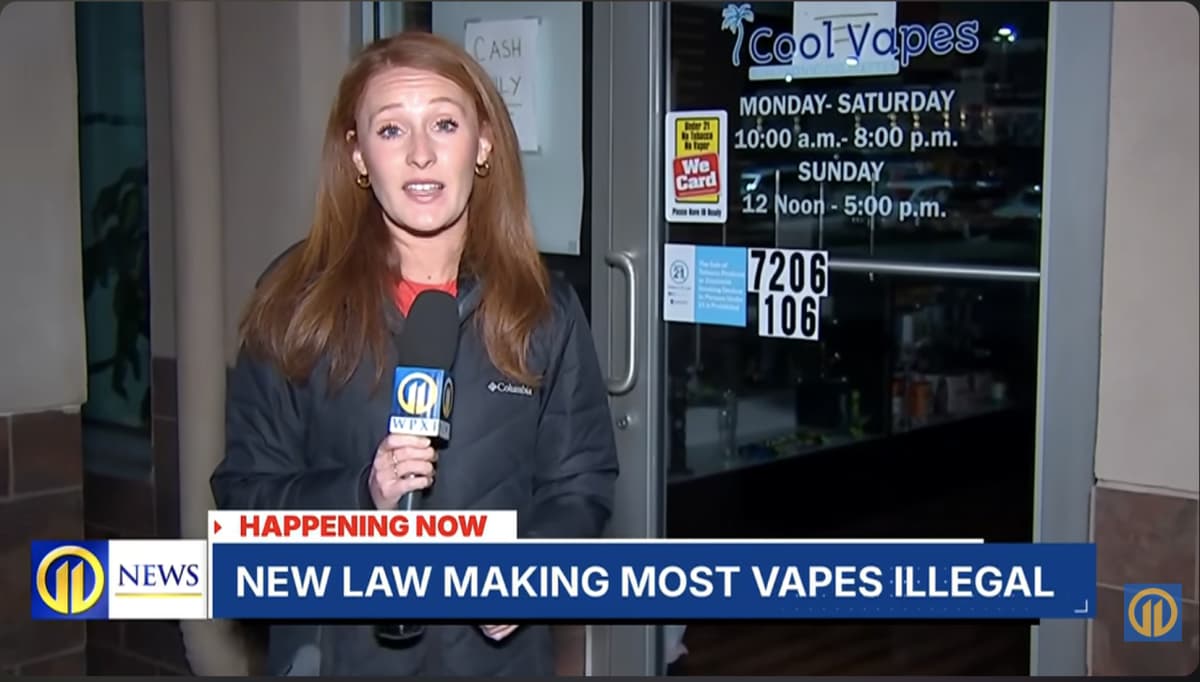
Pennsylvania has begun enforcing a new vape product directory that limits which electronic nicotine delivery systems can be sold at retail across the state. The rules took effect for enforcement on October 19, 2026, creating a significant compliance challenge for vape manufacturers, distributors, and independent retailers.
As of October 18, the state’s published directory contained 163 product listings from seven manufacturers. Brands appearing on the list included Vuse, JUUL, NJOY, Logic, and Naked 100. Several widely recognized disposable vape brands, including Geek Bar, RAZ, Lost Mary, and Elf Bar, were not listed in the directory at that time.
The development highlights how state-level product approval requirements can affect the availability of vaping products even when those products are familiar to consumers. The directory may also change as additional manufacturer certifications are reviewed and approved.
Pennsylvania’s New Vape Sales Rules Begin Enforcement
The requirements stem from Pennsylvania Act 57 of 2025, signed into law on December 22, 2025. The law established a state directory administered by the Pennsylvania Office of Attorney General, identifying electronic nicotine delivery system products eligible for retail sale under the state’s requirements.
Beginning October 19, 2026, applicable products that do not appear on the directory may no longer be sold, offered for sale, or retained as retail inventory in Pennsylvania. The Attorney General’s Office has announced that it can conduct targeted enforcement and impose penalties for violations.
The rules are particularly important for retailers carrying large numbers of disposable vapes, replacement pods, bottled e-liquids, and device kits. Businesses need to check the actual product listing rather than assuming that an entire brand is approved because one of its products appears on the state’s directory.
The directory is a state-level sales compliance system. Inclusion should not be interpreted as a general endorsement of a product, and absence from the list on a particular date does not necessarily mean a manufacturer has never submitted an application.
Pennsylvania’s new requirements are part of a wider shift in U.S. vape regulation, making it important for retailers to follow both federal requirements and state-specific sales rules.
Seven Manufacturers Account for 163 Listed Products
The directory published on October 18 contained products from seven manufacturers. Vuse had the largest number of listings, followed by JUUL and Naked 100.
| Brand or product family | Listed products |
|---|---|
| Vuse Alto, Vuse Solo and Vuse Vibe | 52 |
| JUUL | 40 |
| Naked 100 | 40 |
| NJOY ACE and DAILY product families | 16 |
| e Cig 4 Inmate | 7 |
| CrossBar | 4 |
| Logic Pro and Logic Power | 4 |
| Total | 163 |
These figures reflect the published directory as reported on October 18, rather than a permanent count. The state may update the list as certifications are approved.
Vuse, which is associated with R.J. Reynolds Vapor Company, accounted for 52 listings. JUUL and Naked 100 each had 40. Together, the three brands represented most of the entries in the directory.
Logic, NJOY, CrossBar, and e Cig 4 Inmate accounted for the remaining listings. Imperial Brands’ blu and myblu products did not appear in the published directory at that time.
Geek Bar, RAZ, Lost Mary and Elf Bar Missing From the Published List
One of the most commercially significant aspects of the directory was the absence of several popular vape brands. A review of the published list before enforcement found no listings for Geek Bar, RAZ, Lost Mary, Elf Bar, Breeze Smoke, Flum, Hyde, and Off-Stamp.
For retailers, the practical issue is product-level compliance. A store cannot assume that an unlisted device is eligible for sale simply because its manufacturer or another product from the same brand is familiar in the market.
The same principle applies to individual variants. A listed product does not automatically make every flavor, device, nicotine strength, or package configuration from the same brand eligible for sale.
The directory should therefore be checked against the precise product name and relevant listing details before stock is offered to customers. Businesses should also retain accurate purchasing and inventory records to support compliance.
Product Categories Include Pods, E-Liquids and Disposable Vapes
The 163 directory entries covered several types of products, not just disposable devices.
| Product category | Listings |
|---|---|
| Replacement pods or cartridges | 68 |
| Bottled e-liquid | 40 |
| Kits | 24 |
| Devices | 16 |
| Disposable vapes | 15 |
| Total | 163 |
Replacement pods and cartridges made up the largest category, while disposable vapes represented 15 entries. Bottled e-liquid accounted for 40 listings.
The published list also did not show an approved open-system refillable device alongside the listed bottled e-liquids. Separately, Boulder and Rock products appeared on a publicly disclosed pending list but were not included in the formal directory as of October 18.
This distinction matters because the presence of a bottled e-liquid in a directory does not, by itself, establish that a compatible refillable device is also listed.
Ten Zero-Nicotine E-Liquid Listings Also Appear
The directory included 10 Naked 100 e-liquid listings labeled as containing 0mg nicotine. The reported 40 Naked 100 entries covered 10 product lines, with four listed nicotine strengths per line: 0mg, 3mg, 6mg, and 12mg.
Pennsylvania’s certification guidance also addresses certain non-nicotine products that use the same brand name as nicotine-containing electronic cigarettes. In the circumstances described by the Attorney General, manufacturers must certify the absence of nicotine and provide appropriate test results from a certified U.S. laboratory.
This means that a product labeled nicotine-free should not automatically be assumed to fall outside the state’s requirements. Its brand relationship and the applicable certification rules can also matter.
For manufacturers, the distinction creates an additional compliance consideration when a brand sells both nicotine-containing and nicotine-free products.
Twenty-Two Manufacturer Certifications Remain Under Review
As of the reported October 18 update, the Attorney General’s Office had 22 manufacturer certifications under review. The agency has stated that the directory will be updated as products receive approval.
The public pending information included applications associated with companies and brands such as LYCO, OXBAR, Boulder, and Rock. Those names were not included in the formal sales directory at the time covered by the report.
A pending application should not be treated as an approval. Equally, the absence of a company from a publicly disclosed pending list does not necessarily prove that it has never submitted an application, because disclosure of pending information may depend on authorization and the applicable rules.
For brands seeking to maintain access to Pennsylvania retailers, complete documentation and timely certification are therefore important. For retailers, monitoring updates is essential because the list may change after the initial enforcement date.
Manufacturers should also understand the FDA’s premarket tobacco product application process when assessing the requirements for marketing vape products in the United States.
What the Rules Mean for Vape Retailers
Pennsylvania’s directory system adds a further product-level compliance check to the work of operating a vape store. Retailers should verify that the exact products they intend to sell appear on the current official directory and should not rely solely on a distributor’s assurance or an older product catalog.
The Attorney General has said enforcement may involve targeted inspections, with penalties that escalate for repeat violations. Products that do not meet the applicable requirements may face seizure or other legal consequences.
Retailers can reduce uncertainty by reviewing the official directory regularly, checking product names and variants against the published entries, and asking suppliers for documentation where needed. Manufacturers should also follow the state’s certification guidance and keep product information current.
Where to Check Pennsylvania’s Official Vape Directory
The Pennsylvania Office of Attorney General maintains the official ENDS directory, certification information, and related guidance.
Retailers and manufacturers should use the Pennsylvania Attorney General’s official ENDS Directory to check current listings and review the rules that apply to their products.
Because the directory can be updated, the October 18 figures in this report should be treated as a snapshot of the list before enforcement began, not a guarantee of the current number of approved products.
Conclusion
Pennsylvania’s October 19 enforcement milestone marks a major change for the state’s vaping retail market. The directory contained 163 listings from seven manufacturers as of October 18, while several familiar disposable vape brands were absent from the published list.
For retailers, the immediate priority is verifying each product against the current directory. For manufacturers, the challenge is completing the certification process and ensuring that product variants meet the applicable requirements. With 22 certifications still under review at the time of the report, the list may continue to evolve.
The central takeaway is straightforward: retail eligibility in Pennsylvania depends on the applicable state requirements and the specific product’s directory status, not brand recognition alone.