








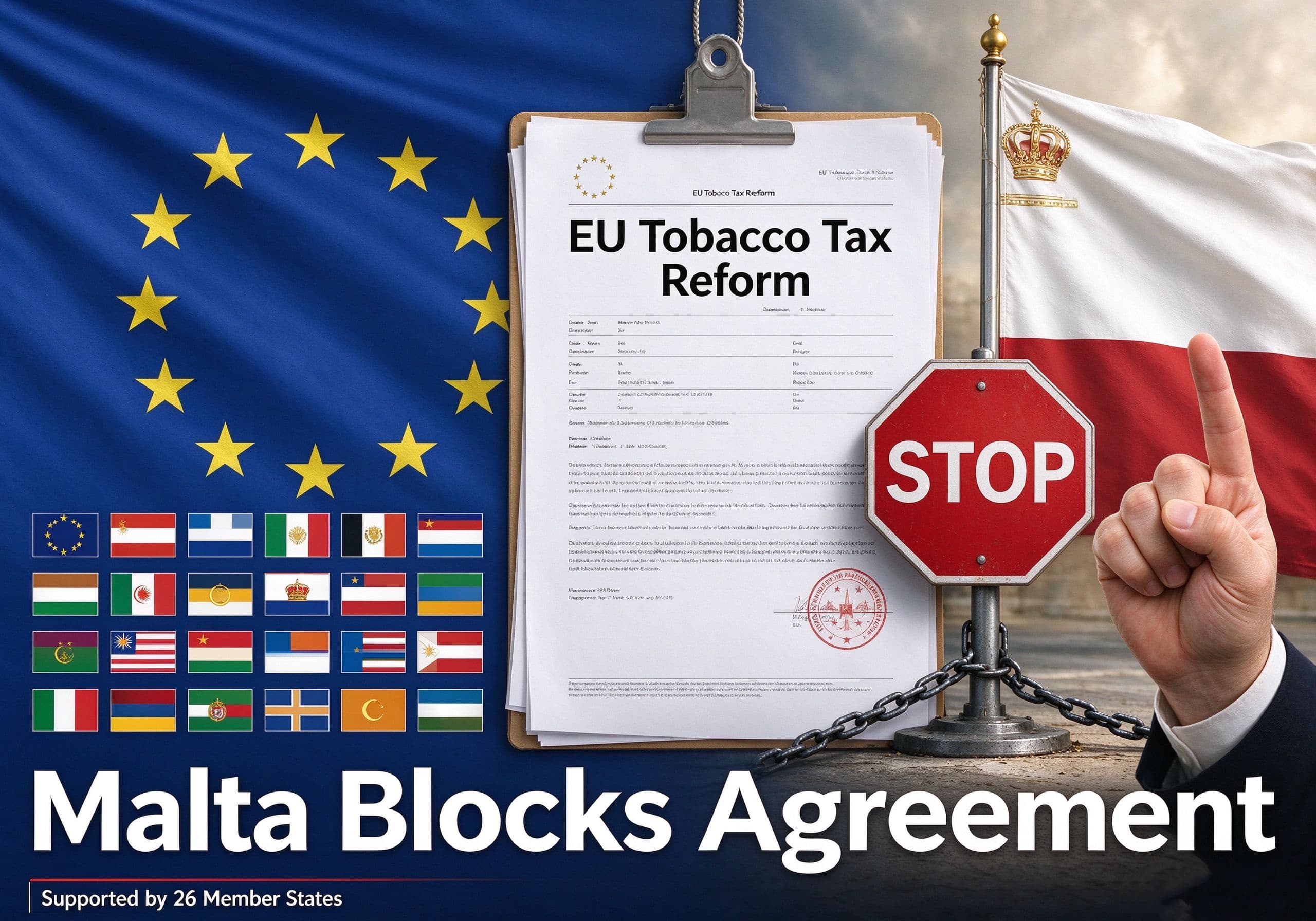
The European Union’s proposed tobacco taxation reform has encountered another obstacle after finance ministers failed to reach an agreement at their November 9, 2026 meeting. Although 26 of the bloc’s 27 member states reportedly supported a compromise proposal presented by Ireland, Malta refused to approve the latest version, preventing the Council from establishing a common position.
The proposed reform would reshape the EU’s tobacco excise tax framework by increasing minimum taxes on traditional tobacco products and bringing e-cigarette liquids, heated tobacco products, and nicotine pouches under a shared EU minimum taxation system.
The outcome represents progress in negotiations, but it also leaves the future tax treatment of several nicotine products uncertain. Ireland, which currently holds the rotating Council presidency, plans to continue discussions in December rather than restart the entire negotiation process.
Malta Remains the Main Obstacle to an EU-Wide Tax Agreement
The negotiations took place during the Economic and Financial Affairs Council (ECOFIN) meeting in Brussels on November 9.
Irish Deputy Prime Minister and Finance Minister Simon Harris said that support from 26 member states represented significant progress. However, Malta remained unwilling to accept the proposed compromise, leaving the reform without the unanimous backing required for this type of EU tax legislation.
Malta’s objections reportedly focus on three main issues:
- Minimum excise tax levels: The proposed EU minimum rates could exceed Malta’s existing domestic tax levels.
- Automatic tax adjustments: Malta opposes mechanisms that would periodically increase minimum rates without sufficient flexibility for national governments.
- Purchasing-power adjustments: The country argues that the proposed system does not adequately account for differences in economic conditions and consumer purchasing power between member states.
Malta’s Finance Minister Clyde Caruana has indicated that his government supports the general objective of updating tobacco taxation but believes the current proposal could impose a disproportionate burden on the country’s economy.
Under Article 113 of the Treaty on the Functioning of the European Union, relevant tax harmonization legislation requires unanimous approval from the Council. Consequently, support from 26 countries is not enough to move the proposal forward as an agreed Council position.
Finland and Estonia Accept Further Compromises
Malta was not the only country to raise concerns during the negotiations.
Finland had previously argued that the proposed minimum tax on nicotine pouches was too low. Estonia, meanwhile, objected to a mechanism that could automatically adjust EU minimum tax levels without requiring another unanimous decision from member states.
Both countries eventually accepted additional concessions proposed by the Irish presidency.
Estonia reportedly secured an arrangement that would suspend automatic adjustments to EU minimum tax rates until the next revision of the directive. The timing of that future revision has not yet been established.
Finland also accepted the broader compromise package following discussions over the proposed nicotine pouch taxation rules.
These concessions helped Ireland secure support from almost the entire bloc, leaving Malta as the only remaining opponent of the latest negotiating text.
Nicotine Pouch Taxation Could Be Decided Separately
One of the most important changes discussed during the negotiations concerns the proposed taxation of nicotine pouches.
The taxation debate is unfolding alongside broader regulatory discussions, including the EU’s upcoming TPD3 regulatory changes, which could reshape the rules governing e-cigarettes and other nicotine products.
An earlier compromise document, dated November 5, 2026, outlined a phased minimum excise tax structure:
| Proposed implementation date | Proposed minimum tax |
|---|---|
| January 2028 | 10% of retail price or €30 per kg |
| January 2030 | 25% of retail price or €40 per kg |
| January 2032 | 50% of retail price or €50 per kg |
These figures appeared in a negotiating document and were not adopted as final EU rules.
To address objections from member states, Ireland reportedly proposed separating two decisions: first, agreeing that nicotine pouches should fall within the EU’s common excise tax framework, and then determining their specific minimum tax rates at a later stage.
This approach could make it easier for governments to agree on the general taxation structure without immediately resolving every disagreement over the exact rates.
However, the proposal did not secure the unanimous support needed to conclude the broader reform.
As a result, the EU has not yet established a new common minimum excise tax rate for nicotine pouches.
Proposed Transitional Period Could Extend to 2036 for Ten Countries
The latest compromise also includes potential flexibility for countries that would face greater difficulties meeting the proposed minimum tax levels for traditional tobacco products.
According to reports cited by 2Firsts, ten member states could receive an extended transition period until January 1, 2036, for adjustments involving cigarettes and fine-cut tobacco.
The countries identified include:
- Cyprus
- Greece
- Italy
- Spain
- Bulgaria
- Croatia
- Luxembourg
- Portugal
- Romania
- Slovenia
The proposed extension would apply to qualifying countries whose average annual excise tax increases would exceed 2.35% when calculated against their 2025 tax levels.
This transitional arrangement is intended to give affected governments more time to adapt their national tax systems.
However, it remains part of the negotiation package rather than an adopted EU regulation. Its final form will depend on whether member states eventually reach an agreement.
The latest compromise follows several rounds of negotiations, with earlier EU nicotine tax negotiations highlighting disagreements over minimum rates and the potential impact on different national markets.
E-Cigarette Liquids and Heated Tobacco Remain Part of the Proposed Reform
The EU initiative is not limited to conventional cigarettes.
The European Commission presented its reform proposal in July 2025, seeking to modernize the existing tobacco excise framework and introduce common minimum taxation rules for additional nicotine-related categories.
The products covered include:
- E-cigarette liquids, including qualifying nicotine-free liquids under the proposed directive’s definitions
- Heated tobacco products
- Nicotine pouches
- Raw tobacco and certain related tobacco products
At present, these categories are subject to different national tax arrangements across the EU.
The proposed reform aims to reduce differences between national systems by introducing a shared minimum taxation framework.
However, the failure to reach an agreement on November 9 means that the proposed common minimum tax rules have not entered into force. Existing national taxation systems therefore continue to apply.
For manufacturers, importers, distributors, and retailers, the negotiations remain important because any eventual EU-wide framework could affect product pricing, market access, and compliance planning.
Ireland Plans to Resume Negotiations in December
Ireland intends to continue discussions with Malta and other relevant parties rather than reopen the entire reform package.
Simon Harris has indicated that the Irish presidency hopes to address Malta’s remaining concerns and return to the issue in December.
The next regular ECOFIN meeting is scheduled for December 11, 2026, although it has not been confirmed whether the tobacco taxation reform will be finalized at that meeting.
The legislative process also involves two related proposals: one concerning the structure and minimum rates of tobacco excise duties, and another addressing amendments to the general arrangements for excise duties.
The European Parliament issued consultation opinions on the proposals on June 17, 2026. Its opinion did not terminate the legislative process, meaning the Council can continue working toward a final agreement under the applicable procedure.
What the Negotiation Delay Means for Europe’s Nicotine Market
The latest ECOFIN meeting demonstrates how difficult it can be to harmonize tobacco taxation across countries with different economic conditions and national tax policies.
The support of 26 member states suggests that Ireland has made substantial progress in negotiating a compromise. Nevertheless, Malta’s opposition means the EU still lacks an agreed framework for the proposed minimum excise taxes.
For the vaping and nicotine industries, several important questions remain unresolved, including the future taxation of e-liquids, the treatment of nicotine pouches, and the minimum tax levels that could eventually apply to heated tobacco products.
Businesses operating across multiple European markets should continue monitoring national tax requirements rather than treating the proposed EU rates as confirmed obligations.
The bottom line: The EU’s tobacco tax reform has not been approved. Ireland hopes to secure an agreement in December, but until all member states reach the required consensus and the legislative process is completed, the proposed common minimum tax framework remains under negotiation.