










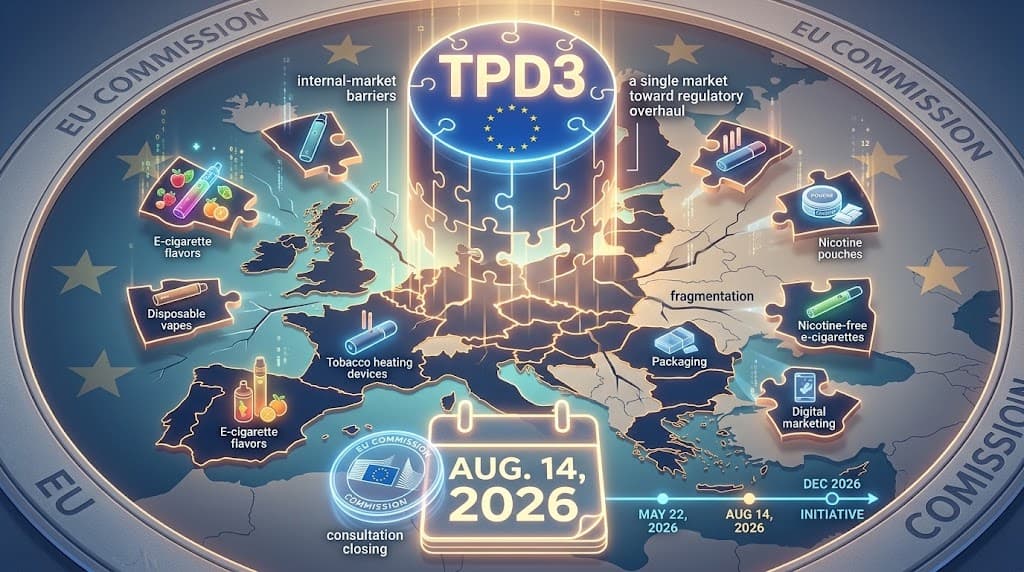
August 14, 2026: The European Union’s next review of its tobacco and nicotine regulatory framework has reached an important procedural milestone, with the European Commission’s public consultation on revisions to the Tobacco Products Directive (TPD) and Tobacco Advertising Directive (TAD) closing on August 14, 2026.
The consultation is part of the Commission’s broader assessment of whether the EU’s existing regulatory framework remains suitable for a rapidly changing nicotine market. The Commission has indicated an indicative target of December 2026 for a formal legislative initiative, although both the timing and final content remain subject to change.
The reform is frequently described by industry participants and media outlets as “TPD3” or “TPD 3.0.” However, it is important to emphasize that TPD3 is not currently an adopted law. As of August 14, the EU remains in the consultation, evidence-gathering, impact-assessment, and legislative-preparation stages.
The next phase could nevertheless have significant implications for e-cigarettes, heated tobacco products, nicotine pouches, and other emerging nicotine categories across the European market.
From a Unified Framework to Increasing National Fragmentation
When the current TPD framework was developed, today’s diverse range of nicotine products was far less established.
Since then, the European market has expanded to include a much wider variety of products, including flavored e-cigarettes, disposable vapes, heated tobacco products, nicotine pouches, and nicotine-free electronic delivery systems.
The European Commission’s assessment, published in April 2026, concluded that the existing framework has not fully kept pace with changes in products, consumption patterns, and digital marketing.
One of the central problems identified by the Commission is the growing divergence between national regulations.
Member states have introduced different approaches in areas including:
- E-cigarette flavors
- Disposable e-cigarettes
- Plain packaging
- Heated tobacco products
- Other nicotine products
- Nicotine-free electronic delivery systems
- Packaging and labeling
- Digital marketing and advertising
From the Commission’s perspective, these differences can create barriers within the EU internal market and potentially distort competition between businesses operating across member states.
The result is an increasingly fragmented regulatory environment in which the same product may face substantially different requirements depending on where it is sold.
E-Cigarette Flavors Are a Major Area of Divergence
E-cigarettes are among the clearest examples of regulatory fragmentation.
The existing TPD establishes product requirements for nicotine-containing e-cigarettes and refill containers, but it does not impose a single EU-wide prohibition on e-cigarette flavors.
Individual member states have therefore adopted different approaches. Some have introduced restrictions on flavors, while others continue to permit a broader range of flavored products.
This divergence has become one of the issues now being considered as part of the next stage of EU regulatory reform.
The Commission’s consultation documents indicate that potential measures could include restrictions or prohibitions on certain flavors, as well as controls on flavor names, packaging imagery, and other visual elements that could influence consumer appeal.
However, these remain policy options under consideration, rather than finalized EU rules.
Disposable Vapes Face Increasing National Restrictions
Disposable e-cigarettes represent another area where national policies have diverged significantly.
The European Commission’s records under Article 24(3) of the TPD show that several member states have pursued national measures concerning disposable or specific categories of e-cigarettes.
Belgium and France previously obtained authorization for certain national measures, while measures concerning disposable e-cigarettes in Bulgaria and Austria entered relevant EU procedures in 2026. Ireland and Spain have also taken national regulatory action concerning specific e-cigarette products.
These developments illustrate the practical consequences of regulatory fragmentation.
A disposable e-cigarette that is permitted in one EU market could face restrictions or even be prohibited in another, creating additional compliance challenges for manufacturers, importers, distributors, and retailers.
The Commission is now considering whether greater EU-level harmonization could reduce these differences.
Flavor and Disposable Vape Restrictions Are Still Policy Options
The latest consultation represents a further step beyond earlier discussions because it explicitly identifies several emerging product categories and regulatory areas for potential reform.
The Commission is considering possible rules concerning:
- E-cigarette flavors
- Disposable e-cigarettes
- Heated tobacco devices
- Nicotine pouches
- Nicotine-free e-cigarettes
- Nicotine requirements
- Product safety
- Labeling and packaging
- Digital marketing and advertising
Stakeholders are also being asked for their views on potential measures such as restricting or banning certain flavors, limiting flavor names and visual packaging elements, changing nicotine requirements, strengthening equipment safety standards, and restricting or prohibiting disposable e-cigarettes.
However, it is crucial to distinguish consultation from legislation.
The fact that a measure appears in a consultation document does not mean that the European Commission has decided to introduce it.
As of August 14, 2026, there is no finalized legislative text establishing an EU-wide flavor ban or disposable vape ban under a new TPD.
Nicotine Pouches Could Become a Major Focus of the Next TPD
Nicotine pouches present a different regulatory challenge.
Unlike e-cigarettes, they are not comprehensively covered by the existing TPD framework. The current system primarily regulates tobacco products and certain categories of e-cigarettes, leaving other emerging nicotine products outside the same level of EU-wide regulation.
The rapid growth of nicotine pouches in recent years has made this regulatory gap increasingly visible.
The European Commission is therefore considering whether the scope of the legislation should be expanded to cover currently under-regulated or insufficiently covered new products.
Nicotine pouches have been explicitly identified within this policy discussion.
Potential future rules could address issues such as product composition, nicotine content, flavors, packaging, labeling, and marketing.
This is also why speculation about an EU-wide nicotine pouch flavor ban has intensified.
Nevertheless, the Commission’s current documents do not establish that the EU has already decided to introduce a blanket ban on flavored nicotine pouches.
No Official Confirmation of a “12-Country Flavor Ban”
Some industry websites have previously claimed that 12 EU member states are jointly promoting a nicotine pouch flavor ban.
However, based on the official European Commission, European Council, and relevant member-state documents referenced in the source material, there is currently no official documentation confirming this specific “12-country” claim.
It should therefore not be treated as an established fact.
What can be established is that nicotine pouches, their regulatory coverage, and potential rules concerning flavors and other product characteristics have entered the Commission’s policy discussion.
The distinction is important because the EU legislative process remains at a preliminary stage.
Member States Also Disagree on How Strict Regulation Should Be
The challenge for Brussels is not simply to reconcile different national rules.
Member states also have different views about how strictly emerging nicotine products should be regulated in the first place.
According to reporting by Euractiv in March 2026, countries including France and the Netherlands have generally favored stricter controls on new tobacco and nicotine products.
Other countries, including Italy and Greece, have emphasized the importance of scientific evidence and argued that policymakers should carefully assess whether new nicotine products differ sufficiently from conventional cigarettes to justify different regulatory treatment.
This policy divide could make the next TPD revision more complicated than a straightforward technical update.
The EU will need to address not only differences between national regulations, but also differences in regulatory philosophy among member states.
Heated Tobacco Products Are Also Under Review
Heated tobacco products are already covered by the existing TPD framework, but they have not been excluded from the next review.
The Commission has identified some legal uncertainty concerning whether the individual sale of tobacco-heating devices is fully covered by the existing framework.
As a result, heated tobacco devices have also been included within the areas being examined for possible changes.
For major tobacco companies with portfolios spanning cigarettes, heated tobacco, e-cigarettes, and other nicotine products, changes in this area could have broader implications for product design, distribution, packaging, and compliance.
Digital Marketing Is Becoming Part of the Regulatory Debate
The regulatory discussion is also expanding beyond the physical product itself.
The Commission’s review recognizes that the nicotine market has changed significantly since the current framework was established, particularly in terms of digital marketing and advertising.
As brands increasingly communicate with consumers through websites, social media, digital advertising, influencers, and other online channels, policymakers are examining whether existing advertising rules remain appropriate.
Potential changes to digital marketing requirements could therefore become an important component of the future TPD/TAD framework.
For companies operating across multiple European markets, this could add another layer of compliance alongside product, packaging, and distribution requirements.
What Happens After August 14?
The end of the public consultation does not mean that the new regulatory framework has been finalized.
After August 14, the European Commission will analyze stakeholder submissions and combine the consultation results with its previous TPD/TAD assessment, evidence-gathering work, and impact assessment.
The Commission’s current indicative timetable points toward a formal legislative initiative in December 2026.
That future proposal will provide a much clearer indication of how far Brussels intends to harmonize rules covering flavors, disposable e-cigarettes, nicotine pouches, heated tobacco devices, and other emerging nicotine products.
If a legislative proposal is ultimately presented, it would still need to pass through the EU’s legislative process involving the European Parliament and the Council of the European Union.
Consequently, August 14 should be viewed as an important procedural milestone rather than the date on which the regulatory outcome is decided.
Potential Impact on the Industry
The consequences of the next TPD revision could extend well beyond individual product categories.
Large international tobacco companies such as BAT, PMI, and JTI, as well as independent e-cigarette and nicotine-pouch businesses operating in Europe, could all be affected by changes to:
- Product definitions and regulatory scope
- E-cigarette flavors
- Disposable vape requirements
- Nicotine limits
- Device safety standards
- Packaging and labeling
- Heated tobacco devices
- Nicotine pouch regulation
- Digital marketing and advertising
For companies selling across multiple EU markets, greater harmonization could potentially simplify compliance in some areas.
At the same time, stricter EU-wide rules could require significant changes to existing products, packaging, marketing strategies, and supply chains.
The final impact will depend heavily on how the Commission ultimately balances market harmonization, public-health objectives, consumer protection, and differences between emerging nicotine products.
The Bigger Question: How Much Harmonization Will Brussels Choose?
The central issue behind the next phase of the TPD review is increasingly clear.
The European Commission has identified regulatory fragmentation among member states as a significant problem. The question now is how far the EU will go in attempting to resolve it.
For e-cigarettes, the debate is likely to center on flavors, disposable products, nicotine requirements, device standards, packaging, and marketing.
For nicotine pouches, the issue is more fundamental: whether they should be brought into a unified EU regulatory framework in the first place, and if so, what rules should apply to nicotine content, flavors, packaging, and promotion.
For heated tobacco products, the focus could include clarifying existing legal provisions and addressing regulatory uncertainty around devices.
Final Thoughts
The EU’s TPD/TAD review has entered a critical new phase, but it would be premature to describe August 14, 2026, as the beginning of “TPD3” in the legal sense.
The term TPD3 remains an informal industry and media label. No new TPD has yet been adopted, and the European Commission has not published a final legislative text establishing an EU-wide ban on flavored e-cigarettes, disposable vapes, or flavored nicotine pouches.
What has changed is the scope of the regulatory debate.
The European Commission is now examining whether the existing framework can adequately address a nicotine market that has expanded far beyond the products that existed when the current TPD was designed. At the same time, national restrictions have created an increasingly fragmented European market.
The next major milestone is expected to be the Commission’s potential legislative initiative in December 2026.
That proposal will ultimately determine whether Europe moves toward a more unified regulatory framework for e-cigarettes, heated tobacco, nicotine pouches, and other emerging nicotine products—or whether significant national differences remain.
For businesses operating across Europe, the period between now and the release of the formal proposal will therefore be critical. The consultation has closed, but the regulatory debate is only moving into its next stage.