









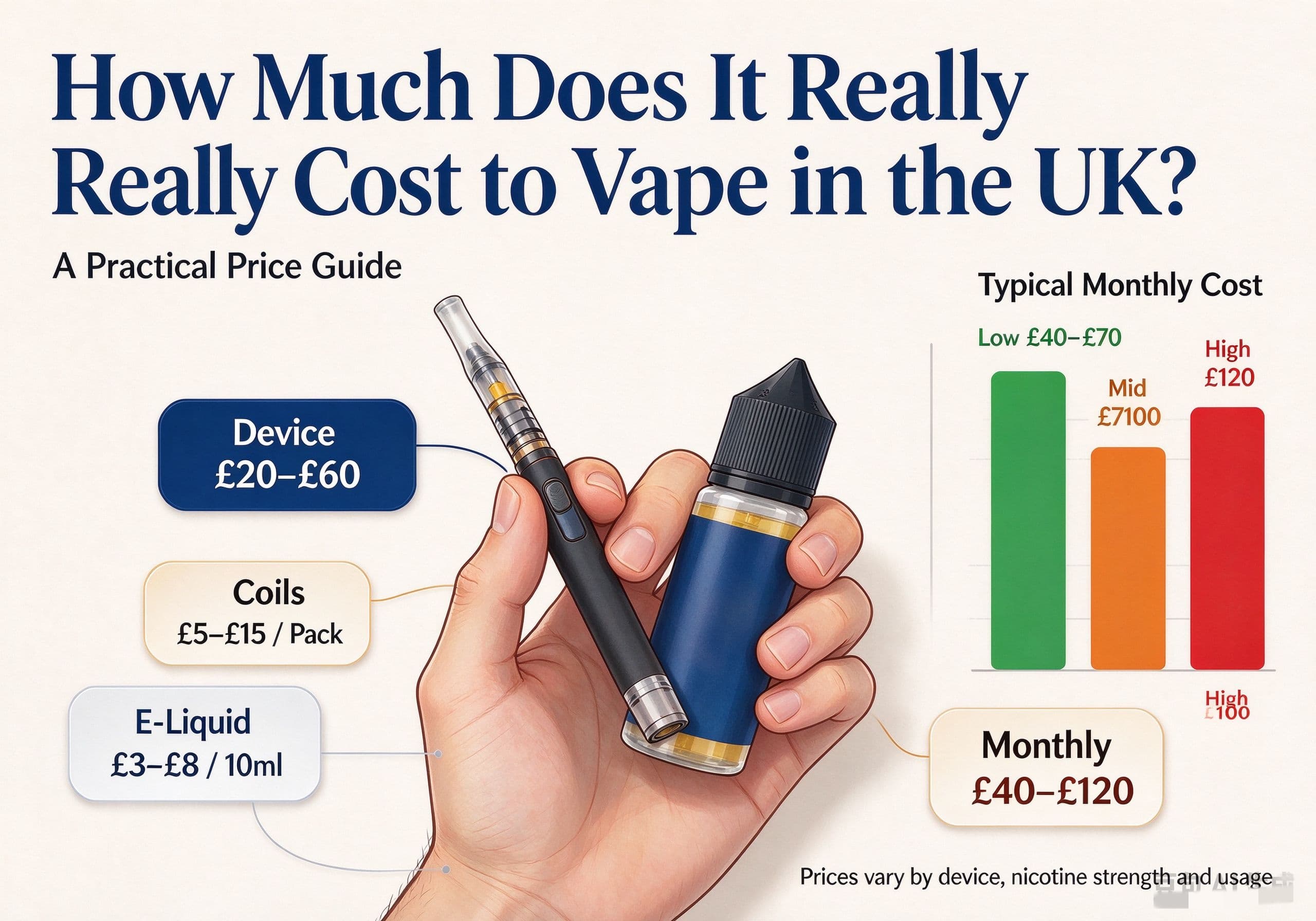
The cost of vaping in the UK depends on more than the price printed on a device or e-liquid bottle. A starter kit might cost less than £20, but replacement pods, coils, e-liquid and the new Vaping Products Duty can make a noticeable difference to ongoing expenses.
There has also been an important change in the UK market: single-use vapes have been banned from sale and supply since 1 June 2025, while a new £2.20-per-10ml Vaping Products Duty came into force on 1 October 2026. This means consumers need to look at reusable devices and the cost of keeping them running.
This guide breaks down the main expenses, explains how the new tax affects prices, and shows how to estimate a monthly budget without relying on misleading puff-count comparisons.
How Much Does It Really Cost to Vape in the UK? A Practical Price Guide
The cost of vaping in the UK depends on more than the price printed on a device or e-liquid bottle. A starter kit might cost less than £20, but replacement pods, coils, e-liquid and the new Vaping Products Duty can make a noticeable difference to ongoing expenses.
There has also been an important change in the UK market: single-use vapes have been banned from sale and supply since 1 June 2025, while a new £2.20-per-10ml Vaping Products Duty came into force on 1 October 2026. This means consumers need to look at reusable devices and the cost of keeping them running.
This guide breaks down the main expenses, explains how the new tax affects prices, and shows how to estimate a monthly budget without relying on misleading puff-count comparisons.
1. How Much Does a Vape Device Cost in the UK?
The initial device purchase is usually a one-off expense, although the amount varies considerably depending on the type of system.
For adults legally purchasing reusable vaping products, the main options include refillable pod kits, prefilled pod systems and more advanced refillable devices.
| Device type | Indicative UK price | What to expect |
|---|---|---|
| Basic refillable pod kit | £8–£15 | Simple controls and compact construction |
| Standard pod system | £10–£25 | More pod choices and additional features |
| Advanced pod kit | £20–£40+ | Greater adjustment and more complex hardware |
| Advanced mod system | £30–£50+ | Larger equipment and more configuration options |
These are approximate shopping ranges rather than fixed market prices. Promotions, brand reputation, included accessories and product specifications can all affect the final amount.
For someone comparing starter devices, the cheapest kit is not necessarily the most economical option. A device with affordable replacement pods and widely available spare parts may cost less to maintain over time.
2. E-Liquid: The Main Recurring Expense
For refillable devices, e-liquid is one of the most important ongoing costs.
In the UK, standard consumer e-liquid bottles are commonly sold in 10ml sizes. Nicotine-containing e-liquids are subject to UK product requirements, including the applicable nicotine concentration and packaging restrictions.
As an indicative example, a market price snapshot published in August 2026 reported a median price of approximately £3.45 for a 10ml nicotine salt bottle, with the middle half of listed prices between £2.59 and £3.99.
That provides a useful reference point, although actual prices can vary between retailers and the new vaping duty changes the cost calculation.
Example: Buying 10ml Bottles
| Purchase quantity | Example price before the new duty |
|---|---|
| One 10ml bottle | £3.45 |
| Two bottles | £6.90 |
| Three bottles | £10.35 |
| Six bottles | £20.70 |
The figures above use the illustrative £3.45 price, not a guaranteed current checkout price.
The important point is to compare the price per millilitre rather than judging a product by its bottle price alone.
A £3 bottle is not automatically cheaper than a £5 bottle if the second product contains significantly more liquid.
3. How the UK Vaping Products Duty Changes the Cost
One of the biggest developments for the UK vaping market in 2026 is the introduction of Vaping Products Duty.
The new tax took effect on 1 October 2026. HMRC applies a flat rate of:
£2.20 per 10ml of vaping liquid
That is equivalent to 22p per millilitre.
Importantly, the duty applies to vaping liquid whether or not it contains nicotine. It is paid by approved manufacturers, importers and warehousekeepers, although businesses decide how much of the additional cost to pass on to retailers and consumers.
For a more detailed breakdown of how the new tax affects different product formats, read our guide to UK vaping tax and its impact on e-liquid and pod prices.
How Much Duty Applies to Different Liquid Volumes?
| E-liquid volume | Duty amount |
|---|---|
| 2ml | £0.44 |
| 5ml | £1.10 |
| 10ml | £2.20 |
| 20ml | £4.40 |
| 30ml | £6.60 |
| 50ml | £11.00 |
| 60ml | £13.20 |
| 100ml | £22.00 |
This calculation makes it easier to understand why liquid consumption matters when estimating the cost of vaping.
For example, someone using 60ml of liquid per month would generate £13.20 in duty across that volume. This is the tax amount attributable to the liquid, not necessarily a separate charge shown on the customer’s receipt.
Does Every Vape Product Become £2.20 More Expensive?
No. The duty is calculated by liquid volume, not as a fixed charge per device.
A product containing 2ml of liquid has a duty amount of 44p, while a 10ml bottle has a duty amount of £2.20.
The actual retail price increase depends on how manufacturers, importers and retailers handle the additional cost. Products already on sale may also have different supply-chain and stock circumstances.
Consumers should compare the final advertised retail price rather than automatically adding £2.20 to every bottle or device.
4. Replacement Pods and Coils Add to Monthly Spending
E-liquid is not the only recurring expense associated with a refillable vape.
Many pod systems use replaceable cartridges, while other devices rely on separate coils installed inside a tank.
These components wear out and need replacing periodically. The replacement interval depends on the device, e-liquid, power settings and frequency of use.
For an indicative price reference, a UK retail-market snapshot from August 2026 reported a median price of approximately £2.20 per replacement coil.
Replacement pods are generally more expensive than individual coils because they may include the coil and cartridge together.
Before choosing a device, check:
- Whether it uses replaceable coils or complete replacement pods.
- How much compatible replacement parts cost.
- Whether the manufacturer continues to supply the relevant components.
- Whether replacement pods are available individually or only in multipacks.
A low-cost starter kit can become less attractive if its replacement components are expensive or difficult to find.
5. Prefilled Pods vs Refillable Devices: Which Costs Less?
The difference between refillable and prefilled systems is an important part of the overall budget.
A refillable device uses bottled e-liquid, while a prefilled system requires compatible sealed pods or cartridges.
| Cost factor | Refillable pod system | Prefilled pod system |
|---|---|---|
| Initial device cost | Usually low to moderate | Usually low |
| Liquid purchase | Bottled e-liquid | Prefilled replacement pods |
| Replacement parts | Coils or pods | Complete replacement pods |
| Refilling | Required | Not normally required |
| Cost comparison | Depends on liquid price and consumption | Depends on pod price and liquid volume |
Prefilled systems offer a more straightforward replacement process, but their cost per millilitre can be higher.
Refillable systems require more involvement, including filling the cartridge and maintaining the coil or pod. However, buying bottled e-liquid can make the ongoing liquid cost more economical.
The best comparison is based on the same amount of liquid rather than the number of bottles, pods or advertised puffs.
6. A Practical Monthly Cost Example
How much does vaping actually cost over 30 days?
To demonstrate the calculation, consider an illustrative adult user consuming 2ml of e-liquid per day through a refillable device.
That works out as:
- Daily consumption: 2ml
- Monthly consumption: 60ml
- Number of 10ml bottles: 6
- Example bottle price before duty: £3.45
- Monthly liquid cost before duty: £20.70
- Duty attributable to 60ml: £13.20
The resulting illustrative liquid cost is:
| Expense | Monthly amount |
|---|---|
| Six 10ml bottles | £20.70 |
| Vaping Products Duty | £13.20 |
| Total liquid cost | £33.90 |
This example excludes replacement coils, replacement pods, device purchases and delivery charges.
It also assumes the £3.45 reference price is a pre-duty baseline and that the full duty amount is passed through. It is a budgeting calculation, not a statement that every UK retailer currently charges £5.65 for a 10ml bottle.
Actual checkout prices depend on the product and retailer.
7. What About Larger Shortfill Bottles?
Shortfill e-liquids are another format found in the UK market. They generally contain a larger quantity of nicotine-free liquid in a bottle with additional space for mixing, where permitted.
Their larger format can make the price per millilitre look attractive compared with smaller bottles.
However, the introduction of Vaping Products Duty changes the calculation. The duty also applies to qualifying nicotine-free liquid intended to be vaporised.
For example, 50ml of qualifying liquid attracts £11 in duty under the current rate.
Consumers should therefore compare the complete price, including any additional ingredients or compatible products, rather than assuming that a larger bottle automatically offers the lowest final cost.
8. The UK Disposable Vape Ban: Why the Market Has Changed
The UK introduced a ban on the sale and supply of single-use vapes on 1 June 2025.
The rules apply to disposable products whether they contain nicotine or not. Businesses can continue selling reusable products that meet the legal requirements.
To qualify as reusable under the government guidance, a vape must have a rechargeable battery and a refillable liquid container, while any coil it contains must also be removable and replaceable by the user.
This has changed the way consumers compare products. Instead of looking only at the purchase price of a disposable device, buyers now need to consider the cost of a reusable device and its replacement components.
It is also important to remember that a rechargeable device is not automatically legal to sell as a reusable vape. It must meet the relevant refillability and replacement requirements.
9. Five Ways to Understand and Control Your Vaping Budget
For anyone who legally purchases vaping products, a few simple calculations can make monthly spending easier to understand.
1. Calculate your liquid consumption
Record how many millilitres you use each week. This gives you a more reliable cost estimate than counting puffs.
2. Compare the cost per millilitre
Divide the final retail price by the liquid volume. Remember to account for the new duty in the price you actually pay.
3. Check replacement-part prices
A device may be inexpensive initially, but replacement pods and coils can become a regular expense.
4. Avoid comparing products by puff count alone
Advertised puff numbers are not a standardized measure of liquid consumption. Different devices and draw patterns can produce very different results.
5. Include the initial device purchase
When calculating the first month’s total, include the starter kit, charger or other necessary accessories. For later months, separate one-off purchases from recurring expenses.
You can also explore our guide on how to manage UK vaping costs under the new Vaping Products Duty for additional budgeting considerations.
10. Is Vaping Still Cheaper Than Smoking in the UK?
There is no single answer that applies to everyone.
The total cost depends on the type of tobacco product being compared, consumption levels, device choice, e-liquid prices and the cost of replacement parts.
The new Vaping Products Duty also changes the financial comparison from October 2026.
It is important not to assume that vaping will automatically be cheaper for every consumer. Anyone comparing costs should use their actual spending rather than relying on broad claims or promotional savings estimates.
For adults who smoke and are considering stopping, NHS stop-smoking services can provide evidence-based support and information about available quitting options.
Final Thoughts: Calculate the Full Cost, Not Just the Device Price
So, how much does it really cost to vape in the UK?
The answer depends on three main factors: how much liquid is used, which type of device is chosen and how frequently replacement components are needed.
A basic refillable pod kit may have a relatively low initial price, but the ongoing budget should include e-liquid, coils or replacement pods. Since 1 October 2026, the £2.20-per-10ml Vaping Products Duty has also become an important part of the retail cost calculation.
For a more accurate comparison, work out your monthly liquid consumption, compare prices per millilitre and include replacement parts. That approach provides a much clearer picture than relying on a device’s advertised puff count or its introductory price.
Vaping is not risk-free, and nicotine is addictive. This guide is intended as a price and market overview, not a recommendation to start vaping. People who do not smoke or use nicotine products should not take up vaping.