









If you’ve used two-way radios in your operations, you’ll recognize this scene: voices crackle through the device, but tasks remain incomplete. A maintenance request vanishes into the airwaves. A critical message gets lost in background noise. Batteries die during the most crucial moments of your shift.
These aren’t minor inconveniences—they’re symptoms of a fundamental disconnect between what conventional radios provide and what businesses actually need. While most manufacturers compete on technical specifications like range and channel capacity, one company is taking a different approach by focusing on the operational realities that professionals face every day.
RETEVIS, through its MateTalk C3 and C4 series, has embarked on a different path—one that addresses the actual workflow challenges rather than simply improving radio-to-radio communication.
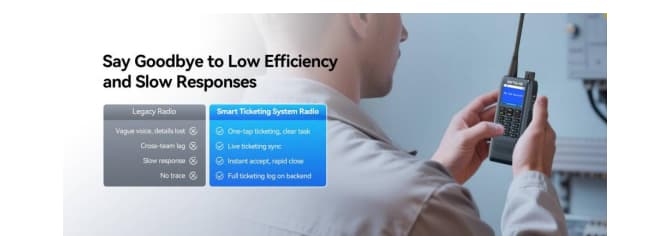
The Accountability Gap: How C3’s Ticketing System Brings Order to Chaos
The Problem: Voice Communication Isn’t Enough
In environments like hotels, retail complexes, and facility management companies, the critical challenge isn’t transmitting voice—it’s ensuring tasks get completed. According to a study by Hospitality Technology, 68% of hotel managers cite “lack of task accountability” as their primary communication challenge. A voice instruction like “Check the HVAC in room 514” leaves room for ambiguity: Who’s responsible? Was the task completed? Traditional radios provide no answers.
The C3 Solution: From Voice Calls to Trackable Tasks
The MateTalk C3 introduces an integrated ticketing system that transforms how work is assigned and tracked:
Structured Task Creation: Managers create digital tickets with specific details—”AC Repair – Room 514 – High Priority”—through PC software or a management radio
Direct Assignment: Tickets are assigned to specific team members, eliminating the “who’s handling this?” ambiguity

SMS Notification & Confirmation: Assignments are received as text messages on the device, where staff can acknowledge with a single button.
Completion Tracking: Managers monitor real-time status updates through the interface
The Hands-Free Dilemma: C4’s Intelligent Voice Control in Demanding Environments
The Problem: Traditional VOX Falls Short
On construction sites, in warehouses, and in manufacturing facilities, workers need truly hands-free operation. Standard Voice-Activated Transmission (VOX) systems often misfire in noisy environments, while physical buttons require stopping work and removing protective gear. These design flaws don’t just slow work down—they create hidden risks when safety matters most.
The C4 Solution: True Intelligent Hands-Free Technology
The MateTalk C4 moves beyond basic VOX with a sophisticated voice control system:
Wake Phrase Activation: The system activates only with the specific phrase “Hi Radio,” preventing accidental triggering
Natural Language Commands: Workers can use intuitive commands like “EMERGENCY-CALL,” “VOLUME-THREE,” or “ROGER-ON”
Noise Discrimination: Advanced algorithms distinguish between voice commands and background noise
No-Touch Operation: Complete control without ever touching the device, crucial when hands are dirty or occupied
Real-World Application: Safety Through Simplicity
The C4’s approach demonstrates an understanding that in high-risk environments, complexity creates danger. By reducing operational friction, the device allows workers to maintain focus on their tasks while staying connected.
Engineering for the Real World: Three Design Principles That Set C3 and C4 Apart
- Battery Life That Matches Work Reality
While many manufacturers highlight maximum battery life under ideal conditions, RETEVIS has focused on real-world usage. The C3’s 2200mAh battery delivers 17 hours of continuous operation, while the C4’s 2500mAh battery extends this to 22 hours—both carefully calibrated to exceed typical shift lengths across multiple industries.
- Coverage That Works Where You Work
Both models offer 5W transmission power covering 350,000 square feet (32,000 square meters) and 30 floors—specifications grounded in the actual dimensions of large hotels, shopping malls, and office complexes. More importantly, the UHF frequency selection and repeater compatibility ensure reliable performance in challenging environments like underground parking garages and concrete-heavy construction sites.
- Purpose-Driven Differentiation
Rather than creating one-size-fits-all devices, RETEVIS has developed specialized tools for different operational needs:
C3 excels in coordinated service environments where task tracking and accountability are paramount
C4 shines in hands-busy settings where operational simplicity and safety take priority
The Broader Implications: What These Devices Reveal About Professional Communication
The C3 and C4 represent a significant shift in how we think about professional communication tools. They demonstrate that the future isn’t about better radios—it’s about better workflows.
From Communication to Coordination
Traditional radios facilitate conversation; the C3 and C4 enable coordination. This distinction matters because, in business contexts, communication has value only when it leads to action.
The Data Advantage
Unlike conventional systems that leave no digital trace, these devices generate valuable operational data. Managers can analyze response patterns, identify bottlenecks, and optimize team performance based on actual communication metrics.
Industry-Specific Thinking
Perhaps most importantly, RETEVIS has moved beyond generic “business radios” to create tools that address the particular challenges of specific industries—a recognition that a hotel’s communication needs differ fundamentally from those of a construction site.
Conclusion: The Quiet Revolution in Professional Communications
The RETEVIS C3 and C4 may not represent flashy technological breakthroughs, but they signal something more important: a manufacturer finally listening to what professionals actually need from their communication tools.
In an industry often obsessed with technical specifications, these devices refocus attention on what truly matters—solving real operational problems. For businesses tired of communication tools that create more work than they save, that focus might be the most important feature of all.
As communication technology continues to evolve, the success of the C3 and C4 suggests a promising direction: one where devices are designed not just to help people talk, but to help teams accomplish their work more effectively, safely, and efficiently.