









High-capacity disposable vape devices are increasingly differentiated by more than their advertised puff counts. Tank construction, battery capacity, power settings, display design, and the way e-liquid is stored can all influence the overall hardware experience. The NEXA Ultra II and Puffeel Aster 50K illustrate two approaches to this category, with both manufacturers advertising up to 50,000 puffs in their respective product descriptions.
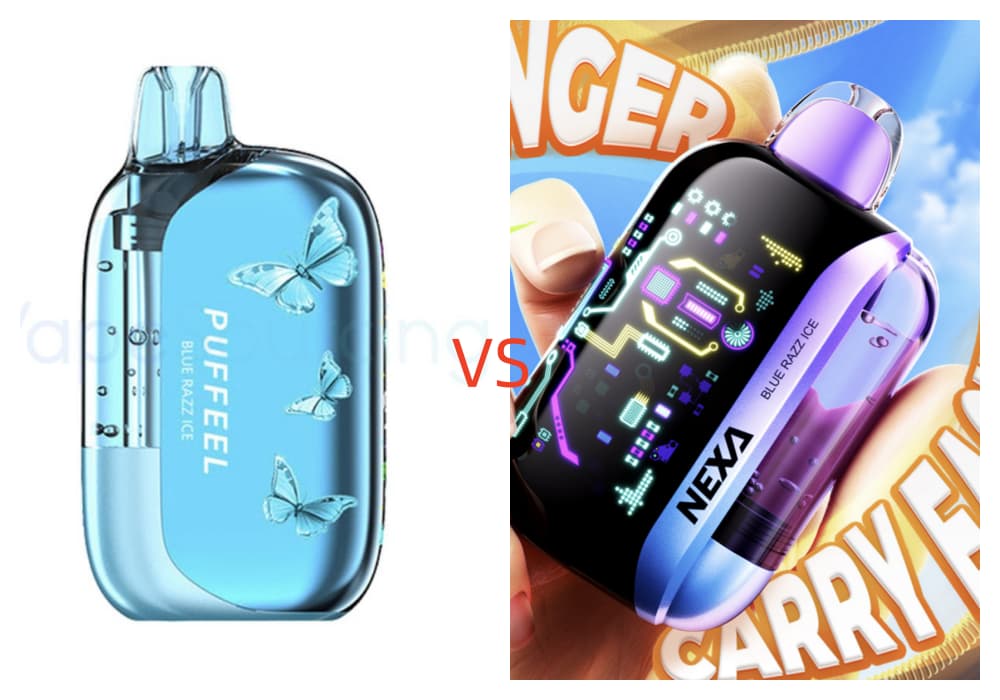
NEXA Ultra II vs Puffeel Aster 50K comparison is particularly interesting because their headline capacities are similar, yet their published specifications and design priorities offer different points of comparison. NEXA emphasizes its Juicy Lock system, transparent Crystal Tank, and selectable power modes. Puffeel highlights its crystal-style exterior, dual-mesh configuration, adjustable airflow, and integrated display.
Rather than treating the largest number on the packaging as the deciding factor, this comparison examines what the published specifications actually tell us, which details remain unverified, and what adult consumers should consider when evaluating either device.
NEXA Ultra II vs Puffeel Aster 50K: Key Specifications
The following table summarizes the specifications available from the manufacturers’ product information and the Puffeel Aster 50K product listing.
| Specification | NEXA Ultra II | Puffeel Aster 50K |
|---|---|---|
| Advertised maximum | Up to 50,000 puffs in Normal mode | Up to 50,000 puffs |
| Higher-power setting | Turbo mode, rated up to 30,000 puffs | Specific mode-dependent puff rating needs verification |
| E-liquid system | 20 mL total: 16 mL visible tank and 4 mL internal cotton chamber | 20 mL listed capacity |
| Battery | 900 mAh | 1,000 mAh |
| Coil configuration | Dual mesh | Independent dual mesh, according to the product listing |
| Airflow adjustment | Confirm the exact configuration on the model being sold | Adjustable airflow |
| Display | 3D curved OLED display, according to published product information | Battery and e-liquid status display |
| Charging | USB Type-C | USB Type-C |
| Standout design feature | Juicy Lock and transparent Crystal Tank | Transparent crystal-style shell |
Specification note: Published specifications can vary by market or product revision. Confirm the nicotine concentration, local compliance, dimensions, charging requirements, and other details against the exact product packaging before relying on them.
1. Tank Design: Visible E-Liquid Versus a Freshness-Focused System
The most useful distinction between these devices is not their shared 50K label, but how their manufacturers describe the e-liquid system.
NEXA Ultra II: Juicy Lock and Crystal Tank
The NEXA Ultra II uses a transparent Crystal Tank alongside its Juicy Lock system. Its published 20 mL total capacity comprises a 16 mL visible tank and an additional 4 mL in an internal cotton chamber.
This arrangement makes the relationship between the visible reservoir and the internal liquid supply important. The transparent section allows the remaining liquid to be checked visually, while the separate internal chamber forms part of the manufacturer’s delivery design.
For a technical comparison, the relevant questions are whether the tank seals reliably, whether liquid feeding remains consistent during normal operation, and how much residual liquid remains when the device reaches the end of its usable life. Marketing descriptions alone cannot establish those results.
Puffeel Aster 50K: A Crystal-Style Exterior
Puffeel takes a design-led approach with a transparent shell featuring decorative diamond and star elements. Its product listing also specifies a 20 mL e-liquid capacity.
The distinction is that a transparent exterior and a transparent liquid reservoir are not necessarily the same thing. Buyers should check whether the particular Aster 50K version provides a clearly visible liquid level and how its internal reservoir is arranged.
A transparent design can make liquid monitoring easier, but appearance alone does not demonstrate leak resistance, freshness retention, or complete liquid utilization. Those characteristics depend on the internal construction and the quality of the sealing system.
2. Battery Capacity and Power Modes
Battery specifications provide another concrete comparison.
Battery specifications are only one part of device performance, and our guide to vape battery and coil safety explains important considerations for rechargeable hardware.
The NEXA Ultra II is listed with a 900 mAh rechargeable battery, while the Puffeel Aster 50K listing specifies 1,000 mAh. On paper, Puffeel has the larger battery rating.
However, battery capacity is only one part of the equation. Power consumption, coil resistance, heating behavior, draw length, and charging management all affect how long a charge lasts.
A larger battery therefore does not automatically translate into a longer operating time or more usable puffs.
The NEXA Ultra II also specifies two power settings:
- Normal mode: Advertised for up to 50,000 puffs.
- Turbo mode: Advertised for up to 30,000 puffs.
These figures illustrate a basic trade-off in device design: a higher-power setting can consume the available e-liquid and battery energy more quickly.
For Puffeel, the advertised 50,000-puff figure should not be treated as directly equivalent to NEXA’s Normal-mode rating unless the testing conditions and operating modes are comparable. A reliable head-to-head assessment would require the same draw duration, power conditions, and end-of-life criteria for both devices.
3. Coil Technology and Airflow
Both products list dual-mesh coil configurations, but that shared feature does not establish that their heating systems perform identically.
Readers who want a deeper explanation of mesh heating technology can explore our guide to how mesh coils work in vape devices.
Mesh coils distribute heating across a metal mesh structure. Their real-world behavior depends on the mesh material, resistance, surface area, power delivery, and how effectively e-liquid reaches the heating element.
The NEXA Ultra II uses a dual-mesh configuration as part of its hardware design. Puffeel’s listing describes independent dual mesh and also specifies adjustable airflow.
Airflow adjustment is a practical hardware distinction because it changes how freely air passes through the device. However, the available product descriptions do not provide enough standardized test data to determine which model delivers better airflow consistency or greater coil longevity.
Likewise, numerical claims about vapor output, flavor intensity, or coil lifespan should not be treated as independently established results without supporting test methods and evidence.
4. Display and Everyday Device Information
Integrated displays are becoming a common feature in high-capacity vape hardware. Their practical value depends on the information they provide rather than the visual complexity of the screen.
The NEXA Ultra II is described with a 3D curved OLED display and selectable operating modes. Its transparent tank provides a separate visual reference for the remaining e-liquid.
The Puffeel Aster 50K listing describes a display that shows battery and e-liquid status. This approach places emphasis on checking the device’s remaining resources without relying entirely on an estimate based on usage.
There are two separate questions to consider when comparing these interfaces:
- Does the display provide clear, useful status information?
- Does that information accurately reflect the device’s actual operating condition?
A screen may improve visibility, but it cannot guarantee a particular puff count, prevent every device fault, or establish that the remaining liquid can be used completely. Those outcomes depend on the underlying hardware.
5. Portability and Exterior Design
The NEXA Ultra II is positioned as a compact, high-capacity device. Its design combines a transparent tank with a body intended to remain portable despite its advertised endurance.
Puffeel differentiates the Aster 50K through its crystal-style appearance, including decorative elements within its transparent exterior.
These are different design priorities: NEXA places considerable emphasis on its liquid-storage system, while Puffeel gives more prominence to the visual presentation of the device.
A fair comparison would also require verified dimensions and weight for both models. Without those measurements, it would be premature to declare either one smaller, lighter, or easier to carry.
6. Why a 50,000-Puff Rating Needs Context
The advertised puff count is an important specification, but it should not be mistaken for a guaranteed lifespan.
For another example of how battery capacity, mesh-coil hardware, and advertised puff counts are presented together, see our Mazaya E-Hookah 80K review.
Puff-count estimates depend on the testing method, including draw duration, intervals between draws, and operating mode. Actual results can differ substantially with usage conditions.
E-liquid capacity provides another useful reference, but it does not independently predict the number of usable puffs. Coil behavior, power consumption, and the amount of liquid left unused can all influence the final result.
For this reason, the most informative comparison combines several measurements:
- Published e-liquid capacity
- Battery capacity and charging specifications
- Puff ratings for each operating mode
- Verified device dimensions and weight
- Clearly documented test conditions
- Reliability and end-of-life observations from reproducible testing
The NEXA Ultra II’s Normal and Turbo ratings explicitly show a difference between its two modes. For the Puffeel Aster 50K, additional verified information about its operating settings and testing conditions would help make the comparison more precise.
Neither product’s headline number alone establishes which device offers better overall performance.
7. What to Verify Before Comparing the Two Models
Product descriptions are useful starting points, but they should be checked against the exact device and the regulations in the intended market.
For NEXA Ultra II, verify the 20 mL total capacity, the split between the visible tank and internal chamber, the battery specification, and the mode-dependent puff ratings.
For Puffeel Aster 50K, confirm the listed 20 mL capacity, 1,000 mAh battery, adjustable airflow, and the details of its dual-mesh configuration. Check the display’s actual functions and whether mode-specific puff ratings are available from the manufacturer.
For both devices, authenticity, labeling, local legal requirements, and appropriate battery disposal are also relevant considerations. Nicotine-containing products are addictive and are not suitable for minors or non-users.
Final Assessment
NEXA Ultra II and Puffeel Aster 50K share an advertised maximum of 50,000 puffs and a listed 20 mL e-liquid capacity, but their published features emphasize different aspects of device design.
NEXA’s clearest differentiators are its Juicy Lock system, transparent Crystal Tank, and explicitly stated Normal and Turbo puff ratings. Puffeel’s listed distinctions include its 1,000 mAh battery, adjustable airflow, dual-mesh configuration, and decorative crystal-style exterior.
The available specifications do not establish a definitive performance winner. A meaningful verdict would require consistent test conditions, verified measurements, and evidence of how each device performs over its usable life.
For anyone researching the two models, the more useful question is not simply which one claims the most puffs, but how clearly each manufacturer documents the hardware, operating conditions, and limitations behind that number.