










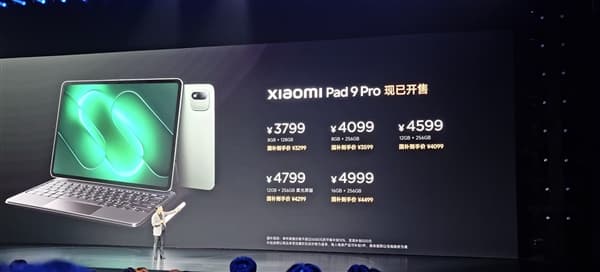
Xiaomi has officially launched Xiaomi Pad 9 Pro in China, positioning the new tablet as a large-screen option for entertainment, study and everyday productivity. The tablet starts at 3,799 yuan, with the price falling to 3,299 yuan after the applicable national subsidy.
The Xiaomi Pad 9 Pro focuses on a combination of a high-resolution display, flagship-class performance, a large battery and desktop-style software support. Its 12.5-inch screen also gives it more working space than the standard Xiaomi Pad 9.
12.5-Inch 3.2K Display With 144Hz Refresh Rate
The display is one of the Xiaomi Pad 9 Pro’s biggest attractions. It features a 12.5-inch LCD panel with a 3.2K resolution and up to a 144Hz refresh rate, making it suitable for everything from watching videos and browsing documents to gaming and taking notes.
If you are comparing Xiaomi’s recent tablet panels, our guide to Xiaomi tablet displays and 144Hz screens explains how resolution, refresh rate and brightness affect everyday use.
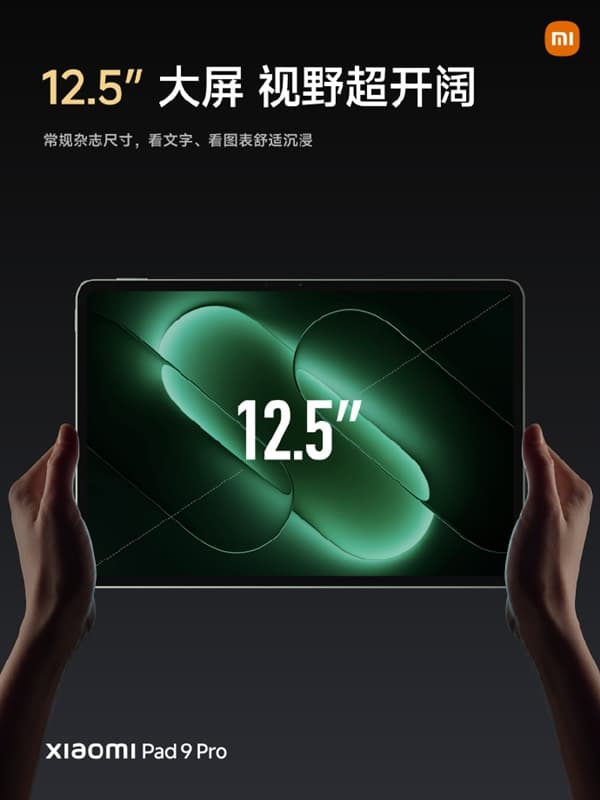
The screen also supports a wide P3 color gamut and reaches up to 1,000 nits of peak brightness. Xiaomi has equipped the panel with DC dimming across the full brightness range, while the tablet also carries three TÜV Rheinland eye-care certifications.
For students attending online classes or users who spend hours reading and watching content, the combination of high resolution, high refresh rate and eye-care features is particularly relevant.
Slim Metal Design at 5.8mm
Despite using a large 12.5-inch display and an 11,000mAh battery, the Xiaomi Pad 9 Pro remains relatively thin and portable.
The tablet measures just 5.8mm thick and weighs approximately 580g. That makes it easier to carry between home, school and the office, while the large screen provides enough space for multitasking, document editing and creative work.
The design is therefore aimed less at being an ultra-compact tablet and more at balancing a large workspace with reasonable portability.
Snapdragon 8 Gen 5 Performance
Under the hood, the Xiaomi Pad 9 Pro uses Qualcomm’s Snapdragon 8 Gen 5 platform. Xiaomi says the tablet can achieve more than 3.4 million points in AnTuTu, although benchmark results can vary depending on software versions, temperature and testing conditions.
The tablet also uses a large-area, high-thermal-conductivity graphite cooling system with a reported heat-dissipation area exceeding 22,000mm².
This cooling setup is intended to help the tablet maintain performance during demanding workloads such as gaming, video editing and other sustained tasks.
For readers interested in mobile-chip performance, see our guide to Snapdragon processors and smartphone performance for a closer look at CPU, GPU and sustained performance.
Six Speakers and Four-Microphone Array
Audio is another area where the Pad 9 Pro has received an upgrade.
The tablet comes with six speakers, compared with the four-speaker setup used by its predecessor. Xiaomi says the upgraded audio system delivers stronger low-frequency performance, which should make movies, music and games more immersive.
For meetings and online classes, the tablet also features a four-microphone array designed to support 360-degree far-field voice pickup.
That combination makes the Pad 9 Pro suitable not only for media consumption but also for video conferences, remote learning and voice-based interactions.
11,000mAh Battery With 67W Charging
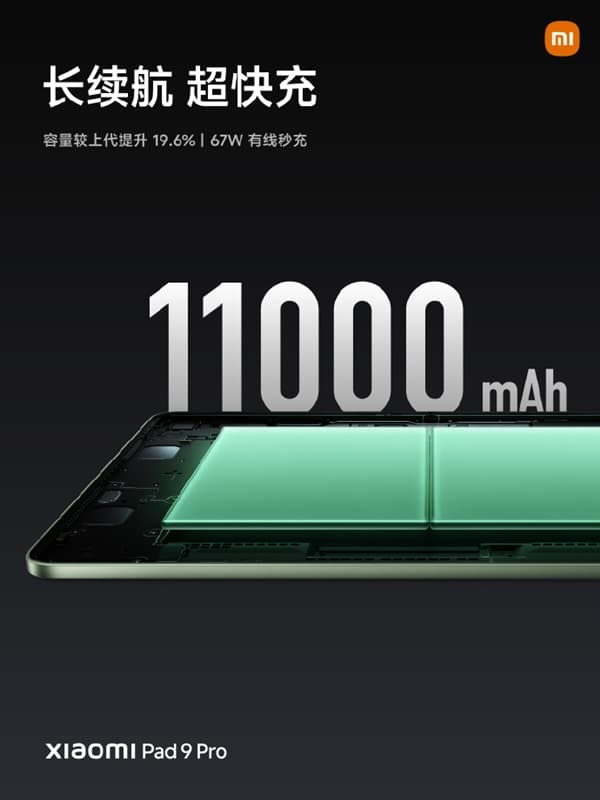
Battery capacity is another major highlight. The Xiaomi Pad 9 Pro packs an 11,000mAh battery and supports 67W wired fast charging.
If battery endurance is a priority, our guide to large-battery tablets and fast charging covers the key specifications to check before buying.
Xiaomi claims up to 14.5 hours of continuous video playback, although actual endurance will depend on brightness, network connectivity, applications and usage patterns.
The tablet also supports 22.5W reverse charging, allowing it to provide emergency power to compatible smartphones and other devices.
For people who use a tablet throughout the day for classes, travel or office work, the large battery is arguably more important than simply having a high peak performance figure.
HyperOS 4 and PC-Class Apps
On the software side, the Xiaomi Pad 9 Pro ships with HyperOS 4 and Super XiaoAI 2.0.
Xiaomi is also pushing the tablet toward more PC-like productivity. Supported applications include WPS for Pad and the professional version of CapCut, giving users more options for document work and video editing without relying entirely on a computer.
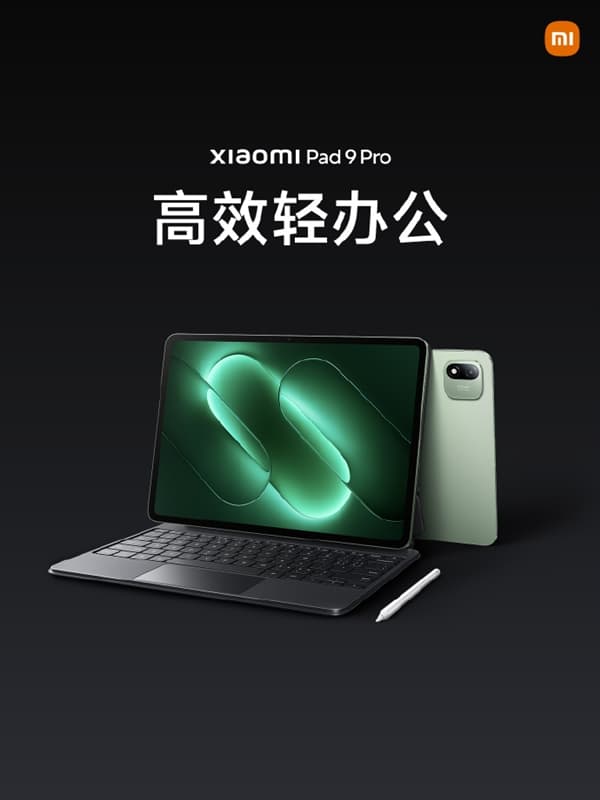
The tablet can also be paired with accessories such as the Focus Touch Pen Pro and an external keyboard. With multi-window support, users can keep a browser, document and notes application open at the same time—for example, researching information while writing an assignment.
The Xiaomi Pad 9 series also supports cross-device features within Xiaomi’s ecosystem, further expanding its role beyond a conventional media tablet.
Xiaomi Pad 9 Pro Specifications
| Feature | Xiaomi Pad 9 Pro |
|---|---|
| Display | 12.5-inch LCD |
| Resolution | 3.2K |
| Refresh rate | Up to 144Hz |
| Color gamut | P3 |
| Peak brightness | Up to 1,000 nits |
| Processor | Snapdragon 8 Gen 5 |
| Battery | 11,000mAh |
| Wired charging | 67W |
| Reverse charging | 22.5W |
| Thickness | 5.8mm |
| Weight | Approx. 580g |
| Speakers | Six |
| Microphones | Four |
| OS | HyperOS 4 |
| AI assistant | Super XiaoAI 2.0 |
Xiaomi Pad 9 Pro: A Large-Screen Productivity Tablet
Xiaomi Pad 9 Pro is built around a straightforward combination: a large 12.5-inch 3.2K 144Hz display, Snapdragon 8 Gen 5 performance, an 11,000mAh battery and productivity-focused software.
Its strongest appeal is likely to be users who want something larger than a conventional tablet without moving all the way to a laptop. The combination of a high-refresh-rate display, six-speaker audio, long battery capacity and PC-style applications gives the Pad 9 Pro a broader role than a device designed primarily for watching videos.
With a starting price of 3,799 yuan before subsidy, the Xiaomi Pad 9 Pro enters the premium tablet segment while emphasizing display quality, performance and productivity rather than simply chasing the thinnest possible design.