










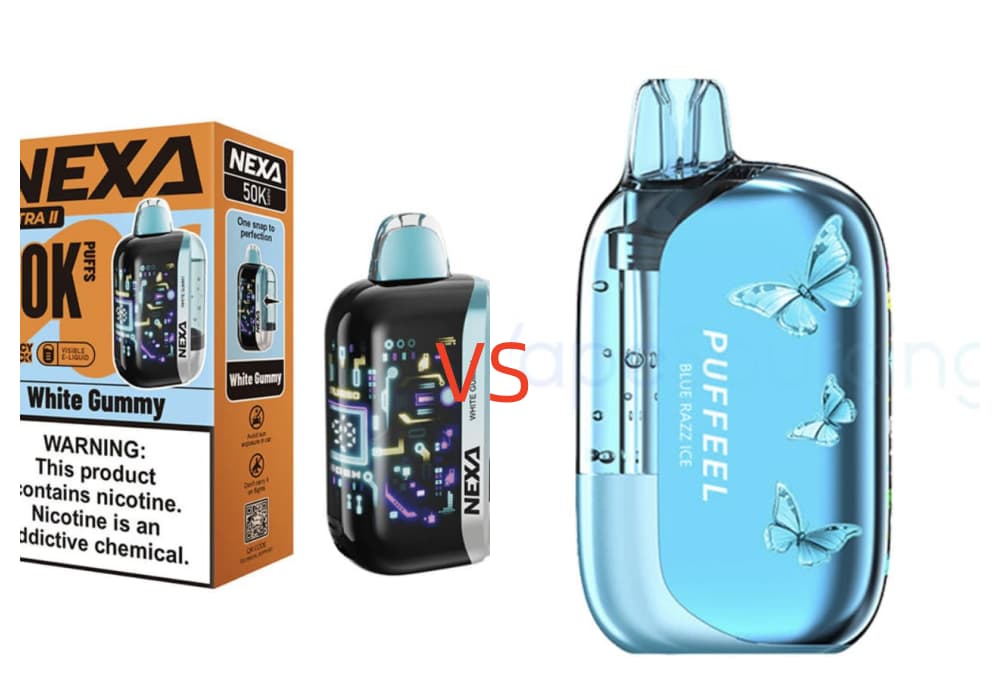
NEXA Ultra II and Puffeel Aster 50K both sit in the high-capacity disposable vape category, but they take noticeably different approaches to the same basic idea.
Both devices are built around a 50,000-puff headline rating, rechargeable batteries, large e-liquid reservoirs and mesh-coil systems. However, the details underneath those numbers are different. NEXA focuses on a compact dual-mode design with its Juicy Lock system and crystal tank, while the Puffeel Aster 50K puts more attention on a transparent decorative body, a larger 1,000mAh battery, adjustable airflow and a visible status display.
That makes this comparison less about simply asking which device has more features and more about understanding what each design is trying to accomplish.
NEXA Ultra II: A Compact 50K Design With Two Power Modes
The NEXA Ultra II is designed around a relatively compact body while retaining a large liquid supply and rechargeable battery.
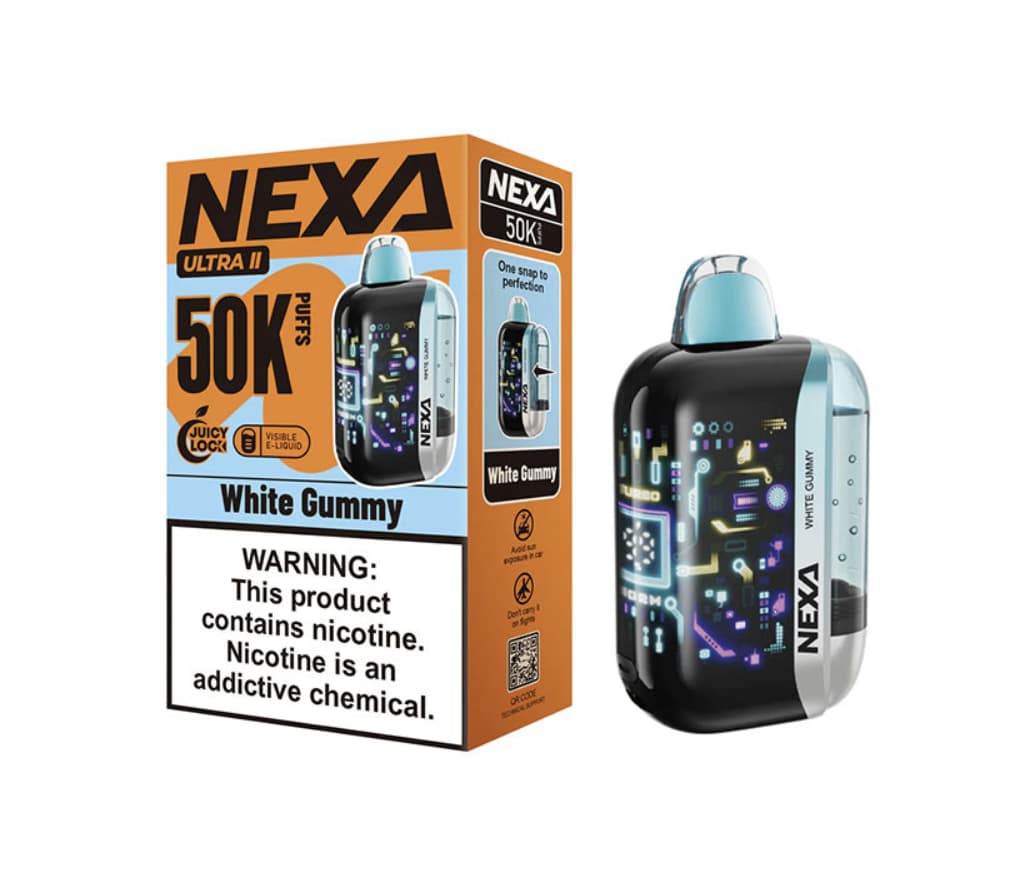
NEXA lists the device with a 900mAh battery and two operating modes: Normal Mode, rated at up to 50,000 puffs, and Turbo Mode, rated at up to 30,000 puffs. The company also specifies a combination of 4ml storage cotton and a 16ml crystal tank.
The two-mode system gives the device a different operating philosophy from a disposable that provides only one fixed output. Normal Mode emphasizes the maximum stated puff count, while Turbo Mode changes the operating profile in favor of a more power-oriented experience.
The important point is that the 50K figure applies to Normal Mode. Switching to Turbo Mode reduces the manufacturer’s stated puff rating to 30K.
Puffeel Aster 50K: Larger Battery and a More Visible Design
The Puffeel Aster 50K takes a more visually distinctive route.
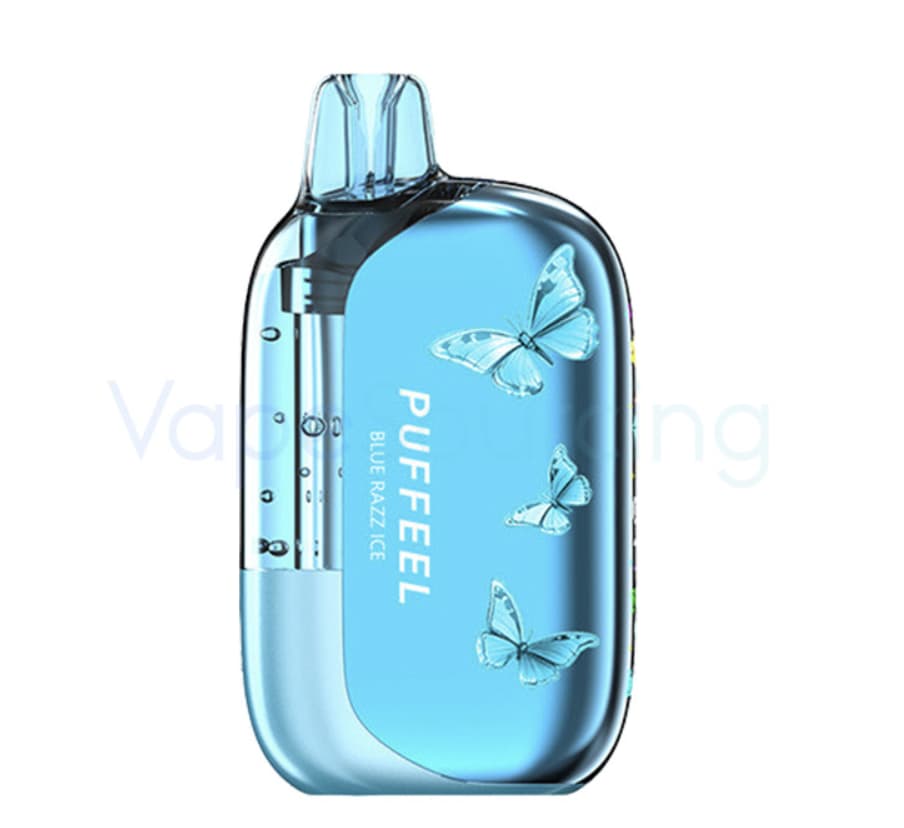
VapeSourcing lists the Aster with a 1,000mAh rechargeable battery and 20ml of e-liquid, along with a transparent crystal-style tank. The device also includes USB Type-C charging and a display that shows battery and e-liquid levels.
Its exterior is one of the defining characteristics. The transparent shell incorporates a decorative diamond-and-star design, making the internal tank part of the visual identity rather than hiding everything behind an opaque enclosure.
In practical terms, this means the Aster is designed to make both its appearance and remaining consumables more visible.
Battery Capacity: 900mAh vs 1000mAh
Battery capacity is one of the clearest specification differences.
| Feature | NEXA Ultra II | Puffeel Aster 50K |
|---|---|---|
| Battery | 900mAh | 1000mAh |
| Stated maximum puff count | 50,000 | 50,000 |
| Turbo/alternate mode | 30,000 puffs | Not listed in the same format |
| Charging | USB-C | USB-C |
| E-liquid | 4ml storage cotton + 16ml crystal tank | 20ml |
| Coil | Dual mesh | Independent dual mesh |
| Airflow | Adjustable | Adjustable |
| Display | 3D curved screen | Battery/e-liquid status display |
The difference between 900mAh and 1,000mAh should not be interpreted as a direct prediction of real-world puff duration. Power output, coil resistance, draw length and usage patterns all affect how quickly a battery is consumed.
Instead, the numbers show the design priorities: NEXA combines its 900mAh battery with selectable Normal and Turbo modes, while the Aster pairs a 1,000mAh cell with its dual-mesh system and status display.
E-Liquid Capacity: Both Reach the 20ml Class
The two devices are also closely matched in overall liquid capacity.
NEXA specifies the Ultra II as 4ml storage cotton plus a 16ml crystal tank, effectively putting 20ml of liquid storage into the device’s architecture.
Puffeel lists the Aster 50K with a straightforward 20ml e-liquid capacity.
The difference is therefore less about the headline volume and more about how that liquid is integrated into each product.
NEXA’s crystal tank is tied to its Juicy Lock structure, while the Aster uses a transparent crystal-style tank that lets the user see the liquid inside. NEXA specifically promotes the Juicy Lock system as part of the Ultra II’s liquid-management design.
Coil Design: Both Use Dual Mesh
Neither device relies on a basic single-wire heating element.
The NEXA Ultra II uses dual 1.0Ω mesh coils, according to NEXA’s product information.
Both devices use dual-mesh coils, a configuration commonly found in high-capacity disposable vapes because it is designed to provide consistent vapor production and flavor delivery.
The Puffeel Aster 50K uses an independent dual-mesh coil configuration. VapeSourcing also lists manufacturer claims concerning vapor density, coil lifespan and flavor performance, but these figures should be regarded as manufacturer claims rather than independently verified measurements.
Dual-mesh construction is relevant because the heating surface and coil arrangement influence how e-liquid is vaporized. However, coil performance in actual use also depends on the liquid formulation, draw pattern and operating conditions.
For buyers comparing the two products, the more meaningful distinction is that both are built around mesh-coil architecture rather than treating the 50K puff rating as the only performance specification.
Adjustable Airflow Gives Both Devices More Control
Both products include adjustable airflow, which is important in a comparison between high-capacity disposables.
Airflow affects how restricted or open a draw feels and can also change the perceived vapor density and cooling sensation. Instead of offering one fixed airflow setting, both the Ultra II and Aster give users some ability to adjust the draw.
This is particularly relevant because a 50K disposable is intended for extended use. A fixed airflow may suit one user but feel too tight or too open to another.
The Aster’s airflow adjustment is listed directly among its specifications, while NEXA also identifies adjustable airflow as part of the Ultra II configuration.
Display and Visibility Take Different Forms
The two products also differ in how they communicate information.
NEXA gives the Ultra II a 3D curved screen, combined with light and dark display modes. The company positions the screen as part of the device’s visual design while retaining a compact form factor.
The Aster 50K takes a more functional approach by providing a display that shows battery and e-liquid levels.
That distinction matters because a screen on a disposable can serve two very different purposes: decoration or information.
For the Aster, seeing remaining battery and liquid levels can help users understand the device’s status without relying only on changes in vapor production or an indicator light.
Design: Minimalist Versus Decorative
The physical designs are perhaps the most obvious difference.
The NEXA Ultra II emphasizes a slim, pocket-oriented format, with NEXA describing it as a compact design intended to maximize portability. The official specification information gives dimensions of approximately 28.7 × 53.1 × 93.0mm.
The Aster 50K takes a more decorative approach, using a transparent shell with diamond and star elements visible inside the body.
This creates two distinct visual identities within the same 50K category:
- NEXA Ultra II: compact, screen-focused and relatively understated.
- Puffeel Aster 50K: transparent, decorative and visually distinctive.
Neither approach is inherently more useful; they simply target different design preferences.
Puff Ratings Need More Context
Both devices carry a 50,000-puff maximum rating, but the numbers should not be treated as a guaranteed number of real-world draws.
NEXA explicitly provides different ratings for its two modes: 50,000 in Normal Mode and 30,000 in Turbo Mode.
This illustrates why puff counts are best read alongside battery capacity, e-liquid volume and operating modes. A longer draw consumes more liquid and battery power than a short draw, while higher-power operation can also change consumption.
For that reason, the 50K label is useful for identifying the product category, but it does not by itself determine how long either device will last for an individual user.
NEXA Ultra II vs Puffeel Aster 50K: Key Differences
| Category | NEXA Ultra II | Puffeel Aster 50K |
|---|---|---|
| Puff rating | Up to 50,000 | Up to 50,000 |
| Battery | 900mAh | 1000mAh |
| Liquid architecture | 4ml storage cotton + 16ml crystal tank | 20ml |
| Coil | Dual 1.0Ω mesh | Independent dual mesh |
| Airflow | Adjustable | Adjustable |
| Modes | Normal / Turbo | Not listed with equivalent dual-puff modes |
| Normal-mode rating | 50,000 | 50,000 |
| Turbo rating | 30,000 | — |
| Display | 3D curved screen | Battery/e-liquid display |
| Charging | USB-C | USB-C |
| Tank visibility | Crystal tank | Transparent crystal-style tank |
| Design focus | Compact portability | Decorative transparent body |
Specifications are based on the manufacturers’ and retailer’s current published information.
Which One Fits a Particular Use Case?
Rather than declaring one device universally better, the differences point toward different priorities.
The NEXA Ultra II is particularly focused on compactness, dual operating modes and its Juicy Lock/crystal-tank design. Its 50K Normal Mode and 30K Turbo Mode let users choose between two stated operating profiles.
The Puffeel Aster 50K puts more emphasis on its 1,000mAh battery, transparent body, adjustable airflow and direct visibility of battery and e-liquid levels.
In other words, the comparison can be reduced to two different design philosophies:
NEXA Ultra II: compact high-capacity disposable with selectable power modes.
Puffeel Aster 50K: high-capacity disposable centered around visibility, battery capacity and decorative design.
Final Thoughts
NEXA Ultra II vs Puffeel Aster 50K comparison shows why looking only at a disposable vape’s puff count can miss the more meaningful differences.
Both products occupy the 50K category and use rechargeable batteries, sizable liquid reservoirs, mesh coils and adjustable airflow. But NEXA combines those features with a 900mAh battery, Juicy Lock system, crystal tank and Normal/Turbo modes, while Puffeel uses a 1,000mAh battery, 20ml liquid capacity, independent dual mesh, visible status information and a transparent decorative shell.
For adult consumers in markets where these products are legally available, the useful way to compare them is therefore to look beyond the 50,000-puff label and consider battery capacity, liquid architecture, airflow, coil design, display information, charging and physical format.
Nicotine warning: Both products are nicotine vaping products. Nicotine is addictive. These products are intended only for adults of legal purchasing age in jurisdictions where they are permitted. Follow local regulations and the manufacturer’s instructions for use, charging and storage.