









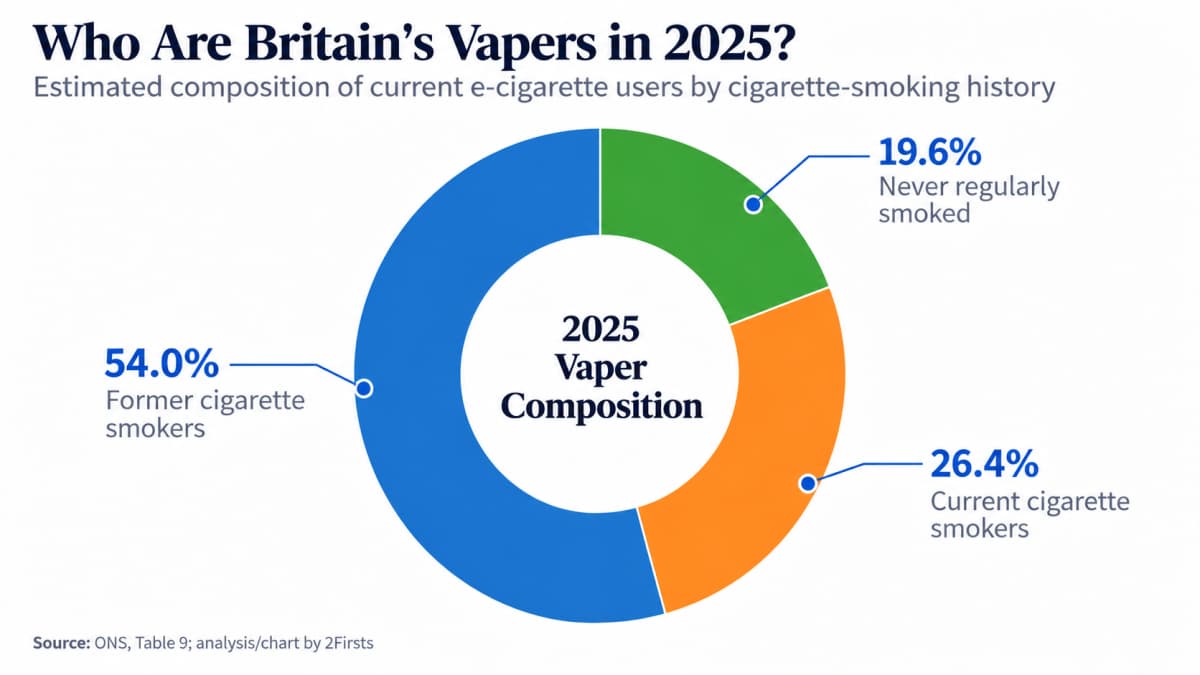
More than half of adults who currently vape in Great Britain have previously smoked cigarettes, according to an analysis of the latest UK Office for National Statistics (ONS) data. The figures for 2025 suggest that former smokers make up the largest group of current vapers, while approximately one in four continues to smoke cigarettes alongside using e-cigarettes.
The analysis, published by 2Firsts on October 14, 2026, estimates that 54% of current adult vapers are former cigarette smokers, 26% are dual users of cigarettes and e-cigarettes, and 20% have never smoked cigarettes regularly. The calculations combine ONS population estimates with reported vaping rates for different smoking-history groups.
The findings offer a more detailed picture of Britain’s vaping market than the overall number of people who vape. They also highlight why smoking history matters when interpreting nicotine-use statistics and evaluating changes in consumer behaviour.
Key Findings From the Latest UK Vaping Data
The 2025 figures show three distinct groups among current adult e-cigarette users in Great Britain.
| Smoking history | Estimated number of current vapers | Share of current vapers |
|---|---|---|
| Former cigarette smokers | 2.9 million | 54% |
| Current cigarette smokers who also vape | 1.42 million | 26% |
| People who never smoked cigarettes regularly | 1.05 million | 20% |
| Total | Approximately 5.38 million | 100% |
Source: 2Firsts analysis of ONS 2025 data. Numbers are approximate estimates based on rounded population figures and vaping rates.
The estimates indicate that former smokers represent the largest segment of the current vaping population. However, the three percentages describe the composition of vapers, not the proportion of people in each smoking-history group who use e-cigarettes.
That distinction is important. A group can account for a large share of all vapers because its population is large, even if its individual vaping rate is relatively low.
Former Smokers Account for More Than Half of Current Vapers
Former cigarette smokers are estimated to account for approximately 2.9 million current vapers, or around 54% of the total.
ONS data show that 20.7% of former cigarette smokers used e-cigarettes daily or occasionally in 2025. That figure was broadly unchanged from 20.8% in 2024.
The difference between these two statistics is worth understanding. The 20.7% figure measures vaping prevalence within the former-smoker population, while the 54% figure estimates how much former smokers contribute to the entire vaping population.
The findings establish a substantial overlap between previous cigarette smoking and current vaping. They do not, however, reveal why each individual began vaping or stopped smoking.
Some former smokers may have adopted e-cigarettes while moving away from combustible tobacco. Others may have stopped smoking for different reasons. The survey does not establish that every former smoker in the vaping group quit cigarettes because of e-cigarette use.
For businesses and policymakers, this makes the distinction between smoking history and individual quitting behaviour particularly important when interpreting the figures.
Around One in Four Vapers Still Smokes Cigarettes
The analysis estimates that approximately 26% of current vapers—around 1.42 million adults—continue to smoke cigarettes.
ONS data indicate that 33.8% of current cigarette smokers used e-cigarettes daily or occasionally in 2025, up from 32.8% in 2024. This measure looks at vaping among cigarette smokers rather than the proportion of all vapers who continue to smoke.
The figures show that using an e-cigarette does not necessarily mean a person has stopped smoking cigarettes. Some consumers use both products, a pattern commonly described as dual use.
The frequency of vaping also differs between groups. According to the 2Firsts analysis, around half of current vapers who still smoke cigarettes use e-cigarettes daily. The corresponding estimated share among vapers who have stopped smoking cigarettes is approximately 81%.
These figures describe usage patterns, not the effectiveness of vaping as a smoking-cessation method. The ONS survey does not track each person’s reasons for vaping or establish whether dual users will eventually stop smoking cigarettes.
For public-health discussions, it is therefore important to distinguish exclusive vaping from continued cigarette smoking alongside e-cigarette use.
Around 1.1 Million Vapers Have Never Smoked Regularly
The third group comprises adults who have never smoked cigarettes regularly. The 2Firsts analysis estimates that this group accounts for approximately 20% of current vapers, or around 1.05 million people.
Within this population, ONS data put current vaping prevalence at 2.9% in 2025, compared with 2.7% in 2024. The estimated number of current vapers in this group rose from approximately 940,000 to 1.1 million.
Looking further back, vaping prevalence among people who had never smoked cigarettes increased from 0.2% in 2014 to 2.9% in 2025.
Although the prevalence rate remains comparatively low, the size of the population means that even a small percentage can represent a substantial number of people.
The category also requires careful interpretation. People who have never smoked cigarettes regularly are not necessarily people who have never tried a cigarette, nor does the category establish whether they have used other nicotine products. It should not automatically be treated as a measure of nicotine-naive consumers.
Daily Vaping Patterns Differ by Smoking History
The data reveal differences not only in who vapes, but also in how frequently people report using e-cigarettes.
Among former cigarette smokers who currently vape, approximately 81% are estimated to use e-cigarettes daily. Among current cigarette smokers who also vape, the corresponding figure is about 50%.
This contrast suggests that daily vaping is more common among current vapers who no longer smoke cigarettes than among those who continue to smoke. However, the survey cannot determine why these patterns differ or whether one behaviour causes another.
The figures also should not be interpreted as proof that daily vaping leads to smoking cessation. The ONS data provide a snapshot of reported behaviours, rather than a longitudinal record following the same individuals through their smoking and vaping histories.
For a more complete understanding of consumer behaviour, future research would need to examine how people move between cigarette smoking, dual use, exclusive vaping, and no current use over time.
How Britain’s Vaping Market Has Changed
The latest findings form part of a longer shift in adult nicotine-use patterns across Great Britain.
ONS figures show that current vaping prevalence reached 9.9% in 2025, equivalent to approximately 5.4 million adults aged 16 and over. This was slightly below the 10.0% recorded in 2024.
Daily vaping prevalence fell from 6.7% in 2024 to 6.5% in 2025, while occasional vaping increased slightly from 3.3% to 3.4%.
These movements suggest that overall vaping prevalence remained broadly stable in 2025, following several years of growth. They do not establish that the market has entered a lasting decline or that a specific policy caused the change.
The figures also need to be interpreted alongside the continuing reduction in cigarette smoking. The ONS’s separate Annual Population Survey estimated that 9.8% of UK adults aged 18 and over smoked cigarettes in 2025, down from 10.6% in 2024.
The smoking and vaping statistics come from different surveys with different population coverage and methods. They should not be treated as directly interchangeable measures.
Product innovation is another factor shaping the market; our vape product coverage offers additional context on devices and developments across the consumer electronics sector.
What the Numbers Mean for the UK Vape Industry
For manufacturers, retailers, and distributors, the smoking-history breakdown provides useful context for understanding the range of consumers who use e-cigarettes.
Former smokers form the largest estimated group of current vapers. This makes it important for market analysis to distinguish consumers who have stopped smoking from those who continue to use both products.
At the same time, the estimated 20% share of vapers who have never smoked regularly highlights a separate area of concern for policymakers, particularly when considering youth access, prevention, and responsible marketing.
The data do not establish future sales, market growth, or the effect of specific regulations. Those outcomes depend on a wider set of factors, including product availability, pricing, consumer preferences, and changes in regulation.
For retailers, the figures are best used as a snapshot of the current adult market rather than as a forecast of future demand. For policymakers, they demonstrate why headline vaping prevalence alone does not provide a complete picture of smoking-related behaviour.
For a broader look at changes in the international vaping business, read our report on China’s vape brands expanding into overseas markets.
What the ONS Data Cannot Tell Us
Although the figures offer a useful breakdown, several limitations should be kept in mind.
First, the 54%, 26%, and 20% shares are estimates calculated by 2Firsts using ONS weighted population figures and reported vaping rates. They are not three percentages directly published by the ONS as a table describing the composition of all vapers.
Second, the data do not establish why people vape, whether they intend to quit, or whether e-cigarette use caused them to stop smoking cigarettes.
Third, the survey’s category for people who have never smoked cigarettes regularly should not be interpreted as meaning that every person in that group has never experimented with tobacco or used other nicotine products.
Finally, these figures relate to Great Britain—England, Scotland, and Wales—and should not be presented as a direct breakdown of the entire United Kingdom, because Northern Ireland is not included in the relevant ONS vaping survey.
These distinctions help ensure that the statistics are used accurately in industry analysis and public-health reporting.
Conclusion
The latest ONS figures indicate that Britain’s adult vaping population consists of several distinct groups. Former cigarette smokers account for an estimated 54% of current vapers, people who continue to smoke cigarettes alongside vaping make up around 26%, and those who have never smoked cigarettes regularly account for approximately 20%.
The figures also show differences in daily vaping patterns and a gradual increase in vaping prevalence among people who have never smoked regularly. At the same time, overall vaping prevalence remained broadly stable in 2025.
The main takeaway is that the vaping market cannot be understood through a single headline number. Smoking history, current cigarette use, and frequency of vaping all provide important context. Continued monitoring of these measures will help explain how consumer behaviour develops, while avoiding conclusions that the survey data alone cannot support.