









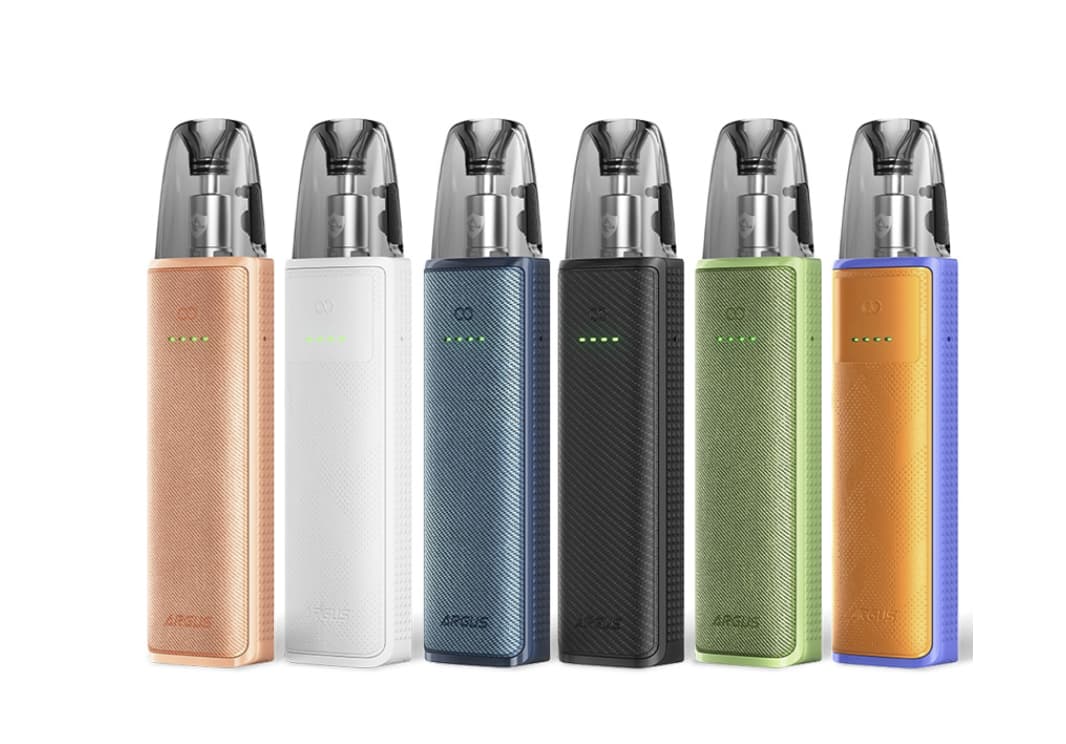
VOOPOO ARGUS Z3 is an interesting pod system because its most important feature isn’t something you can easily advertise with a bigger number.
It isn’t VOOPOO’s most powerful pod. It doesn’t have the largest battery in the ARGUS family. It doesn’t try to overwhelm users with a huge display or a long list of adjustable settings.
Instead, the Z3 appears to be built around a much simpler idea:
What if an everyday pod system simply stayed light, straightforward, and easy to live with?
That philosophy makes the ARGUS Z3 worth looking at more closely.
The device weighs just 41.6g and combines a 1,100mAh battery with a 5–20W output range. It uses VOOPOO’s ARGUS Multi-Ohm cartridge platform and supports 0.7Ω and 1.0Ω configurations.
On paper, those numbers don’t sound spectacular.
But that’s precisely why judging the Z3 by specifications alone misses the point.
The Z3’s Most Important Specification Is Its Weight
Pick up enough pod systems and you eventually notice something manufacturers don’t always emphasize: weight changes how often you want to carry a device.
A few extra grams may seem irrelevant when reading a specification sheet. After carrying a device in a pocket for an entire day, however, the difference becomes much more noticeable.
At 41.6g, the ARGUS Z3 is clearly designed with portability in mind.
This is particularly significant when comparing it with the ARGUS G4. The G4 weighs 65g and brings a larger 1,650mAh battery and a higher 35W maximum output.
The G4 therefore offers more hardware capability.
The Z3 offers less hardware to carry.
Neither approach is automatically better.
If your priority is performance and adjustment, the G4 has the obvious advantage. If the device spends most of its life in your pocket and you rarely change settings, the lighter Z3 starts to make considerably more sense.
That is the first clue to understanding this product.
The Z3 isn’t trying to beat the G4 at its own game.
Why 20W Isn’t Necessarily a Weak Point
A 20W ceiling can look conservative next to modern pod systems capable of considerably higher output.
But maximum wattage only matters if the rest of the device is designed around using it.
The ARGUS Z3 is paired with 0.7Ω and 1.0Ω Multi-Ohm configurations rather than being positioned as a high-output performance platform.
That changes the interpretation of the number.
Instead of asking:
“Why doesn’t it output 30W or 40W?”
A better question is:
“Does the device need that much power for what it is designed to do?”
For a lightweight everyday pod, the answer is not necessarily.
Higher output usually comes with additional demands on the battery, coil, airflow, and overall thermal management. The Z3 avoids turning those areas into the center of the experience.
It is deliberately restrained.
That restraint is part of the product’s identity.
The ARGUS Z3 Doesn’t Need to Be a Miniature Mod
One trend in the pod market is turning compact devices into increasingly complicated pieces of hardware.
Screens get larger.
Menus become more extensive.
Power adjustment becomes more granular.
Airflow systems become more sophisticated.
None of these things are inherently bad. Enthusiasts can genuinely benefit from greater control.
But control also creates responsibility for the user.
You have to understand what the settings do.
You have to decide which power level to use.
You have to remember what you changed.
The ARGUS Z3 takes a different route.
Its automatic power-management approach reduces the number of decisions the user needs to make. Instead of turning the device into a miniature control console, it tries to make the basic interaction more straightforward.
For an experienced enthusiast, that might feel limiting.
For someone who wants a reliable everyday pod without constantly adjusting it, that can be exactly what they want.
The Multi-Ohm Cartridge Gives It Some Breathing Room
The Z3 isn’t completely locked into one fixed configuration.
Its ARGUS Multi-Ohm cartridge system supports 0.7Ω and 1.0Ω options, giving users some ability to change the character of the device without turning the Z3 into a highly adjustable mod.
This is an important distinction.
There is a sweet spot between a completely fixed disposable-style experience and an enthusiast setup where almost every variable can be adjusted.
The Z3 sits closer to that middle ground.
You can choose between cartridge configurations, but the device still handles much of the power-management side for you.
That makes it easier to understand why VOOPOO didn’t give this model the same specification sheet as the G4.
The two devices are solving different problems.
Battery Size Versus Pocketability
The 1,100mAh battery is another specification that needs context.
A larger battery would obviously provide more capacity, assuming similar conditions.
But batteries aren’t weightless.
The larger 1,650mAh battery inside the ARGUS G4 contributes to a heavier overall device.
The Z3’s smaller battery therefore isn’t simply a cost-cutting decision.
It is part of the portability equation.
Think of it as a trade:
More capacity → more weight
Less capacity → lighter device
For a heavy user, the first option may be preferable.
For someone who wants a device that virtually disappears in a pocket, the second can be more attractive.
This is one of those situations where a specification that looks worse on paper can actually make sense in the context of the complete product.
What the Energy-Bar Indicator Tells You
The ARGUS Z3 doesn’t go all-in on a large information display.
Instead, its energy-bar indicator provides a simpler way of checking the device’s remaining battery status.
Again, this is consistent with the overall design.
A large screen would give the Z3 more information, but it would also introduce another component that isn’t essential to the core experience.
The question isn’t whether a screen is useful.
It can be.
The question is whether you need one on a lightweight everyday pod.
For users who mainly want to know whether the device needs charging, a simple indicator may be enough.
Where the Z3 Starts to Show Its Limits
The same decisions that make the ARGUS Z3 attractive also define its limitations.
If you want extensive control over your setup, this probably isn’t the VOOPOO pod to choose.
The limitations become clearer when you compare it with the ARGUS G4.
The G4 provides:
- Up to 35W output
- 1,650mAh battery
- A 0.85-inch HD display
- More resistance options
- Adjustable airflow
- 5V/2A charging
The Z3 doesn’t try to compete feature-for-feature.
That means an enthusiast may look at the Z3 and see missing features.
A casual user may look at the same device and see fewer things to worry about.
That’s an important distinction.
The Z3 Versus the ARGUS G4 Is Really a Lifestyle Choice
The usual comparison asks:
Which device is better?
I don’t think that’s the right question.
The better question is:
Which device fits the way you use a pod?
Choose the ARGUS G4 if you enjoy adjusting your setup and want more headroom.
Choose the ARGUS Z3 if you prioritize carrying comfort and uncomplicated operation.
The G4 is closer to an enthusiast-oriented pod.
The Z3 is closer to an everyday companion.
That difference is more useful to a buyer than simply saying the G4 has more power.
And What About the VMATE MAX 2?
That makes our VMATE MAX 2 vs. ARGUS Z3 comparison particularly useful if you’re deciding between a simpler pod and a more adjustable one.
If the Z3’s philosophy is essentially “let the device handle the basics,” the VMATE MAX 2 is more appealing to users who want to interact with their hardware and customize the experience.
That makes this comparison particularly useful:
ARGUS Z3 = simplicity
VMATE MAX 2 = greater user control
Neither philosophy is inherently superior.
Some people enjoy tuning their device.
Others just want to pick it up and use it.
The Z3 makes more sense for the second group.
The Real Test: Would You Notice It in Your Pocket?
This is where the ARGUS Z3’s design starts to become compelling.
Imagine two devices with similar everyday functionality.
One weighs 41.6g.
The other is 65g.
Neither difference sounds dramatic when written down.
But when one device stays in your pocket all day, the lighter option has a practical advantage that doesn’t show up in a benchmark.
The Z3’s design appears to understand this.
It isn’t trying to be the device you show off with a giant screen.
It’s trying to be the device you don’t think about carrying.
That may actually be a better definition of an everyday pod.
Who Is the ARGUS Z3 Actually For?
The Z3 makes the most sense for users who value:
Portability
The 41.6g weight is one of its biggest selling points.
Simple operation
There are fewer controls and less reason to constantly adjust the device.
Moderate output
The 5–20W range fits its compact, everyday positioning.
Cartridge flexibility
The 0.7Ω and 1.0Ω Multi-Ohm options give the user more choice than a completely fixed setup.
ARGUS ecosystem compatibility
Existing users already familiar with the VOOPOO pod system lineup may find the Z3 easier to integrate into their collection.
Who Should Probably Buy Something Else?
The Z3 is not the ideal choice if your priorities are:
- Maximum power
- Large battery capacity
- Detailed on-device information
- Extensive manual adjustment
- Aggressive performance
- Maximum airflow customization
In that situation, moving upward within VOOPOO’s lineup makes more sense.
The Z3 isn’t a compromise you have to tolerate.
It’s a deliberately simplified product.
If you don’t value simplicity, you may not appreciate what it is trying to achieve.
The More Interesting Question: Is Less Actually More?
The pod market has spent years adding features.
More power.
More screens.
More modes.
More adjustment.
More battery capacity.
The ARGUS Z3 takes a step in the other direction.
It asks whether an everyday pod really needs all of that.
For some users, the answer will be yes.
For others, absolutely not.
And that’s where I think the Z3 has a legitimate place in VOOPOO’s lineup.
Its lighter construction, moderate output, automatic adjustment, and relatively straightforward interface create a product that is easy to understand.
You aren’t buying the Z3 because its specification sheet dominates the competition.
You’re buying it because the specification sheet doesn’t get in your way.
Final Verdict
VOOPOO ARGUS Z3 pod system is a good example of why product reviews shouldn’t be reduced to specification comparisons.
Its 1,100mAh battery isn’t the biggest.
Its 20W output isn’t the highest.
Its interface isn’t the most sophisticated.
But those aren’t necessarily flaws.
Together, they create a compact pod system that prioritizes low weight, uncomplicated operation, and everyday portability.
That’s what separates the Z3 from more feature-heavy VOOPOO devices.
The VOOPOO ARGUS Z3 vs. G4 comparison shows the more important difference: the G4 prioritizes power and customization, while the Z3 focuses on portability and simpler operation.
The VMATE MAX 2 is a better fit for users who enjoy greater control.
But if your ideal pod is one that you can carry comfortably, operate without constantly changing settings, and simply get on with your day, the ARGUS Z3 has a much stronger argument.
It doesn’t try to do everything. It tries to make everyday use easier.
And for a device designed to spend most of its life in your pocket, that may be the more useful feature of all.
This article is intended for adults of legal vaping age. Vaping products contain nicotine, which is addictive.