








If you’ve been paying attention to outdoor communication gear lately, you might have noticed a trend: more and more people are choosing GMRS radios.
From weekend hiking families to national park campers to sports enthusiasts on ski slopes and bike trails — GMRS is moving from a niche technology to a mainstream choice.
Why?
This article covers two things: the three core reasons why GMRS is being chosen by more people, and how EZTALK 5 turns these advantages into everyday outdoor safety you can rely on.

Why Is GMRS Being Chosen by More People?
Reason 1: 5 Watts of Power + UHF Band — Longer Range, Better Penetration
This is GMRS’s most core technical advantage, and the primary reason it’s being chosen by more people.
GMRS handheld devices feature 5 watts of transmit power. Combined with the characteristics of the UHF (Ultra High Frequency) band, this delivers two key capabilities in outdoor environments: longer range and better penetration.
First, “longer range.”
In open terrain — grasslands, deserts, lake surfaces — a 5-watt GMRS device can achieve effective communication over 10 kilometers or more. What does this mean? On a family hike, the dad at the front and the child lagging behind, even separated by several hills, can still stay in contact. At a campsite, you walk a kilometer to gather firewood, call out “I found some,” and the people back at camp hear you instantly.
Under ideal conditions (peak to peak, no obstacles), GMRS devices can even reach communication distances of 50 kilometers or more. While you won’t need that far in daily outdoor use, this capability ensures that even in complex terrain, there’s plenty of reserve after signal attenuation.
Second, “better penetration.”
The characteristic of the UHF band is shorter wavelengths, which penetrate buildings, forests, and rock gaps more easily. In dense forests, leaves and tree trunks contain plenty of water, and water molecules absorb radio waves. An underpowered signal might become choppy after passing through 200 meters of forest, but a 5-watt signal can “squeeze” through gaps in branches and leaves and remain clearly audible a kilometer away.
In mountainous terrain, ridges and bends block the line-of-sight propagation of signals. Signals need to rely on “diffraction” — a bending phenomenon that occurs when radio waves encounter obstacles — to reach the other side. Diffraction requires energy; the stronger the power, the stronger the diffraction capability. A 5-watt signal can “crawl” over the edge of a ridge, keeping the front team and rear team connected even when separated by an entire mountain.
What this advantage means in practice:
For outdoor users, this range advantage means three things:
First, the team can spread out, and everyone can keep their own pace. Faster hikers don’t have to constantly wait; slower ones don’t have to constantly rush. Want to stop for a photo? Stop. Want to rest? Rest. No worry about losing contact with the team.
Second, the exploration range is larger. At a campsite, kids can go farther to play by the stream; parents can go farther to gather firewood in the woods. No one is confined to each other’s line of sight.
Third, an extra layer of security in emergencies. If someone gets separated or injured, the farther you can reach your teammates, the higher the probability of rescue.
Reason 2: Interoperability with FRS — No Need for the Whole Team to Upgrade
GMRS and FRS share the same 22 channels (462-467 MHz band). This means that even if your teammates are using regular FRS radios, you can still communicate with them using a GMRS device.
This advantage is extremely practical in group settings.
For example, you’ve upgraded to a GMRS device, but your friends are still using regular FRS radios. You go hiking together. Can you communicate? Yes. Your GMRS device can switch to FRS-compatible channels and talk directly to your friends’ devices.
For example, you and your spouse each have a GMRS device, but your child is still young and you don’t want to give them an expensive device. You can give the child an inexpensive FRS radio and still stay in contact with the whole family.
For example, you join a hiking club where some members use GMRS and some use FRS. As long as everyone uses the same channel, you can all talk together. No need for the entire team to switch devices.
What this advantage means in practice: It lowers the barrier to forming a group. Not everyone needs to upgrade. One GMRS device can talk to various FRS devices, keeping the whole team easily connected.
Reason 3: Cleaner Frequencies, Less Interference
FRS channels are completely open — anyone can use them without any registration. In popular outdoor areas — like a national park on a weekend or a large campground — it’s common to see dozens of groups using FRS channels simultaneously.
The result is bleed-over, interference, and other people’s conversations breaking into your channel. You’re confirming a route with your teammate when suddenly a neighboring group’s chatter cuts in. You’re calling your child back for dinner when another conversation drowns you out.
GMRS is different. GMRS uses a different frequency plan, and because the barrier to entry is relatively higher, channel congestion is much less common. When you use GMRS channels, your communication environment is much “cleaner” — fewer congested channels, lower chance of being interrupted by strangers, and your group can focus more on its own communication.
What this advantage means in practice: No more shouting over a noisy channel to reach your teammates. Your calls are clear. Your channel is clean. Your group stays focused on its own communication.
RETEVIS EZTALK Series: A Family of Products Built for the Outdoors
Now that we’ve covered the technical advantages of GMRS, let’s look at the product family that brings these technologies to life.
RETEVIS, a Chinese brand founded in 2010, has spent 15 years establishing itself in five distinct areas: commercial, industrial, extreme outdoor, general outdoor, and HAM (amateur radio). With stable performance and exceptional value for money, it has built a deep reputation in overseas markets.
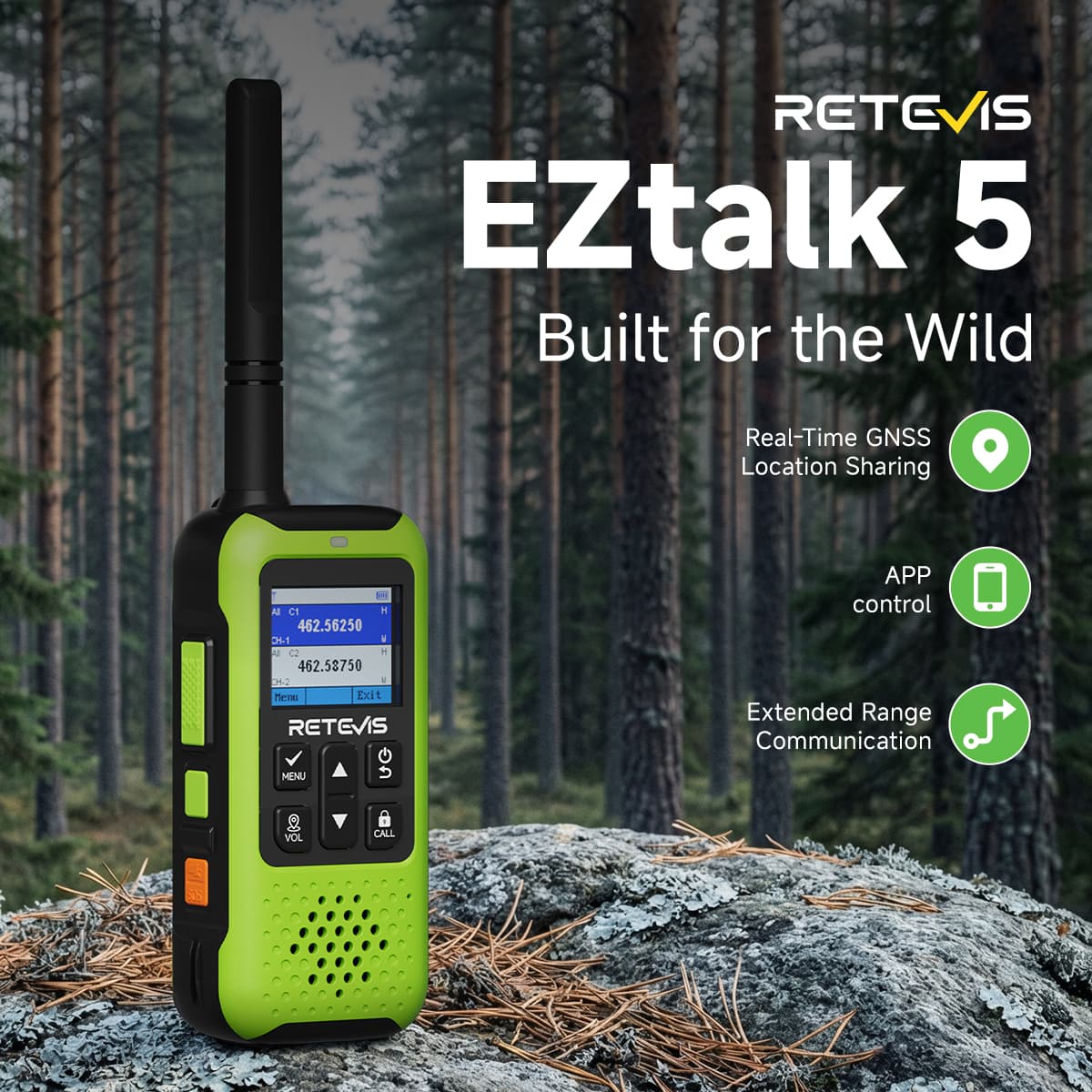
The EZTALK series, designed for general outdoor users, is RETEVIS’s important recent initiative. The name itself is a declaration: EZ = Easy, TALK = Communication — simple communication. The EZTALK 5, as the GMRS product in the series, features 5 watts of transmit power and dual-satellite positioning, designed specifically for family outdoor scenarios like mountaineering, trekking, and camping.
EZTALK 5: Turning GMRS Advantages into “Everyday Usability”
With the technical advantages of GMRS in hand, you still need a device that turns all those advantages into “everyday usability.” The EZTALK 5 is the answer.
Below are seven core features that show how the EZTALK 5 brings GMRS to life in real outdoor scenarios.
Feature 1: Phone Programming — Set Everything Up in 30 Seconds
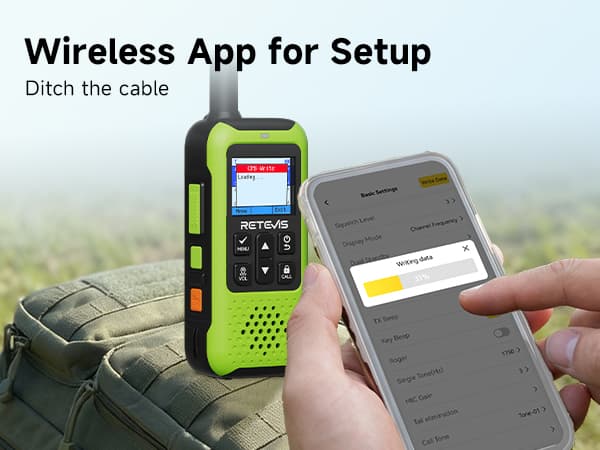
How complicated is traditional radio programming? You need a data cable, drivers, software, a manual… crouching in a parking lot for half an hour is the norm.
The EZTALK 5 supports Bluetooth app programming. Before departure, just pull out your phone to set channels, adjust power, and enable GPS tracking. No laptop, no data cable, no manual needed.
Scenario value: Set up in 30 seconds before departure. No technical background needed.
Feature 2: Type-C Charging — One Cable for Everything
On outdoor trips, every device has its own charging cable, and your bag becomes a tangled mess. The EZTALK 5 uses a Type-C port. Your phone, power bank, and radio can all share one cable. With a 2000mAh battery — 100 hours of standby, 15 hours of operation — when it runs low, just plug in your power bank and charge it.
Scenario value: One less cable means one less tangle in your bag.
Feature 3: Dual-Satellite Positioning — See Where Your Teammates Are in Real Time
In the outdoors, the most unsettling feeling isn’t difficult terrain — it’s “not knowing where you are, and not knowing where your teammates are.” The EZTALK 5 features built-in GPS and BeiDou dual-satellite positioning. Using a mobile app, you can see the real-time locations of all your teammates on a custom map.
Scenario value: No need to turn back to check on slower family members. No need to shout across hills to find wandering kids. Just open your phone and look.
Feature 4: Electronic Fence — You’ll Know the Moment Someone Wanders Off
Set a safe zone on the app — say, a 300-meter radius around the campsite. Give a child an EZTALK 5, and the moment they walk outside that zone, your radio will alert you immediately.
Scenario value: Freedom for kids to explore. Peace of mind for parents.
Feature 5: Rescue Whistle + LED Light + High-Decibel Alarm — Triple Safety Redundancy
Rescue whistle: Radio battery dead? The whistle is still there. Three short blasts are the international distress signal.
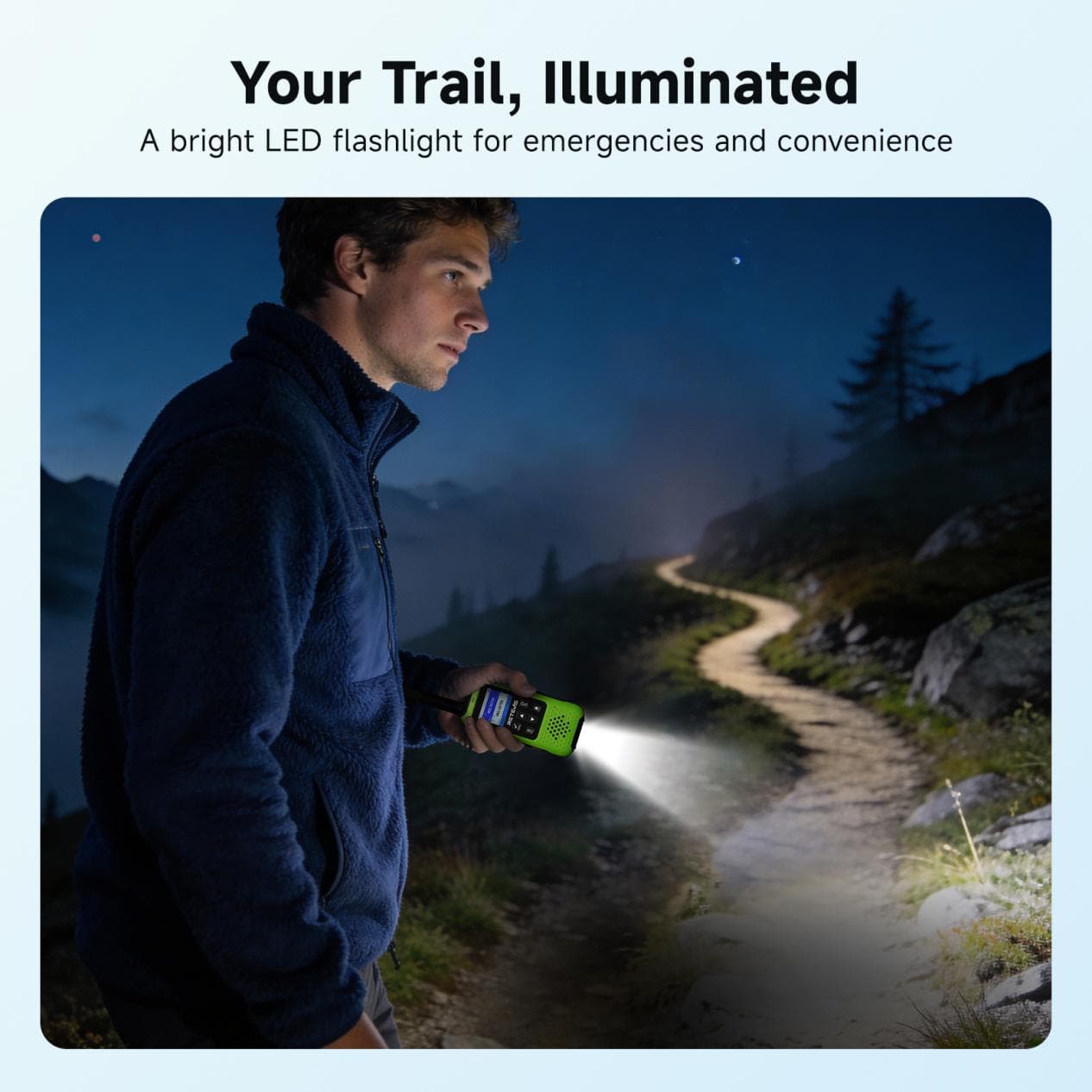
LED light: Finding your way on night trails, lighting up your camp, searching for dropped gear — pull it out and it shines.
High-decibel alarm: Press the emergency button to tell anyone within a few hundred meters: “Someone needs help here.”
Scenario value: You’ll probably never need them. But if you do, they’ll be worth everything.
Feature 6: Large Buttons + Big Screen — Operable with Gloves On
During late autumn or early spring outdoor activities, everyone wears thick gloves. Regular radios have tiny buttons that are impossible to press accurately. The EZTALK 5’s buttons are a full size larger, allowing precise operation even with camping gloves on. The screen remains clearly readable under sunlight.
Scenario value: No need to take off gloves in cold weather. Easy for older family members to use.
Feature 7: VOX Voice Activation — Talk Even When Your Hands Are Full
Setting up a tent, cooking, packing gear — both hands are busy. The EZTALK 5 supports VOX voice activation. No need to press any button — just speak, and it transmits automatically.
Scenario value: Stay in contact while working with your hands, without interrupting what you’re doing.
Summary: Longer Range, Cleaner Channels, Less Hassle
GMRS is being chosen by more people for clear reasons: 5 watts of power delivers longer range and better penetration; interoperability with FRS removes group barriers; cleaner channels keep your communication interference-free.
And the EZTALK 5 is the tool that turns these three advantages into “everyday usability” — phone programming, Type-C charging, dual-satellite positioning, electronic fence, rescue whistle, large buttons, VOX voice activation. Every feature solves a real outdoor pain point.
For family outdoor scenarios like weekend hikes, campground camping, national park visits, and parent-child mountaineering, GMRS + EZTALK 5 is currently the most sensible combination: professional-grade capability, family-grade simplicity.
Mountains, meadows, streams, oceans — safety should have no blind spots.