









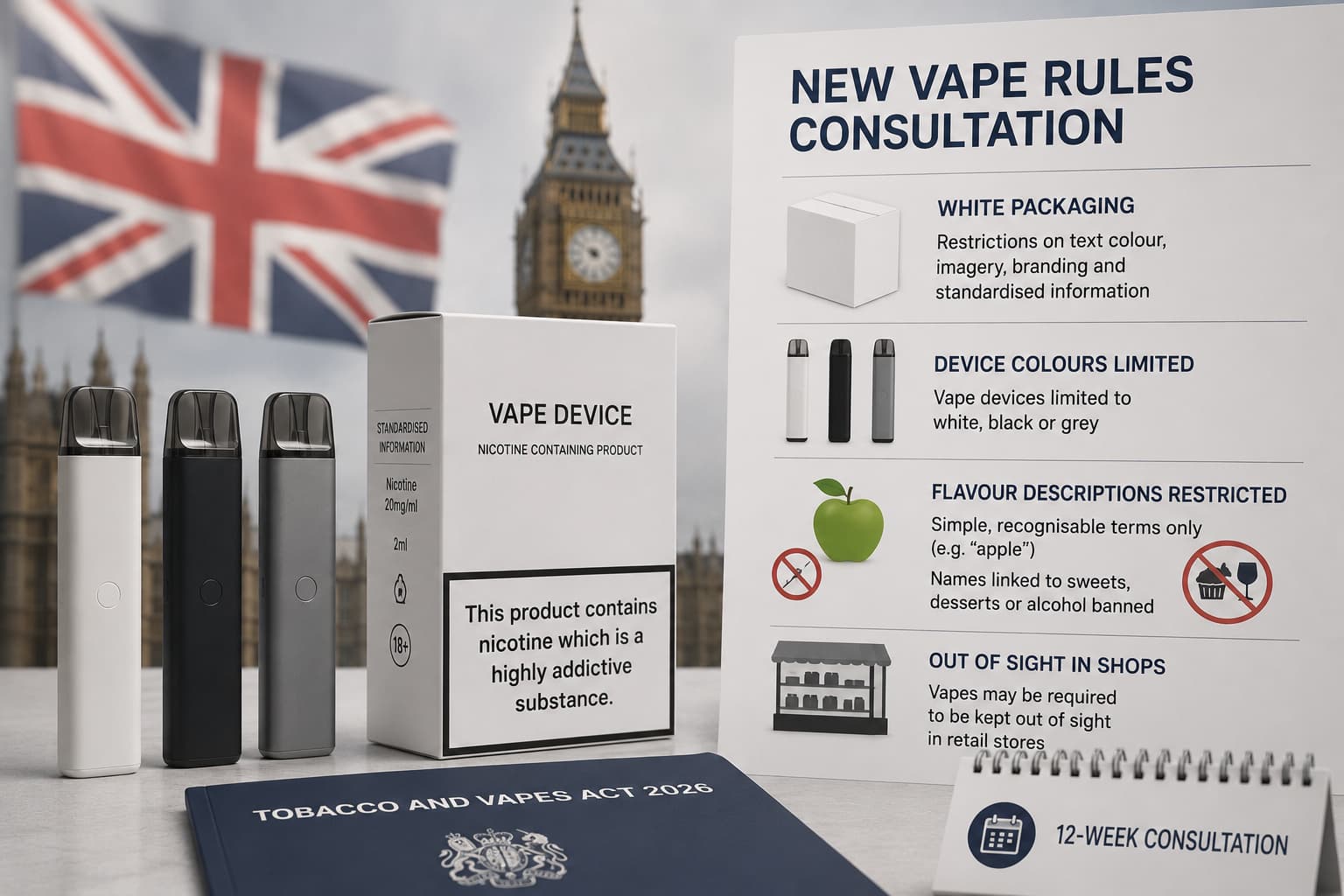
The UK government has launched a 12-week public consultation on a new set of regulations that would significantly tighten the marketing and presentation of vaping products. The proposals aim to reduce the appeal of e-cigarettes to children and teenagers while preserving their role as a smoking cessation aid for adults.
Announced by the Department of Health and Social Care (DHSC), the consultation covers a broad range of measures, including standardized packaging, restrictions on device colors, simplified flavor names, and new rules governing how vaping products are displayed in retail stores.
If adopted, the proposals would represent one of the UK’s most comprehensive regulatory updates for vaping products since the passage of the Tobacco and E-Cigarettes Act 2026.
Plain White Packaging Proposed
One of the most significant proposals would require all vaping products to be sold in standardized white packaging.
Under the consultation, manufacturers would face restrictions on:
- Package color
- Text presentation
- Images and graphics
- Brand display
- Product information layout
The government says the proposal builds on the UK’s experience with standardized tobacco packaging, which was introduced in 2017. Health officials argue that colorful packaging and strong branding can make vaping products more attractive to young people.
If implemented, manufacturers would need to redesign product packaging across the UK market to comply with the new standards.
Device Colors Could Be Limited
The consultation also extends beyond packaging to the appearance of vaping devices themselves.
Under the proposal, e-cigarette devices would only be permitted in black, white, or grey, eliminating many of the brightly colored designs currently available.
According to the government, limiting product colors is intended to reduce the visual appeal of vaping devices among children and adolescents.
The proposal reflects a broader regulatory approach that targets not only advertising and packaging but also the design of the products themselves.
Simpler Flavor Names Under Consideration
Flavor descriptions are another key focus of the consultation.
Rather than banning fruit or sweet flavors outright, the government proposes limiting flavor names to clear, straightforward descriptions. For example, a product could simply be labeled “Apple”, while names referencing candies, desserts, confectionery, or alcoholic beverages could be prohibited.
The objective is to restrict marketing language that may appeal disproportionately to younger consumers without necessarily removing flavor options that adult smokers may prefer.
If adopted, manufacturers may need to revise:
- Flavor names
- Packaging descriptions
- Product labeling
- Marketing materials
- Promotional campaigns
Retail Display Rules May Become More Restrictive
The consultation also seeks public feedback on changing how vaping products are displayed in retail stores.
One option under consideration would require vaping products to be kept out of customers’ direct view, similar to existing rules governing tobacco products in the UK.
Supporters of the proposal argue that reducing the visibility of vaping products could decrease children’s exposure to vaping-related marketing during routine shopping.
Broader Tobacco Measures Included
The consultation extends beyond vaping products and also includes several proposals affecting traditional tobacco products.
Among the measures being considered are:
- Adding smoking cessation information inserts to cigarette packaging
- Expanding standardized packaging requirements to cover all tobacco products, including cigars and rolling papers
- Removing existing exemptions that allow tobacco products to be displayed in airport and duty-free retail outlets
If approved, these changes would further align tobacco display rules across all retail environments.
Part of a Broader Regulatory Strategy
The consultation follows the UK’s recent legislative efforts to strengthen oversight of nicotine products through the Tobacco and E-Cigarettes Act 2026, which provides the government with broader powers to regulate vaping products.
Rather than focusing solely on product availability, policymakers are increasingly targeting the way vaping products are marketed, packaged, and presented to consumers.
Potential implications for manufacturers include:
- Redesigning product packaging
- Limiting device color options
- Renaming flavored products
- Revising branding strategies
- Modifying retail merchandising practices
Compared with an outright ban on flavored vaping products, the proposed approach focuses primarily on reducing marketing elements considered attractive to children while maintaining product availability for adult users.
Balancing Youth Protection and Smoking Cessation
The consultation reflects the UK’s ongoing effort to balance two public health priorities.
On one hand, the government aims to reduce youth vaping and prevent non-smoking adolescents from becoming nicotine users. On the other, UK public health authorities continue to recognize that vaping products may play an important role in helping adult smokers transition away from combustible cigarettes.
Health experts in the UK have consistently emphasized that while vaping is not risk-free, current evidence indicates it is substantially less harmful than smoking traditional cigarettes and has helped many adults quit smoking.
What Happens Next?
The consultation will remain open for 12 weeks, during which businesses, public health organizations, retailers, and members of the public can provide feedback on the proposed measures.
Following the consultation, the UK government will review submissions before deciding whether to implement the proposals in full or with revisions.
Should the measures be adopted, they could reshape the UK vaping market by introducing standardized packaging, stricter flavor naming rules, limitations on device design, and tighter retail display requirements. Given the UK’s influential role in tobacco harm reduction policy, the final regulations may also serve as a reference point for future vaping regulations in other European markets.