









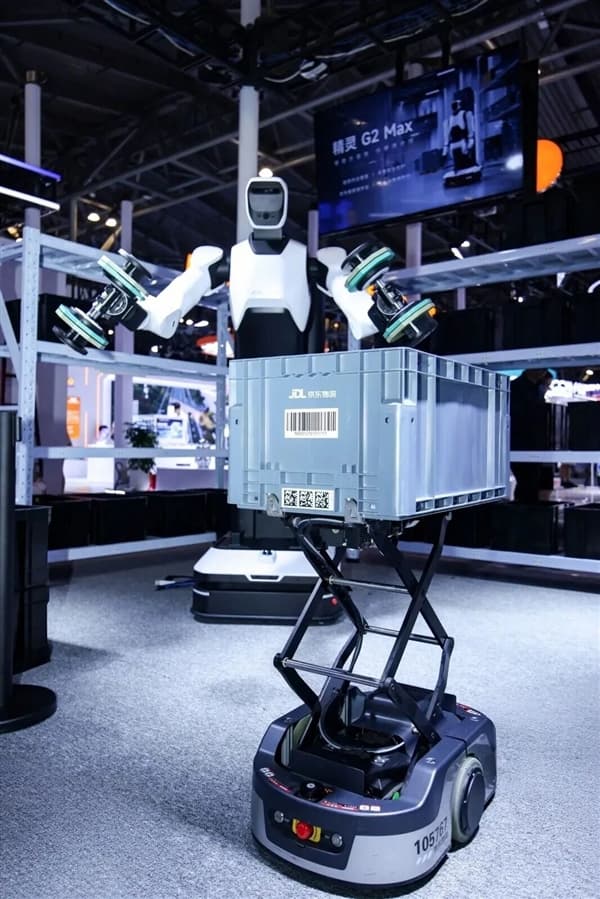
JD Logistics and Zhiyuan Robotics have unveiled the “Spirit G2 Max” heavy-duty humanoid robot at the WAIC 2026 (World Artificial Intelligence Conference) in Shanghai, marking a major step toward the commercial deployment of humanoid robots in real-world logistics environments.
The two companies recently announced a strategic cooperation agreement and introduced the humanoid robot, which will be deployed at JD Logistics’ intelligent warehouse system. The move reportedly represents the first time a humanoid robot has entered regular operational use inside an actual courier warehouse.
Humanoid Robot Targets Labor-Intensive Warehouse Tasks
While modern warehouses have already adopted extensive automation for sorting and outbound delivery processes, many inbound operations—such as unloading, handling, and stacking goods—still rely heavily on human workers.
These tasks often require employees to repeatedly bend, lift, and move heavy packages hundreds of times per day, creating significant physical strain and reducing efficiency during long working hours.
The Spirit G2 Max is designed specifically to address these challenges by taking on repetitive, high-intensity warehouse operations.
Equipped with a dual-arm humanoid structure, the robot is designed to replicate human-like manipulation abilities. Combined with a heavy-load control system, it can reportedly handle large packages while maintaining stability and performing precise movements.
The robot is also capable of 24-hour continuous operation, potentially reducing the need for overnight manual labor and improving warehouse efficiency.
Integration into JD’s Highly Automated Smart Warehouse
JD Logistics’ intelligent warehouse infrastructure already features a high level of automation. Its vertical storage systems, which utilize shelves reaching approximately 10 meters in height, can provide up to four times the storage capacity of traditional warehouses, with a single warehouse capable of storing up to one million items.
After a customer places an order, the system can reportedly identify the location of products within five seconds. Multiple types of transport robots then work together to move goods through the warehouse, allowing some orders to be dispatched in as little as one minute.
Before the introduction of humanoid robots, JD’s existing warehouse automation systems had already significantly reduced manual movement. Employees reportedly walked around 20,000 fewer steps per day due to robotic assistance.
The addition of humanoid robots aims to close the remaining gap in warehouse automation by introducing machines capable of performing more flexible human-like tasks during the inbound process.
Building a Full Logistics Robot Ecosystem
JD Logistics has developed a broad range of robotics solutions, often referred to as its “Wolf Tribe” robot ecosystem. These systems cover multiple stages of logistics operations, including:
- Warehouse storage
- Sorting
- Internal transportation
- Delivery services
The company also operates a self-developed intelligent scheduling system designed to coordinate different robotic platforms across logistics environments.
JD Logistics has announced plans to deploy more than one million robots, autonomous vehicles, and drones over the next five years, further accelerating the transformation toward intelligent logistics.
Humanoid Robots Moving Toward Mass Deployment
Zhiyuan Robotics believes logistics represents one of the most suitable industries for large-scale humanoid robot adoption. With JD’s extensive network of intelligent warehouses in China and overseas markets, the robots can undergo continuous testing and optimization in real operational scenarios.
In the future, the Spirit G2 Max is expected to collaborate with other warehouse robots, forming a more comprehensive automated logistics workforce.
The launch follows another major milestone for Zhiyuan Robotics. At the end of last month, the company announced that its 15,000th general-purpose embodied robot, the Spirit G2, had entered mass production and deployment, highlighting the accelerating development of China’s humanoid robotics industry.
As companies increasingly move humanoid robots from laboratories into practical environments, logistics is emerging as one of the earliest fields where these machines could achieve large-scale commercial adoption. The deployment of the Spirit G2 Max demonstrates how artificial intelligence, robotics, and automated infrastructure are reshaping the future of global supply chains.