









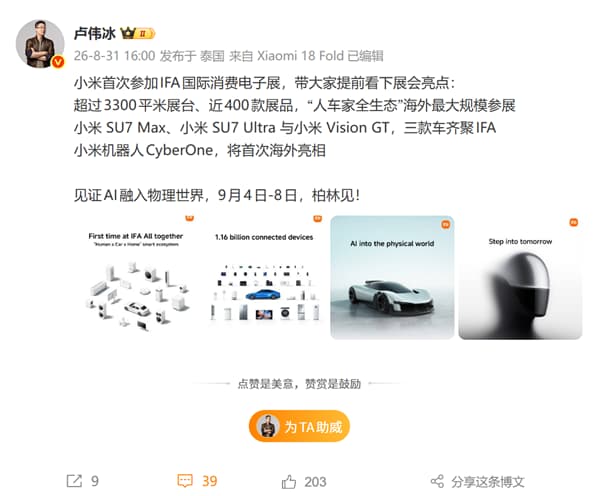
Xiaomi has made its IFA debut in Berlin, bringing its expanding Human × Car × Home ecosystem to one of the world’s largest consumer electronics events. The company’s appearance also marks the first overseas public showing of CyberOne, its full-size humanoid robot, highlighting Xiaomi’s growing focus on robotics alongside smartphones, smart home devices, and electric vehicles.
The IFA 2026 showcase gives Xiaomi an opportunity to present its latest hardware and AI technologies to a global audience, with CyberOne standing out as one of the event’s most distinctive attractions.
According to Xiaomi, the company will occupy a booth covering more than 3,300 square meters and showcase nearly 400 products. The exhibition will represent one of Xiaomi’s largest overseas demonstrations of its integrated Human × Car × Home ecosystem, bringing together products from across its expanding technology portfolio.
Xiaomi SU7 Models and Vision GT to Take Center Stage
Among the highlights will be three vehicles: the Xiaomi SU7 Max, Xiaomi SU7 Ultra and Xiaomi Vision GT. The three models will appear together at IFA, giving international visitors a closer look at Xiaomi’s growing ambitions in the automotive sector.
However, the cars won’t be the only major attraction.
Xiaomi’s CyberOne humanoid robot, also known in China by the nickname “Tie Da,” will make its overseas debut at the event.
CyberOne is Xiaomi’s first full-size bionic humanoid robot. The original model was unveiled on August 11, 2022, marking the company’s entry into full-size humanoid robotics.
What Can the Original CyberOne Do?
For more background, our previous coverage of Xiaomi CyberOne looks at the company’s first full-size humanoid robot and its original capabilities.
Xiaomi equipped the robot with its own technologies covering bionic perception and cognition, electromechanical integration and artificial intelligence. The robot features 21 degrees of freedom across its joint modules and is designed to achieve real-time response times as fast as 0.5 milliseconds.
Xiaomi says its robotics laboratory developed the robot’s intelligent sensing, motion-control and mechanical systems internally, reflecting the company’s effort to build the underlying technology stack rather than relying entirely on external platforms.
While CyberOne’s original unveiling was primarily a technology demonstration, Xiaomi has continued developing its humanoid robotics program since then.
New-Generation CyberOne Gets a Major Hardware Upgrade
Xiaomi recently introduced a new-generation version of its humanoid robot at WRC 2026, giving the public a first look at the company’s latest progress in robotics.
The newer robot is approximately 1.70 meters tall and weighs around 66kg. More importantly, it now features 66 degrees of freedom, a substantial increase over the 21-degree configuration of the original model.
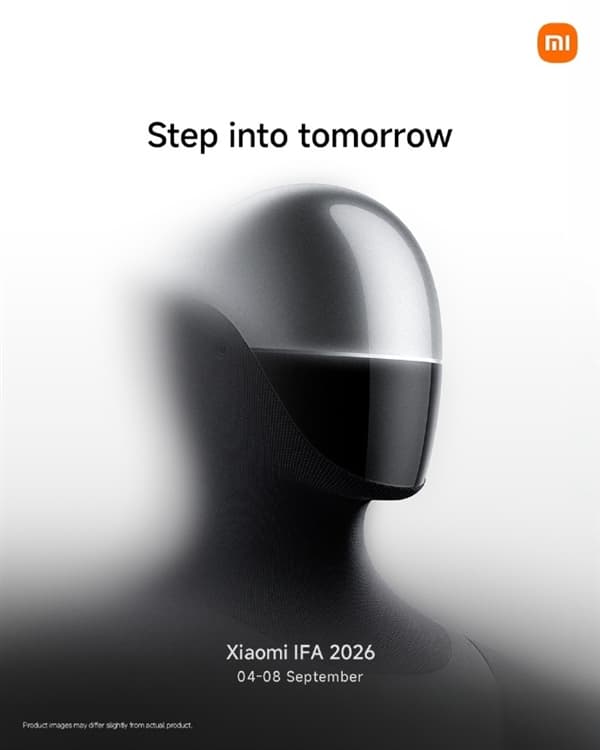
The additional degrees of freedom should allow the newer platform to perform more sophisticated movements and provide greater flexibility in coordinating its body.
The changes suggest that Xiaomi is moving beyond simply demonstrating that a humanoid robot can walk and interact with its surroundings. The company is increasingly focused on making the machines capable of performing useful industrial tasks.
From Robot Demonstration to Factory Worker
Perhaps the most interesting development is that Xiaomi’s latest humanoid robot is no longer confined to a conference stage.
According to staff at the event, the new-generation CyberOne began working at a Xiaomi automotive factory earlier this year. It was assigned to a self-tapping nut installation station, giving the robot an opportunity to perform an actual manufacturing task.
The robot then underwent approximately one quarter of continuous training and optimization.
The results are notable.
Its success rate for performing the task from both sides of the workstation has reportedly reached 98%, compared with a 99% qualification rate for human workers performing the same operation.
That leaves only a one-percentage-point gap between the robot’s reported performance and the human benchmark.
Of course, one production task does not mean humanoid robots are ready to replace factory workers across an entire manufacturing operation. Industrial environments involve many different tasks, unexpected conditions and strict requirements for reliability and safety.
Nevertheless, the example is significant because it demonstrates a shift in Xiaomi’s robotics strategy.
The company is not simply trying to make a humanoid robot that looks impressive on stage. It is testing whether the platform can perform repetitive physical work in a real production environment.
IFA Becomes a Showcase for Xiaomi’s Broader Ecosystem
Xiaomi’s first IFA appearance therefore looks set to be about much more than smartphones and consumer electronics.
With hundreds of products spanning vehicles, robotics and connected devices, the company is using the event to present its broader ecosystem to an international audience.
The combination of the SU7 Max, SU7 Ultra, Vision GT and CyberOne also highlights how far Xiaomi’s product strategy has expanded beyond its traditional smartphone business.
Its “Human × Car × Home” ecosystem is increasingly connecting personal electronics, smart-home products, vehicles and emerging technologies such as humanoid robotics.
The overseas debut of CyberOne could be one of the most closely watched parts of the exhibition, particularly because Xiaomi now has a newer generation of the robot with significantly more degrees of freedom and some reported experience in an actual automotive factory.
What to Expect From Xiaomi at IFA
Xiaomi’s first IFA appearance could provide a useful look at how the company intends to position its ecosystem outside China.
The sheer scale of the exhibition—more than 3,300 square meters and nearly 400 products—suggests that Xiaomi wants its international presence to be viewed as an ecosystem rather than a collection of individual gadgets.
For CyberOne, the event represents another important step.
The original robot demonstrated Xiaomi’s ambitions in humanoid robotics in 2022. Four years later, the new generation is being presented with a much more capable mechanical architecture and reported factory-training experience.
The key challenge for Xiaomi is no longer simply developing a humanoid robot, but proving that CyberOne can move beyond demonstrations and become a practical robotics platform for real-world tasks. Its latest factory-related testing suggests that Xiaomi is exploring how humanoid robots could eventually support manufacturing and other structured work environments.
CyberOne’s appearance at IFA 2026 therefore represents more than a showcase for a futuristic robot. It gives international visitors a closer look at how Xiaomi is combining robotics, AI, smart devices, electric vehicles, and its broader Human × Car × Home strategy into a connected technology ecosystem.