









If you’re shopping for an RC car, one of the first specifications you’ll encounter is the motor type: brushed or brushless.
At first glance, brushless sounds like the obvious choice. It is newer, usually associated with higher performance, and commonly found in more expensive RC models. But that doesn’t mean every driver needs a brushless RC car.
A brushed motor can still be a practical choice for beginners, casual drivers and affordable RC cars. A brushless setup, meanwhile, can make much more sense for someone who wants higher speed, stronger acceleration, better efficiency or more room for performance upgrades.
The important question isn’t simply “Which motor is better?”
It is:
“Which motor type fits the way you plan to use your RC car?”
This guide explains how brushed and brushless RC motors work, how they differ in speed, efficiency, maintenance, price and upgrade potential, and what to consider before buying your next RC car.
Brushed vs Brushless RC Motors at a Glance
| Factor | Brushed Motor | Brushless Motor |
|---|---|---|
| Construction | Uses brushes and a mechanical commutator | Uses electronic commutation |
| Typical cost | Lower | Higher |
| Efficiency | Generally lower | Generally higher |
| Heat | Can produce more heat | Generally more efficient |
| Maintenance | Brushes eventually wear | Fewer wear components in the motor |
| Speed potential | Suitable for moderate performance | Usually higher performance potential |
| Acceleration | Good depending on setup | Typically stronger |
| Upgrade potential | More limited | Excellent |
| Beginner friendly | Yes | Yes, with suitable setup |
| Best use | Casual driving and entry-level RC | Performance driving and serious bashing |
These are general characteristics rather than guarantees. Motor design, gearing, battery voltage, ESC configuration, vehicle weight and drivetrain efficiency all influence the final result.
What Is a Brushed RC Motor?
A brushed motor is one of the traditional electric motor designs used in RC vehicles.
Inside the motor are several important components, including permanent magnets, an armature, a commutator and physical brushes.
When electrical current flows through the motor, the brushes transfer electricity to the rotating commutator. This creates the electromagnetic forces that make the motor turn.
The technology is relatively simple and has been used in RC cars for decades.
That simplicity is one reason brushed motors remain popular.
A manufacturer can build an affordable brushed power system that provides enough performance for recreational driving without requiring an expensive electronic setup.
For a beginner, that can be a major advantage.
Why Are Brushed Motors Still Popular?
The biggest reason is cost.
A brushed motor and compatible ESC can generally be less expensive than a comparable brushless system.
That helps manufacturers keep the overall price of an RTR RC car down.
Brushed motors can also provide perfectly enjoyable performance.
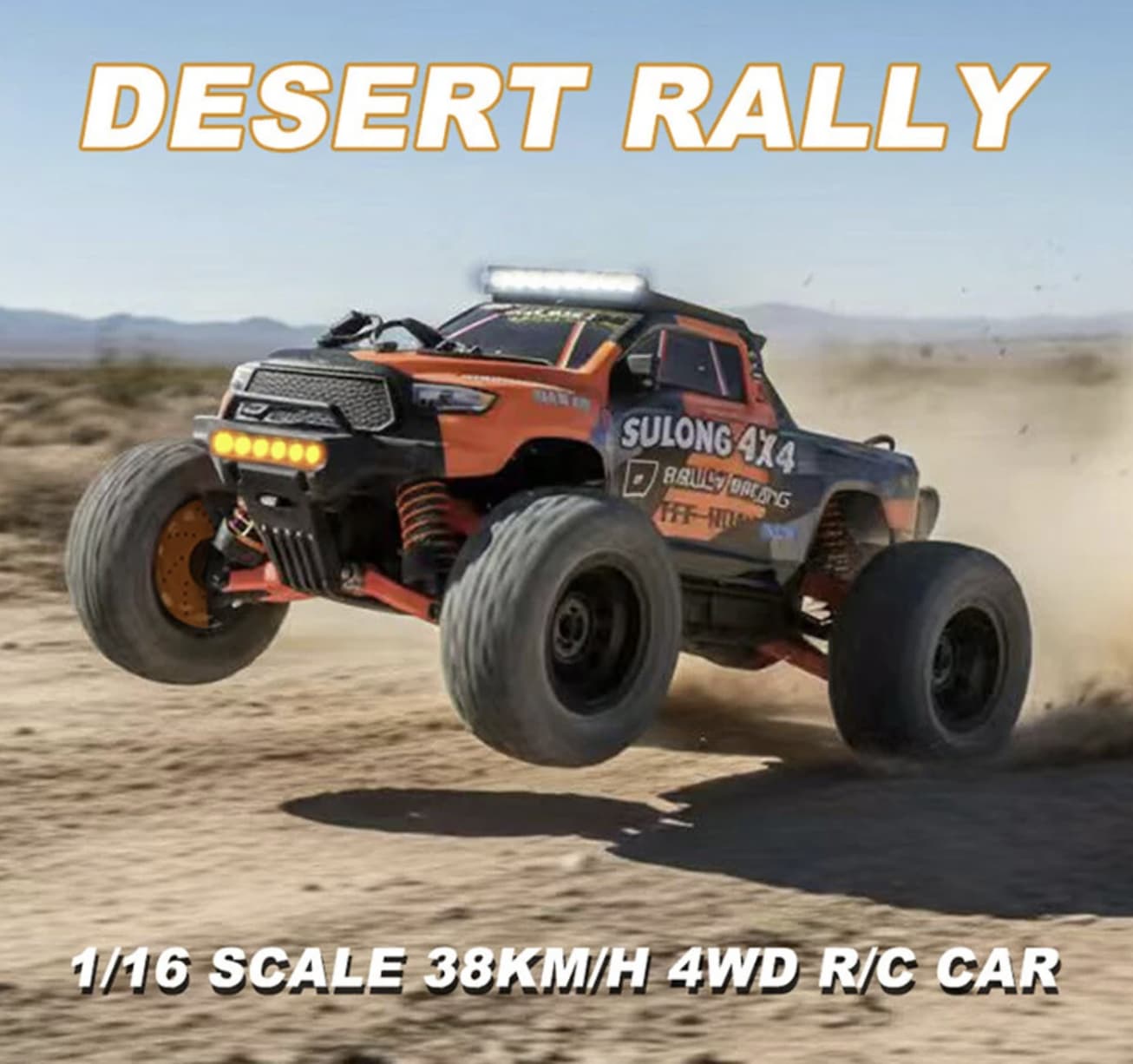
For example, a 1/16 4WD RC car such as the SLRC C7 uses an RS390 brushed motor while offering a listed maximum speed of up to 38km/h. The vehicle also uses proportional throttle and steering, independent suspension and a 4WD drivetrain.
This illustrates an important point:
Brushed does not automatically mean slow.
The complete vehicle design matters.
What Is a Brushless RC Motor?
A brushless motor removes the physical brushes and mechanical commutator used by a traditional brushed design.
Instead, the motor relies on an electronic speed controller (ESC) to control the current flowing through the motor windings.
This allows the motor to operate without physical brushes rubbing against a rotating commutator.
The result is a motor design that can offer higher efficiency, strong performance and fewer internal wear components.
Brushless motors have therefore become extremely common in performance-oriented RC cars.
They are especially popular among drivers who enjoy:
- High-speed bashing
- Racing
- Strong acceleration
- Larger RC vehicles
- Performance upgrades
- Long-term hobby use
The Biggest Difference: Mechanical vs Electronic Commutation
The simplest way to understand the difference is to look at how each motor switches the magnetic fields that make the rotor spin.
Brushed
The motor uses physical brushes and a commutator.
Brushless
The ESC electronically controls the motor’s phases.
That change removes a major source of mechanical contact inside the motor.
It also allows the electronic system to control the motor very precisely.
This is one reason brushless systems can deliver impressive performance when paired with the right battery, ESC and gearing.
Brushed vs Brushless: Which Is Faster?
In general, brushless systems have greater speed potential.
But motor type alone does not determine an RC car’s speed.
A vehicle’s maximum speed depends on several factors:
- Motor KV or motor characteristics
- Battery voltage
- ESC capability
- Gear ratio
- Tire diameter
- Vehicle weight
- Aerodynamics
- Drivetrain losses
- Temperature
- Surface conditions
A poorly matched brushless system can perform worse than a well-designed brushed system.
This is why comparing two RC cars simply by saying “brushless is faster” isn’t enough.
The entire powertrain needs to be considered.
Why Are Brushless RC Cars Usually Faster?
There are several reasons.
A brushless motor can operate efficiently at high rotational speeds while avoiding the physical brush contact found in brushed motors.
The electronic commutation system also provides precise control over the motor’s operation.
When combined with a suitable battery and ESC, a brushless setup can deliver strong acceleration and high sustained performance.
However, more power isn’t always better.
A high-performance brushless system can put considerably more stress on:
- Gears
- Driveshafts
- Differentials
- Tires
- Bearings
- Suspension components
That’s why performance upgrades often require more than simply installing a bigger motor.
Efficiency: Brushed vs Brushless
Efficiency is another major difference.
Brushed motors lose some energy through friction and electrical losses associated with the brushes and commutator.
Brushless motors eliminate the physical brush contact, which can improve efficiency.
In practical terms, this can mean that a brushless RC car converts more of the battery’s energy into useful mechanical output.
However, don’t assume that every brushless RC car automatically has longer runtime.
Runtime depends on the complete system.
A powerful brushless motor driven aggressively can consume energy very quickly.
Similarly, a lightweight brushed RC car driven moderately may run for a respectable amount of time.
Battery capacity, driving style, gearing and terrain all matter.
Which Motor Runs Cooler?
A brushless system is generally more efficient and can therefore produce less wasted heat for a comparable workload.
But that doesn’t mean brushless RC cars never get hot.
High-power brushless systems can generate significant heat when:
- The gearing is too aggressive
- The vehicle is driven continuously at full throttle
- The tires are too large
- The drivetrain is binding
- The vehicle is driven through heavy grass
- The motor or ESC is undersized
Heat management becomes particularly important as performance increases.
For serious RC use, monitoring motor and ESC temperatures is a good habit.
Maintenance: Brushed vs Brushless
This is one area where brushless motors have a clear structural advantage.
Brushed motor maintenance
The physical brushes and commutator experience wear.
Over time, performance can decrease and the motor may eventually need servicing or replacement.
How quickly this happens depends on the motor, load and driving conditions.
Brushless motor maintenance
Brushless motors don’t use physical brushes, so there is no brush replacement in the traditional sense.
That reduces one important source of mechanical wear.
However, the rest of the RC car still requires maintenance.
You still need to inspect:
- Bearings
- Gears
- Driveshafts
- Differentials
- Tires
- Suspension
- Electronics
- Connectors
A brushless motor does not make the entire RC car maintenance-free.
Brushed vs Brushless for Beginners
This is where things get interesting.
Many people assume beginners should always buy brushed.
That’s not necessarily true.
A beginner can absolutely use a brushless RC car.
The bigger question is how much power you actually need.
A brushed RC car can be easier to learn with because the performance is often more manageable.
That can be useful when learning:
- Steering
- Throttle control
- Cornering
- Braking
- Jumping
- Off-road driving
A very powerful brushless RC car can become difficult to control for someone who has never driven an RC vehicle before.
Therefore, beginners should consider controllability rather than simply choosing the most powerful motor available.
Brushed vs Brushless for Off-Road Driving
The best choice depends on the terrain.
Grass
Brushless can provide strong acceleration, but tall grass also places significant load on the drivetrain.
A moderate brushed setup can work well for casual driving on short grass.
Dirt
Both systems can work well.
Brushless becomes attractive if you want fast acceleration and high-speed bashing.
Gravel
A 4WD drivetrain, appropriate tires and good throttle control can matter just as much as motor type.
Rocks
A crawler doesn’t necessarily need a high-speed brushless system.
For technical crawling, torque, gearing and low-speed control can be more important than maximum power.
This is why a brushed crawler can still be an excellent off-road RC vehicle.
Brushed vs Brushless for RC Crawlers
If you’re shopping for a crawler, don’t automatically choose brushless.
Crawlers are usually designed around controlled low-speed movement.
The important characteristics include:
- Torque
- Low-speed throttle control
- Low gearing
- Suspension articulation
- Ground clearance
- Tire grip
- Drag braking
A high-speed motor doesn’t automatically improve crawling.
In fact, too much power can make precise obstacle control more difficult.
For a dedicated crawler, a well-matched brushed system can be completely appropriate.
Brushed vs Brushless for RC Racing
Racing is different.
When acceleration, lap times and sustained performance become priorities, brushless systems become much more attractive.
The combination of high efficiency, strong power delivery and precise electronic control makes brushless technology common in performance RC racing.
But racing also requires a balanced setup.
Motor, battery, gearing, tires and chassis configuration all need to work together.
Simply installing the most powerful motor isn’t a substitute for proper setup.
What Does KV Mean on a Brushless RC Motor?
If you’ve started shopping for brushless RC cars, you’ve probably seen numbers such as:
3300KV
4000KV
5000KV
KV is commonly used to describe the motor’s approximate no-load rotational speed per volt.
As a simplified example, a motor rated at 3000KV could theoretically rotate around 3,000 revolutions per minute per volt under no-load conditions.
However, KV is not the same thing as horsepower or guaranteed vehicle speed.
Real-world performance depends on load, battery voltage, gearing, motor design and many other factors.
This is an important distinction when comparing brushless RC cars.
Does a Higher KV Motor Mean a Faster RC Car?
Not necessarily.
A higher-KV motor generally targets higher rotational speed, while lower-KV motors can be paired with appropriate gearing to provide different torque and performance characteristics.
For example, a heavy RC truck may require a different motor setup from a lightweight racing buggy.
The battery voltage also changes the equation.
Increasing voltage increases the theoretical motor speed for a given KV rating, but it also increases the demands placed on the ESC, motor and drivetrain.
That’s why RC manufacturers specify compatible battery and power-system combinations.
Battery Choice Matters More Than Many Beginners Expect
Motor performance doesn’t exist in isolation.
The battery supplies the energy that allows the motor to produce power.
Common RC battery chemistries include:
- Li-ion
- LiPo
- NiMH
Performance-oriented brushless RC cars commonly use LiPo batteries because of their ability to provide substantial current.
However, the correct battery depends on the vehicle’s electronics.
You should always follow the manufacturer’s voltage, connector, charging and battery recommendations.
Installing an incompatible battery simply to make an RC car faster can damage electronics or create safety risks.
Which Is More Durable: Brushed or Brushless?
The answer depends on what you mean by durability.
The brushless motor itself has fewer mechanical wear components because there are no brushes.
But a brushless RC car can place more stress on the rest of the drivetrain because it can deliver substantially more power.
For example, upgrading a brushed RC car to a high-output brushless setup may expose weak gears, driveshafts or differentials that were never designed for that level of power.
Therefore:
A brushless motor can be more durable internally, while a high-power brushless setup can require a stronger overall RC platform.
This is an important distinction for anyone considering an upgrade.
Can You Upgrade a Brushed RC Car to Brushless?
Sometimes, yes.
But it isn’t always a simple motor swap.
A brushless conversion may require:
- Brushless motor
- Compatible ESC
- Suitable battery
- New connectors
- Appropriate gearing
- Possibly stronger drivetrain components
- Additional cooling
The chassis must also have enough space for the new electronics.
Before converting a brushed RC car, check whether replacement brushless parts are available and whether the manufacturer designed the platform to support the upgrade.
In some cases, buying a brushless version from the beginning makes more sense.
Which Is Cheaper?
Brushed is generally the more affordable option.
That’s why many entry-level RTR RC cars use brushed motors.
A brushed system can deliver enough performance for recreational driving without significantly increasing the purchase price.
Brushless systems usually cost more because the motor and ESC are more sophisticated and because the vehicle may need stronger supporting components.
However, the price difference varies considerably between RC brands and vehicle classes.
Brushed vs Brushless: Which One Should You Buy?
Instead of asking which technology wins, match the motor to your priorities.
Choose brushed if you:
- Are buying your first RC car
- Want a lower initial price
- Prefer moderate performance
- Drive casually
- Want a simple setup
- Don’t need extensive upgrades
Consider brushless if you:
- Want higher performance
- Enjoy high-speed bashing
- Want stronger acceleration
- Plan to upgrade your vehicle
- Want a more efficient motor design
- Participate in performance-oriented RC driving
For crawling:
Don’t choose based on brushed vs brushless alone.
Look at:
- Torque
- Gearing
- Throttle resolution
- Drag brake
- Suspension
- Ground clearance
- Tires
For crawling, the overall drivetrain setup matters more than simply having a brushless badge.
A Practical Example: The SLRC C7
The SLRC C7 is a useful example of why motor type shouldn’t be used as the only buying criterion.
It uses an RS390 brushed motor but combines it with:
- 4WD
- Full proportional throttle
- Full proportional steering
- Independent suspension
- A 35A integrated ESC/receiver
- Approximately 8cm tires
- Metal drivetrain components
- A claimed maximum speed of 38km/h
For a driver interested in recreational outdoor driving, that combination can be more meaningful than simply seeing the word “brushless” on another model’s specification sheet.
The vehicle is designed around a balance of speed, traction and control rather than maximum performance.
The Bottom Line
Brushed and brushless RC motors are not simply “old technology vs new technology.”
They are two different approaches with different advantages.
A brushed motor can be inexpensive, simple and perfectly capable of providing enjoyable performance.
A brushless motor generally offers higher efficiency, fewer motor wear components and greater performance potential, but the overall RC system usually costs more and can demand stronger supporting hardware.
For casual driving, a good brushed RC car for beginners can be all you need.
For high-speed bashing, racing and performance upgrades, brushless becomes much more compelling.
And for crawling, neither motor type automatically wins — torque, gearing, control and chassis design are often more important than the motor label itself.
The best RC car is therefore not the one with the most impressive motor specification.
It’s the one whose motor, battery, drivetrain, suspension and controls match the way you actually want to drive.
Frequently Asked Questions
Are brushless RC cars better than brushed?
Brushless RC cars generally offer greater efficiency and performance potential, but that doesn’t make every brushless model a better choice for every driver. Brushed models can be more affordable and easier to manage for casual use.
Are brushed RC cars slower?
Generally, brushed systems have less performance potential than comparable brushless systems. However, actual RC-car speed depends on the entire powertrain, gearing, battery and vehicle design.
Do brushless RC motors last longer?
Brushless motors don’t have physical brushes that wear down, reducing one major source of motor wear. The rest of the RC drivetrain still requires regular maintenance.
Is brushless better for off-road RC cars?
It depends on the type of off-road driving. Brushless is attractive for fast bashing, while a brushed system can work very well for casual driving or crawling.
Can I put a brushless motor in a brushed RC car?
Some RC cars can be converted, but you may need a compatible brushless ESC, battery, connectors, gearing and potentially stronger drivetrain components.
Does brushless mean faster?
Not automatically. Brushless motors generally have greater performance potential, but speed depends on KV, battery voltage, gearing, vehicle weight, tires and other factors.
Is a brushed RC car good for beginners?
Yes. A brushed RC car can be an excellent starting point because many models offer manageable performance at a lower price.
What is more important than the motor?
For off-road driving, drivetrain layout, tires, suspension, gearing, proportional controls and ground clearance can be just as important as motor type.